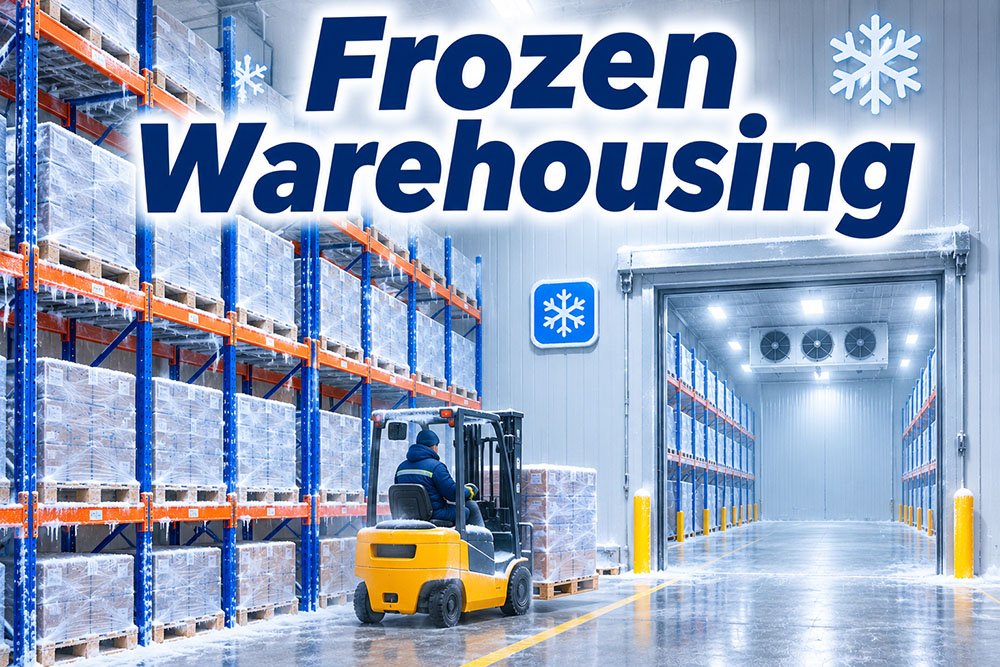
Frozen warehousing is one of the most demanding environments in which pallet racking operates. Temperatures below −18°C fundamentally change how steel behaves, how coatings perform, how floors move, and how operational costs accumulate. A racking system that performs well in ambient warehousing may fail prematurely in frozen service — through cold embrittlement of steel, coating failure under thermal cycling, or hidden structural stress from floor heave. At the same time, frozen warehousing imposes an economic logic that ambient storage doesn’t: every cubic meter of frozen space costs real money to maintain year after year, which pushes rational selection toward the highest-density formats the operation can support.
This guide covers racking selection specifically for frozen warehousing — defined here as storage environments from approximately −18°C down to −30°C — across the five dimensions that matter: steel grade, coating, density format, floor engineering, and energy economics.
Why Frozen Warehousing Is Different from Refrigerated Storage
Before any racking discussion, the distinction between refrigerated and frozen matters, because the two often get conflated under the broader “cold storage” label even though they represent very different engineering problems.
Refrigerated storage typically operates at 0°C to +4°C, serving dairy, fresh produce, meat, and similar products that need to stay cool but not frozen. Standard Q235B carbon structural steel generally performs adequately. Powder coating typically holds up with reasonable service life. Floor engineering follows standard warehouse practice. Energy cost is meaningful but not dominant.
Frozen storage typically operates at −18°C to −30°C, serving frozen meat, seafood, ice cream, frozen prepared foods, and bulk frozen ingredients. Steel behavior changes. Coatings face thermal cycling stress. Floors must address frost heave risk. And energy cost per cubic meter stored is roughly 2 to 3 times higher than refrigerated equivalents, making density a dominant economic driver rather than a secondary consideration.
Deep-freeze and blast-freeze applications below −30°C (reaching −40°C or colder for some specialty products) add further complexity, often requiring specialized cold-tolerant steel grades and dedicated engineering. These extreme cases sit outside the scope of standard frozen warehousing practice.
For racking selection purposes, this guide focuses on the mainstream −18°C to −30°C range, which represents the bulk of frozen warehousing globally.
Current Challenges in Frozen Warehousing Racking Decisions
Treating frozen as “colder refrigerated.” Many operators and some suppliers treat frozen storage as refrigerated with a lower temperature setpoint, using the same racking specifications. This overlooks the material, coating, and floor engineering changes that frozen conditions actually require.
Ignoring cold embrittlement risk. Standard carbon steels lose impact toughness as temperature drops. At frozen temperatures, this can create brittle fracture risk under forklift impact that doesn’t exist at ambient or refrigerated conditions.
Under-specifying coating durability. Thermal cycling between frozen storage and ambient receiving areas creates coating stress — expansion, contraction, condensation on warming, refreezing in service — that powder coating alone often cannot handle for a full service life.
Overlooking floor heave. Frozen floors conduct heat downward into the slab and soil, creating frost penetration that can lift and shift the slab unless engineered against. Base plates and anchoring that don’t account for this face hidden structural risk.
Selecting standard-density formats. Energy cost per cubic meter in frozen storage can approach 2 to 3 times refrigerated equivalents, which fundamentally changes the math on density vs selectivity tradeoffs. Formats acceptable in ambient operations are often economically wasteful in frozen.
Underestimating operator productivity loss. Forklift operators in frozen environments work in restricted shift windows, wear bulky protective equipment, and face productivity reductions that affect throughput assumptions and labor cost modeling.
Assuming standard inspection protocols work. Frozen conditions require inspection scheduling that minimizes door opening and air exchange, specialized access protocols, and different damage patterns than ambient racking. Inspection procedures should be designed for the environment.
The Five Dimensions of Frozen Warehousing Racking Selection
1. Steel Grade and Cold Embrittlement
Steel behavior changes with temperature. At ambient conditions, structural steels absorb impact energy through plastic deformation — they bend rather than break. As temperature drops, this ductile behavior transitions to brittle behavior, where steel fractures without warning under impact loads. The specific transition temperature depends on the steel grade.
Standard Q235B considerations. The “B” in Q235B indicates impact testing at room temperature (typically +20°C), with minimum impact energy of 27 J. At frozen temperatures, Q235B retains reasonable toughness for static loads but shows reduced impact resistance. For light-impact applications, it remains serviceable; for high-traffic or heavy-impact frozen zones, it may be under-specified.
Q235C and Q235D for cold applications. The “C” grade is tested at 0°C and the “D” grade at −20°C, both at minimum 27 J impact energy. For frozen storage applications, Q235C is the minimum recommended specification, with Q235D preferred for environments at −20°C or colder.
Q355B, Q355C, and Q355D parallels. The higher-strength Q355 series follows the same temperature-grade convention. Q355C or Q355D is commonly specified for heavy-duty frozen racking, combining higher load capacity with low-temperature impact tolerance.
European equivalents. European specifications use J0 (tested at 0°C), J2 (−20°C), and K2 (−20°C at 40 J) grades for S235 and S355 steels. S355J2 or S355K2 is common for European frozen storage installations.
Why this matters beyond theory. Cold embrittlement failures in frozen storage are rare but consequential when they occur — a brittle upright fracture under forklift impact can cascade into rack collapse without the warning deformation that ambient racking typically provides. Material specification is the primary defense, and it costs very little premium compared to the risk it addresses. Related material selection principles are covered in this guide to Q235B vs Q355B racking steel.
2. Coating Systems for Frozen Service
Frozen storage coating faces three distinct stresses that ambient coating never encounters.
Thermal cycling. Pallets move between frozen storage and ambient receiving areas, causing racking components adjacent to doors or transfer zones to cycle between temperatures. Each cycle creates coating expansion and contraction stress that accelerates micro-cracking and adhesion loss.
Condensation and refreeze. When ambient air enters a frozen zone — during door openings, forklift transits, or seasonal variations — it carries moisture that condenses on cold surfaces. If temperatures remain below freezing, that moisture freezes into ice on the racking. Repeated condensation-freeze cycles create coating stress and can lift coating from the substrate.
Mechanical impact at low temperature. Powder coating itself becomes more brittle at frozen temperatures, more prone to chipping from forklift contact or load abrasion.
Powder coating alone is generally insufficient. For frozen service, powder coating typically delivers 3 to 7 years of service life, which may not match the 15 to 20 year expected life of the racking structure. For short-service or low-traffic frozen zones it may be acceptable; for long-service installations it typically is not.
Hot-dip galvanization for frozen service. Galvanizing provides significantly better frozen storage performance than powder coating through metallurgical bonding, cathodic protection, and better resistance to coating stress under thermal cycling. Typical frozen storage galvanization (60 to 85 microns zinc) delivers service life matching the racking structure.
Duplex systems for the most demanding frozen applications. Galvanization plus powder coating (sometimes called duplex coating) combines galvanization’s base durability with powder coating’s surface protection and aesthetics, extending service life further and providing better resistance to coating damage from pallet contact. This approach adds cost but delivers the best frozen service performance available. A broader coating comparison is covered in this guide to galvanized vs painted steel pallet racking.
Fastener and hardware specification. Standard zinc-plated bolts corrode faster than the racking itself in frozen conditions. Stainless steel or hot-dip galvanized hardware is typically specified to match the racking’s service life.
3. Density Format Selection Driven by Energy Economics
The economic logic of racking format selection changes significantly in frozen storage, because every cubic meter stored carries ongoing energy cost that doesn’t exist in ambient operations.
Rough energy cost comparison. Depending on local electricity rates, facility design, and system efficiency, maintaining frozen storage at −20°C to −25°C costs on the order of 60 to 150 kWh per cubic meter per year. At typical industrial electricity rates, this translates to several dollars per cubic meter per year in energy cost alone, not counting maintenance, refrigerant, and ancillary systems.
Why this favors high-density formats. In ambient warehousing, the cost of floor space and racking is paid once at installation. In frozen warehousing, every cubic meter of installed volume incurs recurring annual cost across the facility’s service life. Formats that achieve higher density reduce the recurring cost, not just the one-time installation cost, which changes payback math substantially.
Selective pallet racking in frozen storage. Standard selective racking works in frozen service but delivers the lowest density of common formats. For high-turnover frozen operations where retrieval speed matters most, selective remains the right choice despite its density limitations. For lower-turnover zones, alternatives usually deliver better frozen economics.
Drive-in racking in frozen storage. Drive-in delivers 60 to 80 percent more pallet positions than selective in the same footprint, which translates directly to lower cost per pallet-year stored in frozen conditions. Common for frozen meat, seafood, and bulk ingredients where LIFO rotation is acceptable. The forklift-in-rack operation creates damage risk that may be amplified in frozen conditions by operator productivity constraints.
Shuttle pallet racking in frozen storage. Shuttle systems typically deliver the best overall economics for most frozen applications: high density matches the energy economics, shuttle operation keeps forklifts out of the storage lanes (reducing damage), FIFO capability supports inventory rotation for shelf-life management, and reduced in-rack forklift time improves operator productivity in cold conditions. The higher initial investment typically pays back faster in frozen service than in ambient equivalents. Related configurations are covered in this guide to radio shuttle racking.
Mobile pallet racking in frozen storage. Mobile racking delivers the highest density of any common format (60 to 90 percent more than selective), with only one aisle open at any time. For frozen storage, this translates to the lowest cubic volume per pallet position stored. Mobile racking is one of the most economically justified formats specifically because the density premium directly reduces annual refrigeration cost across the service life. Cold storage is often cited as the single application where mobile racking most consistently pays back.
Automated and ASRS frozen configurations. For large-scale frozen facilities, automated storage and retrieval systems provide maximum density and eliminate operator time in frozen aisles entirely. Capital cost is high, but operator productivity and energy cost advantages often justify the investment for operations at sufficient scale.
Frozen Racking Format Density and Economics Summary
| Format | Density vs Selective | Frozen Economics | Best Frozen Application |
|---|---|---|---|
| Selective pallet racking | Baseline | Weakest density economics | High-turnover frozen SKUs |
| Drive-in racking | +60–80% | Good | Bulk LIFO frozen inventory |
| Push-back racking | +30–50% | Moderate | Mid-selectivity frozen |
| Shuttle pallet racking | +80–100% | Strong | Most frozen applications |
| Mobile pallet racking | +60–90% | Strongest | Reserve and lower-turnover frozen |
| Automated ASRS | +100%+ | Strong at scale | Large frozen DCs |
4. Floor Engineering and Structural Interface
Frozen storage floors face engineering challenges that ambient floors don’t.
Frost heave risk. Cold penetrates downward from the frozen storage floor into the slab and underlying soil. If subsoil moisture freezes, it expands and can lift the slab unevenly, concentrating stress on racking base plates and anchoring points. Heave damage is typically slow but progressive and difficult to correct once the slab has moved.
Under-slab heating systems. Purpose-built frozen warehouses typically include under-slab heating (electrical resistance cables or circulating warm glycol) specifically to prevent frost penetration into the subsoil. Racking installations should verify that under-slab heating is functional before installation, since base plate anchoring interacts with slab performance.
Floor flatness under cold. Frozen concrete behaves slightly differently than ambient concrete, with potential micro-cracking and surface effects that affect floor flatness tolerance. For VNA, automated, or mobile racking requiring tight floor flatness, cold-condition floor measurement is needed, not ambient measurement before freezing.
Thermal breaks and cold bridges. Where racking penetrates or touches building envelope components, cold bridges can form that create condensation, ice buildup, and energy loss. Thermal break design should be part of racking specification where racking interfaces with insulated walls or ceilings.
Base plate specification. Standard base plates with standard anchor bolts may not accommodate the micro-movement from slab thermal cycling. Oversized base plates, slip-joint anchoring, or specific cold-storage base plate designs are sometimes specified to accommodate floor movement without concentrating stress.
Foundation inspection cadence. Frozen storage floors benefit from more frequent inspection of base plate condition, anchor security, and any signs of slab movement. Inspection scheduling should account for the operational cost of door opening and warming during access.
5. Energy Economics and Operational Modeling
Frozen storage racking selection requires a different financial model than ambient equivalents, because operating cost is such a significant share of total cost of ownership.
Rough annual energy cost per pallet position. Combining typical refrigeration efficiency, electricity rates, and pallet-position volume assumptions, frozen storage energy cost typically runs USD $5 to $20 per pallet position per year across a facility’s service life. Over a 20-year service life, this accumulates to $100 to $400 per pallet position in energy alone.
Why density pays back faster in frozen service. Consider two formats with a 40% density difference. In ambient storage, the density premium saves one-time floor space cost. In frozen storage, the density premium saves annual energy cost across the facility’s service life, often totaling more than the floor space savings over 15 to 20 years.
Labor productivity in cold. Forklift operators in frozen conditions typically work shorter cycles, wear PPE that restricts movement, and face productivity reductions of 15 to 30 percent compared to ambient operations. Racking formats that reduce operator time in frozen aisles (shuttle, mobile, automated) deliver labor productivity benefits beyond pure throughput calculations.
Door opening cost. Each door opening between frozen storage and ambient areas allows air exchange that requires energy to re-cool. Racking layouts that cluster activity, reduce transit time, and minimize door openings reduce this operational cost. Pick module and consolidation zones adjacent to doors can significantly reduce door opening frequency.
Payback modeling for frozen upgrades. For existing facilities considering racking upgrades, payback modeling should include annual energy savings, labor productivity improvements, and reduced facility expansion needs — not just capacity gain alone. Related principles for ROI modeling in high-density format decisions are covered in this comparison of drive-in vs shuttle pallet racking ROI.
Expected Operational Improvements from Correct Frozen Racking Selection
Operations that specify frozen warehousing racking against the five-dimensional framework typically see:
- Longer service life matching facility life, since correctly specified materials and coatings survive frozen conditions for 15 to 20 years rather than requiring 5 to 7 year replacement cycles
- Lower annual refrigeration cost per pallet stored, when high-density formats reduce the cubic volume that must be maintained at frozen temperature
- Improved operator productivity in cold aisles, when formats reducing in-aisle forklift time (shuttle, mobile, automated) are selected
- Reduced floor movement damage, when base plate and anchoring specification accommodates slab thermal cycling
- Better compliance with food safety requirements, when racking layout and format support batch tracking and rotation for frozen food applications
- More predictable long-term operating cost, since correctly specified racking eliminates the energy inefficiencies of over-sized frozen volume
- Lower long-term maintenance cost, when coating and material specifications match frozen environment stresses rather than fight them
Project Considerations Beyond Format Selection
Fire protection in frozen storage. Frozen warehouses have specific fire protection requirements, since standard wet-pipe sprinklers freeze. Dry-pipe systems, pre-action systems, or specialized designs are typically required, and the fire protection strategy should be coordinated with racking layout.
Receiving and pack-out area integration. Transitions between frozen storage and ambient areas are the operational and energy-loss focal points of the facility. Racking layout at these transitions requires careful planning to minimize door openings and air exchange.
Insulation and vapor barrier interaction. Racking anchoring that penetrates insulation or vapor barriers can create thermal and moisture bridges. Anchoring design should consider the building envelope, not just the floor slab.
Operator safety and PPE accommodation. Frozen-rated PPE (insulated clothing, gloves, face protection) restricts movement and visibility. Aisle widths and rack clearances should accommodate the reality of operators working in frozen conditions.
Maintenance access in frozen conditions. Routine inspection and maintenance in frozen storage is harder than ambient. Rack design that allows inspection without extensive aisle access, or that supports maintenance during warming cycles, reduces operational disruption.
Food safety and traceability. Frozen food applications often require batch tracking, FIFO rotation, and compliance documentation that affect racking layout and inventory management. Format selection should support these requirements, not fight them.
Future expansion flexibility. Frozen warehouses are expensive to build and difficult to expand. Racking specifications should accommodate reasonable inventory growth without requiring facility expansion wherever possible.
Supplier experience with frozen applications. Not all racking manufacturers have deep frozen-service experience. Suppliers with documented frozen installations in comparable climates and applications generally deliver better outcomes than those extrapolating from ambient experience.
Frequently Asked Questions
What temperature range qualifies as “frozen warehousing”? Frozen warehousing typically operates between −18°C and −30°C, serving frozen food, seafood, ice cream, and bulk frozen ingredients. Storage above −18°C is typically considered refrigerated rather than frozen, and storage below −30°C enters deep-freeze territory that often requires specialized engineering beyond standard frozen practice.
Can standard Q235B pallet racking be used in frozen storage? Q235B can be serviceable in low-impact frozen applications, but it’s not the recommended specification. Q235C (tested at 0°C) is the minimum typical recommendation for frozen service, with Q235D (tested at −20°C) preferred for higher-impact zones or temperatures at −20°C or colder. Higher-strength grades Q355C or Q355D follow the same pattern.
Is galvanization really necessary, or is powder coating adequate for frozen storage? Powder coating alone typically delivers 3 to 7 years of service life in frozen conditions, which may not match the 15 to 20 year expected life of the racking structure. Hot-dip galvanization is strongly preferred for frozen service life matching, with duplex systems (galvanization plus powder coating) used in the most demanding applications.
Which racking format works best for frozen warehousing? No single format fits all frozen applications. Shuttle pallet racking and mobile pallet racking are particularly well-matched to frozen economics because their density premium translates to recurring annual energy savings. Drive-in racking suits bulk LIFO frozen inventory. Selective racking remains appropriate for high-turnover frozen SKUs requiring per-pallet access.
How much does frozen storage racking cost compared to ambient equivalents? Frozen-rated racking typically costs 20 to 50 percent more per pallet position than ambient equivalents, due to higher-grade material, galvanized coating, and specialized hardware. Total cost of ownership comparisons usually favor spending the premium, since correctly specified frozen racking matches facility service life while under-specified alternatives require earlier replacement.
What floor engineering do I need to consider for frozen racking? Frost heave from cold penetration into subsoil is the primary floor engineering concern. Under-slab heating systems prevent this in purpose-built frozen facilities. Base plate and anchoring design should accommodate slab thermal movement. For retrofits into existing frozen facilities, floor condition verification is needed before racking specification.
Does operator productivity really drop significantly in frozen storage? Yes. Forklift operators in frozen conditions typically experience 15 to 30 percent productivity reductions compared to ambient operations, due to protective clothing restricting movement, shorter work cycles permitted by cold exposure limits, and reduced reaction speed. Racking formats that reduce operator time in frozen aisles (shuttle, mobile, automated) deliver labor benefits beyond the direct throughput.
How does inventory turnover affect frozen racking format selection? Turnover velocity drives format selection in frozen storage similar to ambient, but the economic weighting differs. High-turnover SKUs favor selective racking for retrieval speed. Lower-turnover SKUs justify higher-density formats more strongly in frozen than in ambient, because the recurring energy cost of holding cubic volume at frozen temperature compounds over time.
Key Takeaways
- Frozen warehousing (−18°C to −30°C) is engineering-distinct from refrigerated storage and requires different racking specifications across material, coating, density format, floor engineering, and operational modeling
- Steel grade should match low-temperature impact requirements — Q235C/D or Q355C/D rather than standard Q235B — to prevent cold embrittlement risk
- Hot-dip galvanization is strongly preferred over powder coating alone for frozen service life matching
- Energy cost per cubic meter in frozen storage runs 2 to 3 times refrigerated equivalents, which fundamentally changes the density-vs-selectivity tradeoff in favor of higher-density formats
- Shuttle and mobile pallet racking are particularly well-matched to frozen economics, often delivering better long-term returns than their ambient-service equivalents
- Floor engineering must address frost heave risk, under-slab heating, and base plate accommodation of slab thermal movement
- Operator productivity reductions of 15 to 30 percent in frozen conditions should factor into throughput and labor modeling
- Correctly specified frozen racking matches facility service life of 15 to 20 years; under-specified racking often requires replacement at 5 to 7 years, incurring major operational disruption
Conclusion
Frozen warehousing racking selection is fundamentally different from both refrigerated and ambient equivalents, and operations that treat the choice as “colder refrigerated racking” generally discover the gaps only after installation, through premature coating failure, structural concerns, or operating cost that doesn’t reflect what high-density formats could have delivered. Warehouses that specify frozen racking against the five-dimensional framework — steel grade matched to cold-impact requirements, galvanized or duplex coating for thermal cycling durability, high-density formats matched to frozen energy economics, floor engineering addressing frost heave and slab movement, and operational modeling accounting for productivity and energy realities — generally achieve the service life, operating cost, and throughput the frozen operation requires. Companies such as Lracking are commonly involved in frozen warehousing projects where operators are navigating this specification across new installations and upgrades, often combining shuttle or mobile racking with cold-service material and coating specifications matched to the specific temperature zone and operational profile. For operations planning frozen storage racking, matching specification to actual cold-service conditions and energy economics remains the most reliable foundation for a racking system that performs across its full service life.