Not every warehouse storage need involves palletized goods and forklifts. Tool rooms, spare parts stores, back-of-house stockrooms, workshops, and small-item picking areas often store thousands of hand-loaded items that never see a pallet. For these environments, heavy-duty pallet racking is overspecified — and the more appropriate solution is often boltless racking, a category of shelving designed for fast assembly, flexible reconfiguration, and moderate loads accessed by hand rather than forklift.
This guide explains what boltless racking is, how it’s constructed, where it fits within a warehouse’s overall storage strategy, and what to consider when selecting it for a specific application.
What Is Boltless Racking?
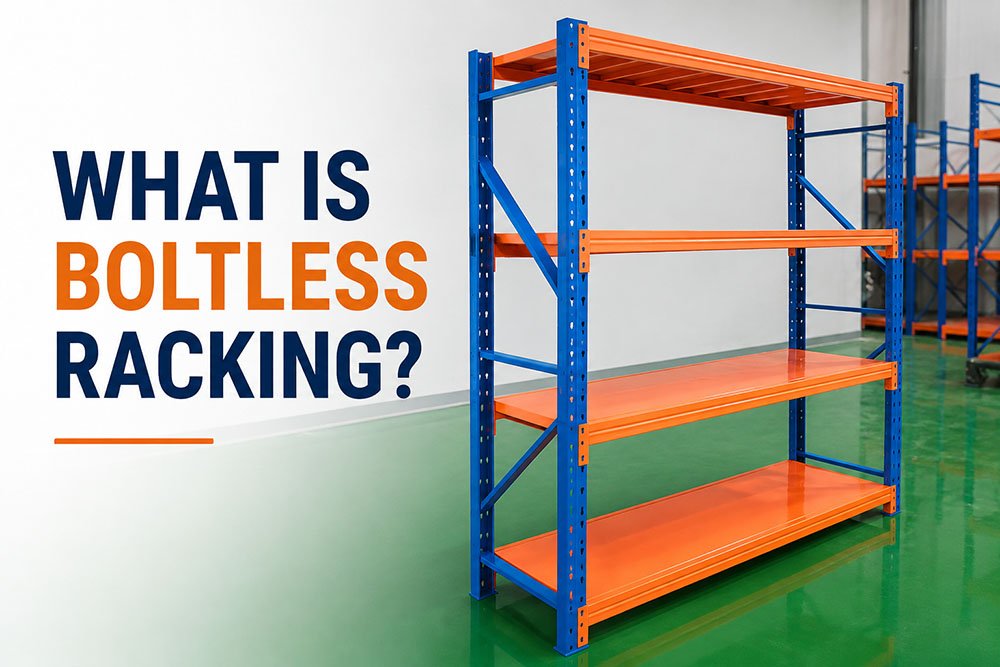
Boltless racking — also called rivet shelving, boltless shelving, or clip-together shelving — refers to steel shelving systems assembled through interlocking connectors rather than nuts, bolts, and screws. Each upright typically features rows of precisely punched slots or perforations, and beams, rivets, or clips engage these slots directly to form a rigid frame. Adding a shelf level is as simple as sliding beam ends into the desired slot height and dropping a decking panel — usually particleboard, MDF, or wire mesh — onto the beam supports.
The result is a shelving system that can be assembled without tools (in most designs), reconfigured for new shelf heights within minutes, and expanded or dismantled with minimal effort. This makes boltless racking fundamentally different from bolted racking or pallet racking, both of which require tools, longer installation time, and typically permanent floor anchoring.
Core components of a boltless racking system:
- Uprights (posts): Vertical steel columns with punched slots along their full length, forming the load-bearing structure and providing beam attachment points at flexible heights.
- Beams: Horizontal supports that clip or rivet into the upright slots, spanning the width of the shelf and carrying the deck panel above.
- Decking: Shelf surfaces that rest on the beams, typically particleboard, MDF, wire mesh, or steel panel depending on load type and environment.
- Braces or diagonal supports: Rear or side bracing that adds lateral rigidity, particularly for taller units or heavier loads.
- Base plates or feet: Contact points at the bottom of each upright that distribute weight to the floor.
How it differs from bolted racking and pallet racking:
Bolted shelving uses nuts and bolts at every beam-to-upright connection, requiring wrenches for assembly and adjustment. Pallet racking is engineered for forklift-loaded pallets weighing hundreds to thousands of kilograms, with correspondingly heavier steel and permanent floor anchoring. Boltless racking sits below both in load class but above in flexibility, occupying a specific niche for hand-loaded, moderate-weight, frequently reconfigured storage needs.
Types of Boltless Racking
Boltless racking comes in several load classes and configurations, each suited to different applications.
Light-duty boltless shelving. Typically rated for 200 to 350 kilograms per shelf level, light-duty units are used for storing small parts, boxed goods, files, and other lightweight items in office storerooms, retail back-of-house areas, and small workshop tool rooms.
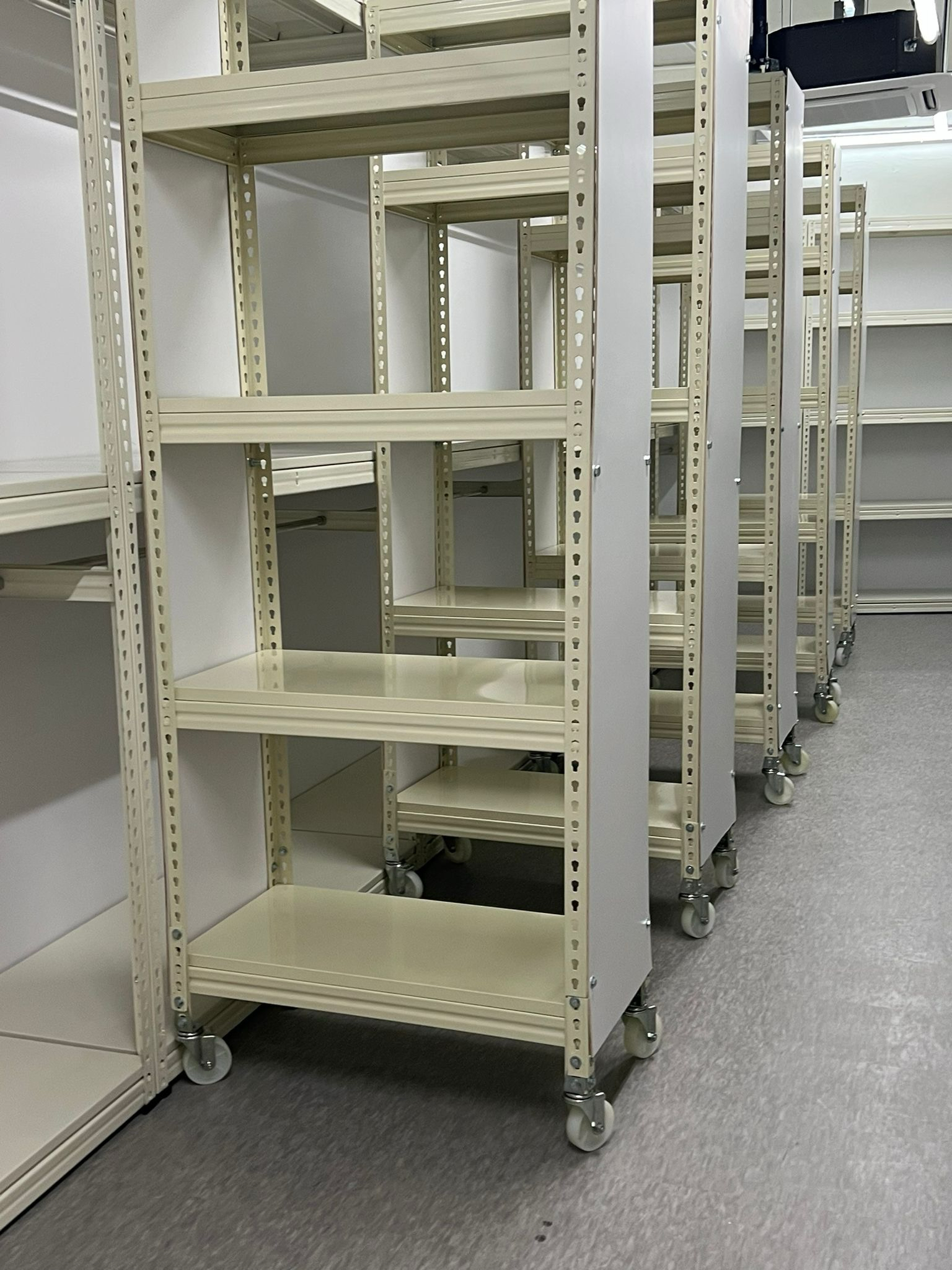
Medium-duty boltless shelving. Rated for approximately 350 to 700 kilograms per shelf, medium-duty configurations handle heavier stock — larger parts, moderate-weight tools, industrial supplies — in workshop and warehouse environments where hand loading remains the primary access method.
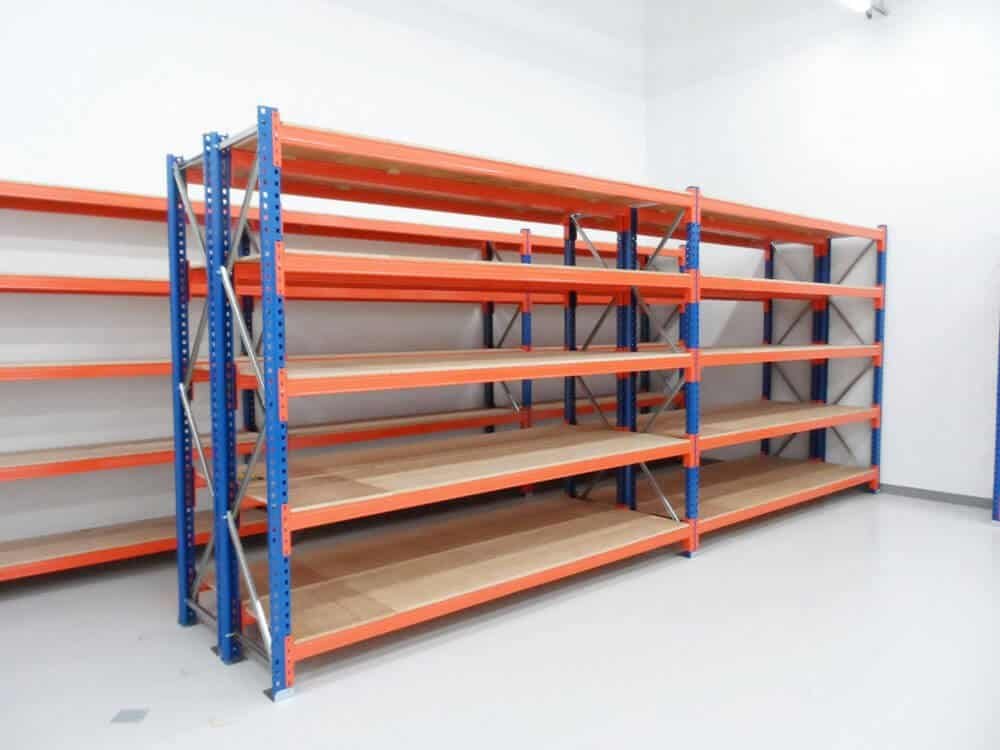
Heavy-duty boltless shelving. Some configurations reach 700 kilograms or more per shelf, using thicker steel and reinforced connectors. These are used for heavier hand-loaded storage, such as automotive parts, machined components, or bulk case goods, though they still fall well below pallet racking load classes.
Long-span boltless shelving. Wider beam spans (typically 1.5 meters or longer) allow storage of oversized boxes, bulky components, or archived files, with reinforced beams to maintain load rating across the greater span. This overview of longspan racking covers the broader long-span category, of which many boltless configurations are a subset.
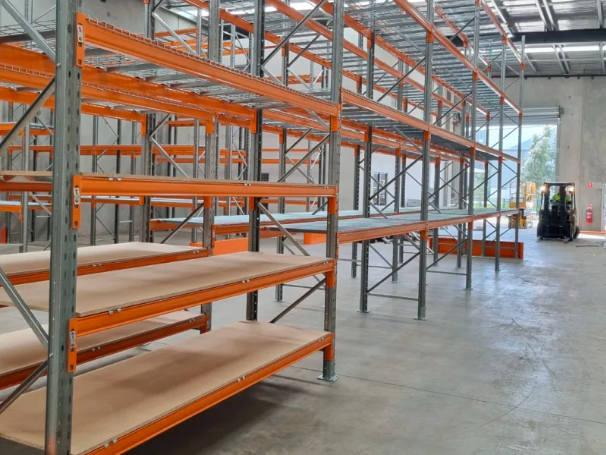
Multi-tier or mezzanine-integrated boltless systems. Some boltless configurations are designed to work within multi-tier picking modules or under mezzanine floors, expanding usable storage vertically without requiring pallet racking infrastructure.
Open or closed side configurations. Open-sided units offer maximum accessibility for picking, while closed-sided units with rear or side panels contain loose items and reduce dust or contamination for sensitive parts.
Boltless Racking Configuration Comparison
| Configuration | Typical Load per Shelf | Common Applications |
|---|---|---|
| Light-duty | 200–350 kg | Office storage, small parts, files |
| Medium-duty | 350–700 kg | Workshop, warehouse hand-picking |
| Heavy-duty | 700+ kg | Heavier parts, bulk case goods |
| Long-span | Varies (based on span) | Oversized boxes, archives, bulky items |
| Multi-tier / mezzanine | Varies | Vertical expansion, picking modules |
Advantages and Disadvantages of Boltless Racking
Advantages:
- Fast assembly. Most boltless configurations can be assembled in minutes without tools, dramatically reducing installation labor compared to bolted alternatives.
- Flexible reconfiguration. Shelf heights can be adjusted quickly as inventory profiles change, without dismantling the entire unit or requiring new components.
- Lower initial cost than pallet racking. For hand-loaded storage of moderate-weight items, boltless racking is significantly less expensive than pallet racking configured for equivalent shelf area.
- No floor anchoring required. Most freestanding boltless configurations do not need to be bolted to the floor, allowing units to be moved or rearranged as facility layout changes.
- Compact shipping and storage. Components ship flat and stack compactly before assembly, reducing freight cost and warehouse space requirements before installation.
- Wide accessory ecosystem. Dividers, bin fronts, label holders, drawers, and other accessories are commonly available to customize storage organization for specific inventory types.
Disadvantages:
- Lower load capacity than pallet racking. Boltless configurations are not designed for palletized loads or the load weights typical of forklift-served warehouse racking, so they cannot substitute for pallet racking in high-load applications.
- Not forklift-compatible. Boltless shelving is intended for hand loading. Forklift contact with a boltless unit generally causes significant damage, since the frames are not engineered for impact resistance.
- Reduced rigidity at height. Very tall boltless configurations may require additional bracing or wall anchoring to remain stable, particularly under load.
- Deck panel material limits. Particleboard and MDF decking common in boltless configurations are vulnerable to moisture damage and are not suitable for cold storage, humid environments, or outdoor use without additional consideration.
- Not code-rated for high-piled storage in most cases. For storage configurations that trigger high-piled storage code requirements, boltless shelving is generally not the appropriate format, since fire protection and structural documentation are more limited than for pallet racking.
Common Applications and Use Cases
Boltless racking fits a specific set of storage needs where hand loading, flexibility, and moderate weight are the defining characteristics.
Tool rooms and maintenance stores. Tools, spare parts, and consumables in factory or warehouse maintenance areas typically require adjustable shelving that can be reorganized as inventory changes. Boltless configurations suit this need well.
Spare parts warehousing. Automotive, industrial, and equipment spare parts stored in small-to-medium quantities benefit from the accessibility and flexibility boltless racking provides.
Order picking modules. Warehouses with hand-pick operations for small items — apparel, cosmetics, electronics accessories — often use boltless shelving as the picking face, sometimes integrated into multi-tier picking modules above the ground floor.
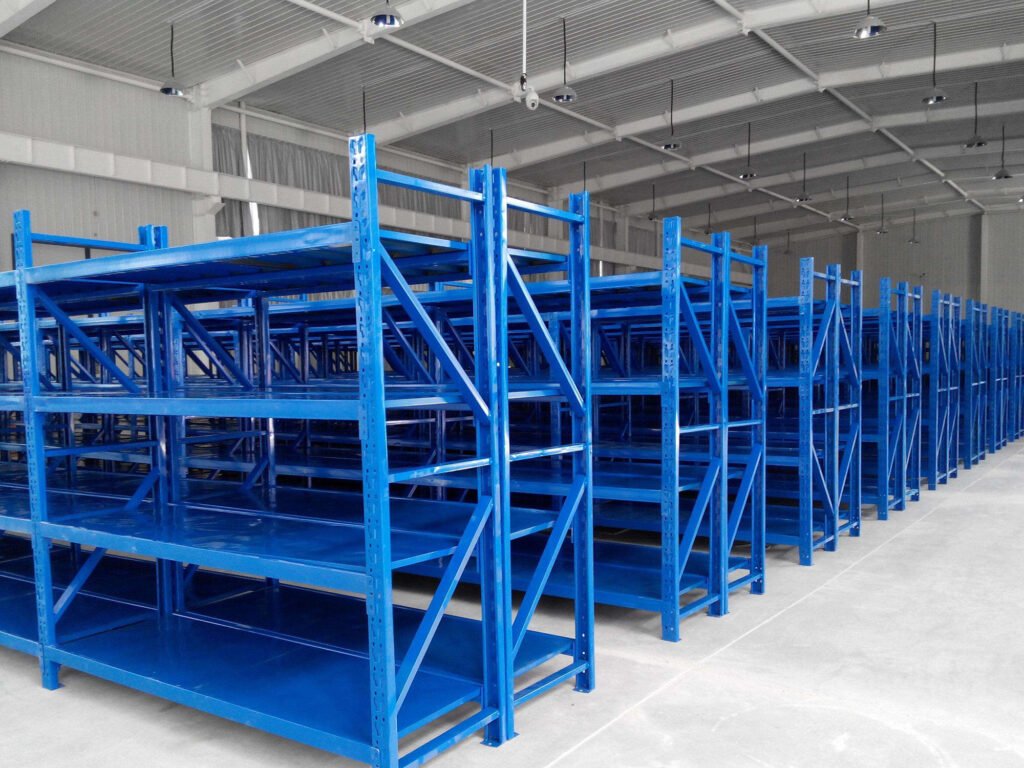
Retail back-of-house. Retail stockrooms use boltless shelving for cartoned goods, bin storage, and stock rotation, since layouts change frequently as merchandise mix evolves. For heavier or more permanent stockroom storage, boltless shelving is often combined with stacking racking systems for palletized reserve stock.
Archive and document storage. File boxes and archived documents in offices or records rooms fit long-span boltless configurations well, since load per shelf remains moderate but shelf area needs to be significant.
Workshop and repair facilities. Repair shops, machine shops, and manufacturing prep areas benefit from boltless shelving’s tool-free assembly and reconfiguration, since layouts often change with new equipment or workflow updates.
E-commerce fulfillment small-item zones. Fulfillment centers picking individual items rather than full pallets frequently use boltless configurations in the small-item pick zone, sometimes combined with heavier mezzanine racking systems for vertical expansion.
Boltless Racking vs Pallet Racking
| Factor | Boltless Racking | Pallet Racking |
|---|---|---|
| Loading Method | Hand loading | Forklift loading |
| Typical Load per Level | 200–1,000 kg | 1,000–5,000 kg+ |
| Assembly | Tool-free, minutes | Requires tools, longer install |
| Reconfiguration | Fast, ongoing | Difficult once installed |
| Floor Anchoring | Usually not required | Required |
| Best For | Small parts, tools, hand-picking | Palletized goods, bulk storage |
| Typical Environment | Workshop, stockroom, pick modules | Warehouse, distribution center |
For hand-loaded moderate storage, boltless racking is usually the more appropriate choice. For palletized loads or forklift-served operations, selective pallet racking remains the standard, and boltless configurations should not be used as a substitute.
Expected Operational Improvements
Warehouses that deploy boltless racking in the appropriate applications — hand-loaded, moderate-weight, frequently reconfigured storage — typically see:
- Faster initial deployment, since installation requires little to no specialized labor
- Higher layout flexibility, since shelf heights and unit arrangements adjust to changing inventory profiles without significant downtime
- Improved small-item organization, when combined with dividers, bins, and labeling accessories designed for the format
- Better use of non-palletized storage zones, since boltless configurations occupy shelf area more efficiently than palletized racking for hand-loaded stock
- Lower total cost for moderate-load applications, since specifying pallet racking for hand-loaded storage generally overinvests in structure the operation doesn’t need
These improvements depend on selecting the appropriate load class and configuration for the actual inventory profile — using boltless racking beyond its rated capacity or in unsuitable environments (heavy pallets, forklift traffic, cold storage) undoes the benefits and creates safety risk.
Project Considerations When Selecting Boltless Racking
Load rating per shelf. Confirm the shelf load rating comfortably exceeds the heaviest anticipated load, including a safety margin. Overloading boltless shelving can lead to bent beams, dropped decks, or upright deformation.
Total unit load rating. In addition to per-shelf ratings, boltless units have a total unit load capacity that limits how much combined weight can be stored across all levels. This should be verified separately from individual shelf ratings.
Decking material. Particleboard and MDF are cost-effective for dry indoor storage but unsuitable for humid, cold, or wet environments. Wire mesh or steel decking should be specified for cold storage, food processing areas, or environments where dust or moisture control is a concern.
Environmental conditions. Standard powder-coated finishes work well in dry indoor environments. Galvanization or specialized coatings should be specified for humid, coastal, or outdoor applications to prevent premature corrosion.
Height and stability. Taller boltless configurations may require rear bracing, wall anchoring, or floor anchoring to remain stable under load. Height limits vary by manufacturer and load rating and should be confirmed for the specific product.
Fire protection interaction. For installations approaching high-piled storage thresholds, fire code implications should be reviewed with a qualified engineer, since boltless racking generally has fewer fire protection design provisions than pallet racking.
Accessory compatibility. If dividers, bins, drawers, or labeling systems will be used, confirm compatibility with the specific boltless product before purchase, since accessory systems vary between manufacturers.
Expansion planning. Boltless configurations are typically easy to expand horizontally by adding starter and add-on units. Planning for future growth at the initial purchase stage helps ensure component compatibility later.
Frequently Asked Questions
Is boltless racking really assembled without any bolts? Most boltless configurations use interlocking rivets, clips, or slot-and-tab connections that do not require bolts for the main frame assembly. Some designs include a small number of bolts for specific components, but the primary frame is assembled without them.
Can boltless racking hold pallets? No, boltless racking is not designed for palletized loads. Palletized storage should use pallet racking, which is engineered for forklift loading and the load classes pallets typically carry.
How much weight can boltless shelving actually hold? Load ratings vary by configuration, but typical ranges are 200 to 350 kilograms per shelf for light-duty units, 350 to 700 kilograms for medium-duty, and higher for reinforced heavy-duty configurations. Always confirm the specific product’s load rating before use.
How long does it take to assemble a boltless shelving unit? Most single boltless units can be assembled by one person in 15 to 30 minutes, depending on size and configuration. This is significantly faster than bolted equivalents, which typically require more time and tools.
Is boltless racking suitable for cold storage or humid environments? Standard boltless configurations with particleboard decking are not well suited to cold storage or humid environments due to moisture susceptibility. Wire mesh or steel decking, combined with galvanized frames, should be specified for these applications.
Can boltless racking be used outdoors? Only with weather-resistant materials — galvanized frames and metal or coated decking — since standard finishes and particleboard decking will degrade rapidly in outdoor conditions.
Does boltless racking require floor anchoring? Most freestanding boltless configurations do not require floor anchoring for stability at typical heights. Taller units, or those in high-traffic areas, may benefit from wall anchoring or floor anchoring for added stability.
Can I combine boltless racking with pallet racking in the same warehouse? Yes, and many warehouses do. Boltless racking is often used for small-item and hand-loaded storage zones, while pallet racking handles palletized bulk storage, with each format serving the applications it’s engineered for.
Key Takeaways
- Boltless racking is a category of shelving assembled through interlocking connectors rather than bolts, designed for fast assembly, flexible reconfiguration, and hand-loaded storage
- It suits applications such as tool rooms, spare parts, order picking, retail back-of-house, archives, workshops, and small-item fulfillment zones
- Load classes range from light-duty (200 to 350 kilograms per shelf) to heavy-duty (700 kilograms or more), with configurations available for standard, long-span, and multi-tier applications
- Boltless racking is not a substitute for pallet racking — it is not designed for palletized loads, forklift loading, or heavy warehouse storage classes
- Selection should account for load rating, decking material, environment, and expected reconfiguration frequency, not just initial cost
Conclusion
Boltless racking occupies a specific and useful role in warehouse storage strategy — not as a replacement for pallet racking, but as the appropriate format for hand-loaded, moderate-weight storage that benefits from fast assembly and ongoing flexibility. Companies such as Lracking are commonly involved in projects where operators need to combine pallet-scale storage with dedicated hand-loading zones for tools, parts, or small-item inventory, particularly in facilities where different storage classes coexist within the same building. For warehouses considering boltless configurations, matching the specific load class and decking specification to the actual inventory and environment remains the most reliable way to ensure the format delivers its intended flexibility and efficiency advantages.