Warehouses facing rising labor costs, growing order volumes, and shrinking available land are increasingly evaluating automated racking as an alternative to manual storage and retrieval. Unlike conventional racking, where forklifts and staff physically move every pallet, automated racking combines a storage structure with mechanized retrieval equipment and control software to store and retrieve goods with minimal manual handling.
This guide covers what automated racking is, the benefits it offers, the main system types available, when automation makes sense for a given operation, what drives project cost, and what to evaluate when selecting an automated racking manufacturer.
What Is Automated Racking?
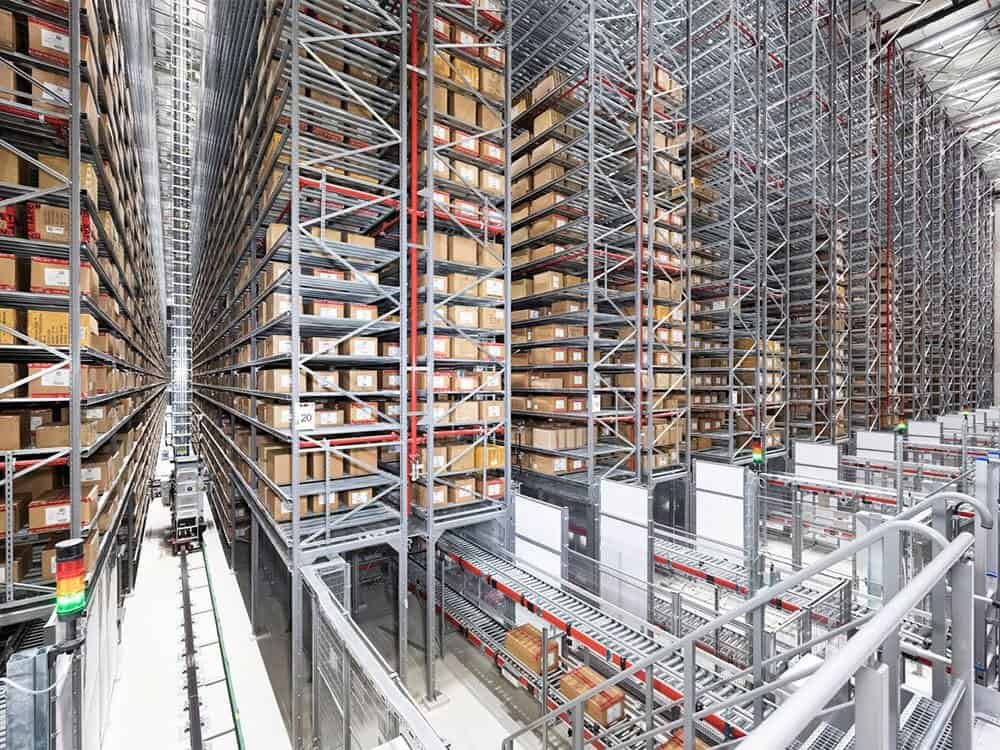
Automated racking refers to storage systems that integrate a physical racking structure with automated handling equipment — such as stacker cranes, shuttles, or robotic carriers — and control software that directs storage and retrieval operations with limited human intervention. Rather than relying on a forklift operator to place and retrieve every pallet, an automated racking system uses sensors, rails, and software logic to move inventory to and from storage locations, often at higher speed and with greater positional accuracy than manual handling.
At its core, an automated racking system consists of three functional layers: the storage structure itself (racks, rails, or shelving), the mechanized retrieval mechanism (cranes, shuttles, or robots), and the control software that coordinates inventory location, movement sequencing, and integration with the warehouse management system. A more detailed breakdown of how these components function together is covered in this overview of what ASRS is, since ASRS represents one of the most common automated racking categories.
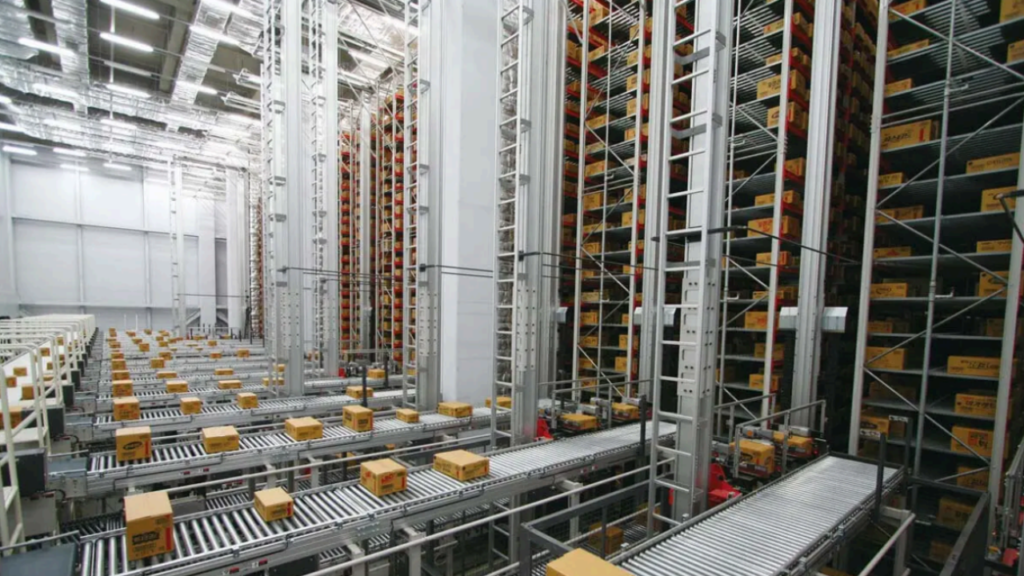
Degrees of automation. Not all automated racking operates at the same level of autonomy. Semi-automated systems, such as single-lane radio shuttle racking, still rely on a forklift to load and unload the shuttle at the aisle end, automating only the deep-lane movement within the rack. Fully automated systems, such as crane-based unit-load ASRS, handle the entire storage and retrieval cycle from receiving through put-away and picking with minimal human contact with the load itself. Understanding where a given system falls on this spectrum matters when comparing project scope, cost, and the operational changes required to support it.
How automated racking differs from conventional racking operationally. In a conventional pallet racking layout, storage locations are typically assigned based on forklift accessibility and aisle width, and inventory location tracking depends on manual scanning or physical labeling. In an automated racking system, the control software continuously tracks exact pallet or tote locations, can optimize slotting based on turnover velocity, and directs equipment movement without requiring an operator to manually navigate to each location. This shift changes not only how goods are physically stored but also how warehouse staff interact with inventory data on a daily basis.
For an independent industry overview and standard terminology, see the MHI Automated Storage/Retrieval Systems Industry Group.
Benefits of Using Automated Racking
Warehouses that implement automated racking commonly report improvements across several operational dimensions:
Increased storage density. Automated systems typically operate in narrower aisles than manual forklift operations, since there is no need to accommodate a driver’s turning radius or sightlines. Crane-based and shuttle-based systems in particular can operate in aisles only slightly wider than the load itself, which allows more storage positions within the same footprint compared to selective pallet racking served by counterbalance or reach trucks.
Higher throughput consistency. Automated retrieval operates at a defined, repeatable speed regardless of shift changes, staff fatigue, or turnover, which tends to produce more predictable order fulfillment times than manual picking. This consistency also makes throughput easier to forecast and plan around during peak demand periods, since the system’s cycle time is largely fixed rather than varying with individual operator performance.
Reduced labor dependency. While automated systems still require technical staff for oversight and maintenance, they reduce the number of personnel needed for repetitive put-away and retrieval tasks, which helps offset rising labor costs and labor shortages in some regions. This shift also tends to reduce the operational impact of seasonal labor turnover, since fewer new hires need to be trained on manual picking routes and equipment operation.
Improved picking and inventory accuracy. Because retrieval locations are controlled by software rather than manual judgment, automated racking generally reduces misplaced pallets and picking errors compared to fully manual operations. Accurate, real-time location data also simplifies cycle counting and reduces the frequency of full physical inventory audits.
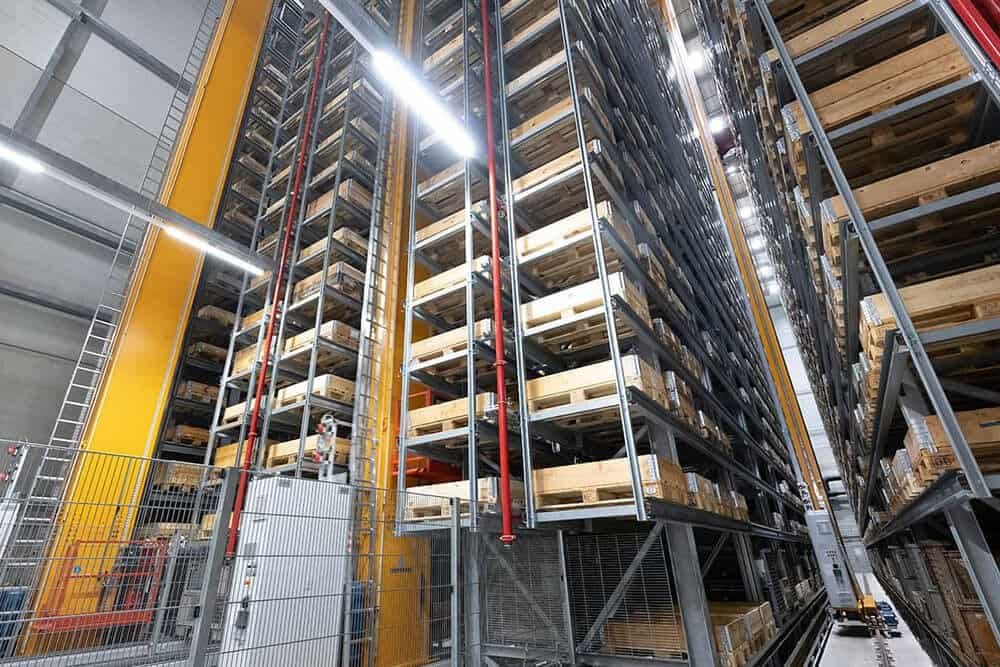
Better use of vertical space. Many automated systems, particularly crane-based ASRS, are designed to operate efficiently at greater heights than manual forklifts can safely reach, allowing warehouses to expand storage capacity vertically rather than acquiring additional floor space. This is particularly relevant in markets where land or lease costs make horizontal expansion economically difficult.
Enhanced safety in high-traffic zones. Reducing the number of forklifts and personnel moving through storage aisles lowers the frequency of vehicle-related incidents and manual handling injuries. Fewer forklift movements in dense storage areas also reduces the likelihood of rack damage from incidental contact, which can extend the service life of the racking structure itself.
These benefits are not universal or automatic — they depend on the automated system being matched to the correct operational profile, which is addressed further in the sections below.
Types of Automated Racking Systems
Automated racking is not a single technology but a category that includes several distinct system types, each suited to different load profiles, throughput requirements, and warehouse layouts.
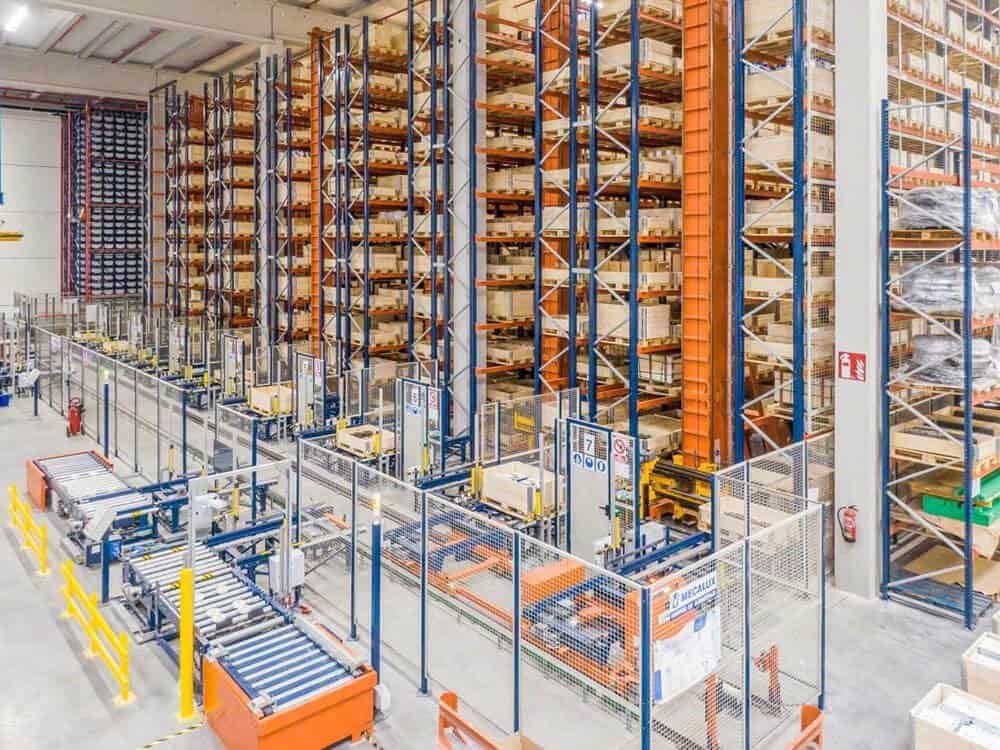
Unit-load ASRS. Designed for full pallets or large unit loads, unit-load ASRS uses stacker cranes running on fixed or movable aisles to store and retrieve heavy loads at height. This type is generally suited to high-volume, palletized storage where load uniformity is relatively high. Fixed-aisle configurations dedicate one crane per aisle for maximum speed, while movable-aisle configurations allow a single crane to service multiple aisles, trading some throughput for a lower equipment count.
Mini-load ASRS. Built for cartons, totes, or smaller unit loads rather than full pallets, mini-load systems are common in operations with high SKU counts and frequent, smaller-quantity retrievals, such as e-commerce fulfillment and parts distribution. Because loads are lighter than full pallets, mini-load cranes can generally cycle faster, which suits operations built around frequent small-batch picking rather than bulk pallet movement.
Carousel-based ASRS. Horizontal or vertical carousels bring stored items to a fixed picking station rather than requiring an operator or machine to travel to the storage location, which can reduce walking time in pick-intensive operations. Vertical carousels are particularly space-efficient for facilities with limited floor area but adequate ceiling height, since the storage mechanism itself occupies a relatively small footprint.
Radio shuttle racking. In this configuration, a battery-powered shuttle travels within the racking structure along a single storage lane, moving pallets to the aisle end for pickup by a forklift. This approach increases density compared to conventional selective racking while requiring less capital investment than a full crane-based ASRS. A closer look at how this configuration operates is available in this guide to radio shuttle racking.
Four-way shuttle racking. Unlike single-lane radio shuttle systems, four-way shuttle racking uses shuttles capable of moving both within a storage lane and laterally between lanes, often with the assistance of a transfer car or elevator. This allows a smaller number of shuttles to service multiple storage lanes and aisles, improving flexibility and reducing the total shuttle count needed compared to a one-shuttle-per-lane configuration. Four-way shuttle systems are generally suited to warehouses with a moderate to high number of SKUs that still require higher density than selective racking allows.
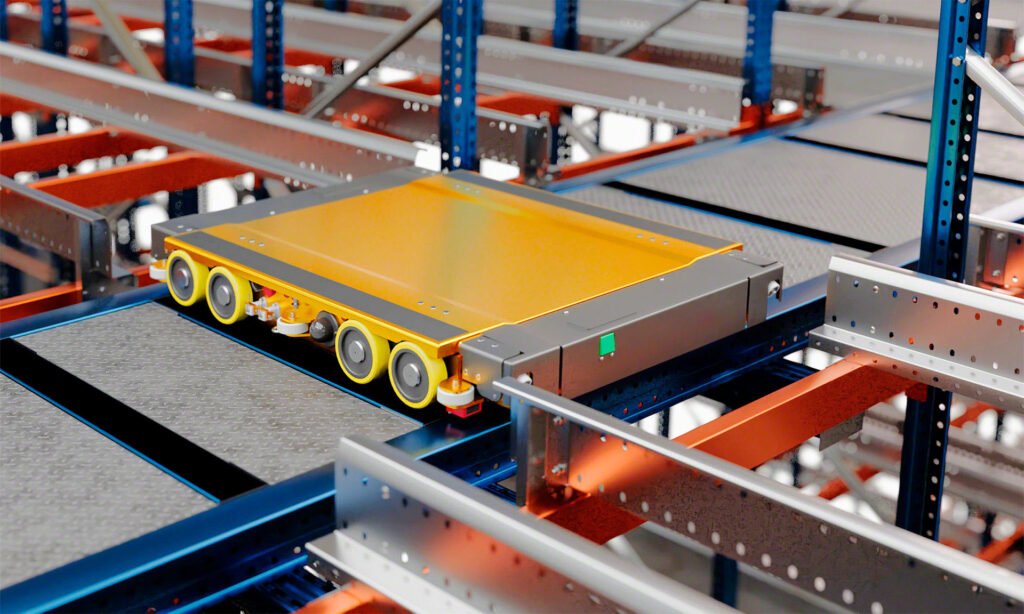
Autonomous mobile robot (AMR) systems. Rather than being fixed to rails within the racking structure, AMR-based systems use mobile robots that navigate the warehouse floor to transport totes, shelving units, or pallets to fixed picking stations, offering more layout flexibility than rail-based shuttle systems.
For a complete breakdown of ASRS subtypes, including additional configurations such as cube-based and micro-load systems, this guide to 8 types of automated storage and retrieval systems covers each format in more depth.
Automated Racking Type Comparison
| System Type | Load Type | Density | Flexibility | Typical Application |
|---|---|---|---|---|
| Unit-Load ASRS | Full pallets | High | Low | High-volume palletized storage |
| Mini-Load ASRS | Cartons, totes | High | Moderate | High-SKU, small-item fulfillment |
| Radio Shuttle Racking | Pallets, single lane | High | Moderate | Homogeneous bulk storage |
| Four-Way Shuttle Racking | Pallets, multi-lane | High | High | Mixed SKU, moderate to high turnover |
| AMR Systems | Totes, shelving units | Moderate | High | Fulfillment centers with layout changes |
Project Considerations Before Automating
Beyond selecting a racking system type and manufacturer, several site-level factors typically need to be assessed before an automated racking project moves into design and installation.
Floor flatness and slab condition. Crane-based and shuttle-based systems generally require tighter floor flatness tolerances than manual forklift aisles, since rail-guided equipment is more sensitive to unevenness. Existing slabs may need grinding, leveling, or reinforcement before installation.
Ceiling height and structural clearance. Automated systems, particularly crane-based ASRS, are often designed to maximize vertical storage, so accurate clear-height measurements and clearance around sprinklers, lighting, and HVAC ductwork are necessary during layout planning.
Power supply and electrical infrastructure. Automated equipment requires reliable power for cranes, shuttles, sensors, and control systems, and older facilities may need electrical upgrades to support the additional load and backup power requirements.
WMS and software integration. The automated racking system’s control software needs to communicate with the existing warehouse management system, which may require custom integration work depending on the WMS platform already in use.
Fire protection and code compliance. High-density automated storage can affect fire protection requirements, including in-rack sprinkler placement and flue space, and should be reviewed with a fire protection engineer alongside the racking design.
Throughput and SKU data accuracy. Because automated systems are engineered around specific throughput and load assumptions, inaccurate or incomplete data on order volume, SKU dimensions, and peak demand periods can lead to a system that is undersized or inefficient once operational.
Downtime contingency planning. Since automated systems concentrate significant throughput through a smaller number of mechanical components, warehouses should plan for how operations will continue during scheduled maintenance or unexpected downtime, particularly for facilities with limited manual backup capacity.
When Should You Choose Automated Racking?
Automated racking is not the right fit for every warehouse, and the decision generally depends on several operational factors rather than automation being universally preferable to manual storage.
Choose automated racking when throughput volume is high and consistent. Facilities processing a large, steady volume of pallet or carton movements tend to see the strongest return on automation, since the system’s speed and consistency are used at or near capacity.
Choose automated racking when labor costs or labor availability are a persistent constraint. In regions or industries facing rising wages or difficulty staffing warehouse roles, automation can offset labor dependency for repetitive storage and retrieval tasks.
Choose automated racking when vertical space is available but floor space is limited. Facilities unable to expand their footprint but with adequate ceiling height can often gain more usable storage capacity from automation than from further optimizing manual racking layouts.
Choose automated racking when inventory accuracy and traceability are critical. Operations with strict compliance requirements, such as pharmaceutical or high-value electronics storage, benefit from the consistent, software-tracked movement automation provides.
Reconsider automation when order volume is low or highly seasonal. Facilities with infrequent or highly variable throughput may not generate enough utilization to justify the capital cost, since automated systems perform best when operating near their designed capacity consistently.
Reconsider automation when SKU characteristics change frequently. Warehouses with constantly shifting product dimensions, packaging, or handling requirements may find that a flexible manual or semi-automated layout adapts more easily than a fixed automated configuration.
Reconsider automation when budget constraints limit the ability to absorb a longer payback period. Automated systems generally require a larger upfront investment than manual racking, and the payback period depends heavily on labor savings and throughput gains specific to each facility.
How Much Does Automated Racking Cost?
Automated racking project costs vary significantly based on system type, scale, and site-specific requirements, making a single universal figure unreliable. Instead, it is more useful to understand the major cost components that make up a typical project budget.
| Cost Component | What It Covers | Relative Cost Impact |
|---|---|---|
| Racking structure | Uprights, beams, rails, and supporting steel | Moderate |
| Automation hardware | Cranes, shuttles, robots, or carousels | High |
| Control software | Warehouse control system (WCS) and integration with WMS | Moderate to High |
| Installation and commissioning | On-site assembly, calibration, and testing | Moderate |
| Site preparation | Floor leveling, power supply, safety infrastructure | Low to Moderate |
| Ongoing maintenance | Preventive maintenance, spare parts, software updates | Ongoing, Moderate |
Automation hardware and control software typically represent the largest share of project cost, since these components involve precision engineering, sensors, and custom programming rather than standard structural steel. Racking structure costs scale with warehouse height and footprint, while site preparation costs depend heavily on the condition of the existing facility, including floor flatness tolerances required for crane or shuttle rail systems.
Facilities evaluating automated racking should request a project-specific quotation based on throughput requirements, SKU profile, and building specifications, since published cost estimates rarely reflect the full scope of a given warehouse’s automation needs.
Thinking about cost in terms of payback period rather than upfront price alone. Because automated racking carries a higher initial investment than manual racking, project evaluations typically focus on payback period — the time required for labor savings, throughput gains, and error reduction to offset the initial capital cost — rather than comparing sticker prices directly. Facilities with high, consistent throughput generally reach payback faster than those with lower or more variable volume, since the fixed capital cost is spread across a larger number of storage and retrieval cycles.
Total cost of ownership beyond the initial project. Ongoing maintenance, software licensing or updates, spare parts availability, and periodic recertification of safety systems all contribute to the total cost of an automated racking system over its operational lifespan. Facilities budgeting for automation should request maintenance cost estimates alongside the initial project quotation, rather than evaluating cost based on installation price alone.
Project Considerations When Choosing an Automated Racking Manufacturer
Selecting a manufacturer for an automated racking project involves different evaluation criteria than a standard racking purchase, since the system’s software, integration capability, and long-term support are as important as the physical structure itself.
Engineering and design capability. A qualified manufacturer should be able to conduct a site assessment and produce a layout design based on actual warehouse dimensions, load profiles, and throughput targets, rather than offering a generic configuration.
Software and WMS integration experience. Since automated racking depends on control software communicating with the broader warehouse management system, manufacturers should demonstrate experience integrating with common WMS platforms relevant to the buyer’s operation.
After-sales support and maintenance response time. Automated systems require ongoing maintenance, and downtime on a fully automated line can halt significant portions of warehouse throughput. Buyers should confirm response times for technical support and the availability of spare parts before committing to a manufacturer. This general manufacturer evaluation criterion also applies to related heavy-duty pallet racking manufacturers selection, where structural quality and support reliability are equally important considerations.
Safety certification and compliance. Automated equipment should meet relevant safety standards for the region of installation, including sensor-based collision prevention and emergency stop systems, and the manufacturer should be able to document compliance.
Track record with similar project scale and industry. A manufacturer experienced with facilities of comparable size and SKU complexity is generally better positioned to anticipate configuration challenges specific to that type of operation.
Customization and scalability. Since automation is a significant capital investment, buyers should evaluate whether the proposed system can be expanded or reconfigured as throughput or SKU requirements change over time, rather than requiring a full system replacement.
Training and change management support. Transitioning from manual to automated operations requires staff retraining, and manufacturers offering structured onboarding and operator training tend to reduce disruption during the commissioning phase.
Project communication and documentation practices. Automated racking projects typically involve multiple phases — design, manufacturing, installation, and software commissioning — spread over several months. Manufacturers that provide clear documentation, defined milestones, and consistent project communication generally reduce the risk of misalignment between the design specification and the delivered system.
Post-installation performance validation. Before final acceptance, a qualified manufacturer should support performance testing against the throughput and accuracy targets defined at the start of the project, rather than considering the installation complete once the physical equipment is in place.
Frequently Asked Questions
Is automated racking only suitable for large warehouses? No. While large, high-throughput facilities see the strongest returns from full automation, smaller warehouses can benefit from partial automation, such as radio shuttle racking, without committing to a full crane-based ASRS installation.
How is automated racking different from ASRS? ASRS is a specific and widely used category within the broader automated racking field, referring to systems that use cranes or shuttles to automatically store and retrieve items. Automated racking is a broader term that also includes shuttle-based, AMR-based, and other mechanized storage configurations.
What is the difference between radio shuttle racking and four-way shuttle racking? Radio shuttle systems typically operate within a single storage lane, requiring one shuttle per lane or manual repositioning between lanes. Four-way shuttle systems can move both within and between lanes, often using a transfer car, allowing fewer shuttles to service more of the warehouse.
How long does an automated racking project typically take to implement? Implementation timelines vary based on system complexity and site readiness, but projects generally progress through site assessment, engineering design, manufacturing, installation, and software commissioning over a period of several months.
Can existing manual racking be converted to automated racking? In some cases, existing racking structures can be retrofitted with shuttle-based automation if the structural specifications are compatible. Crane-based ASRS, however, typically requires a purpose-built structure and is less commonly retrofitted into existing conventional racking.
Does automated racking eliminate the need for warehouse staff? No. Automated racking reduces the labor required for repetitive storage and retrieval tasks, but staff are still needed for system oversight, maintenance, exception handling, and tasks that automation does not fully cover.
What happens if the automated system experiences downtime? Downtime response depends on the manufacturer’s support agreement and the system’s design. Some facilities maintain manual backup procedures for critical operations, which is a factor worth discussing directly with the manufacturer during project planning.
Is automated racking compatible with cold storage or hazardous environments? Many automated systems can be adapted for cold storage or other specialized environments, though this typically requires additional engineering considerations for equipment performance and safety in those conditions, and should be confirmed directly with the manufacturer.
Key Takeaways
- Automated racking combines a storage structure, mechanized retrieval equipment, and control software to reduce manual handling and improve throughput consistency
- Common system types include unit-load and mini-load ASRS, radio shuttle racking, four-way shuttle racking, and AMR-based systems, each suited to different load profiles and SKU characteristics
- Automation tends to deliver the strongest returns for high-volume, consistent-throughput operations, and is less suited to low-volume or highly variable inventory environments
- Project cost is driven primarily by automation hardware and control software rather than the racking structure alone, and should be evaluated through a project-specific quotation
- Manufacturer selection should weigh engineering capability, software integration experience, after-sales support, and safety compliance alongside physical build quality
Conclusion
Automated racking represents a significant shift from conventional manual storage, and the decision to implement it should be based on a clear-eyed evaluation of throughput volume, labor cost pressures, available space, and long-term scalability needs rather than automation trends alone. Companies such as Lracking are commonly involved in projects where operators are weighing the transition from manual to automated storage, particularly in facilities balancing rising labor costs against the capital investment automation requires. For warehouses evaluating whether automated racking fits their operation, a project-specific assessment of throughput data, SKU profile, and facility constraints remains the most reliable way to determine which system type, if any, delivers the best return.