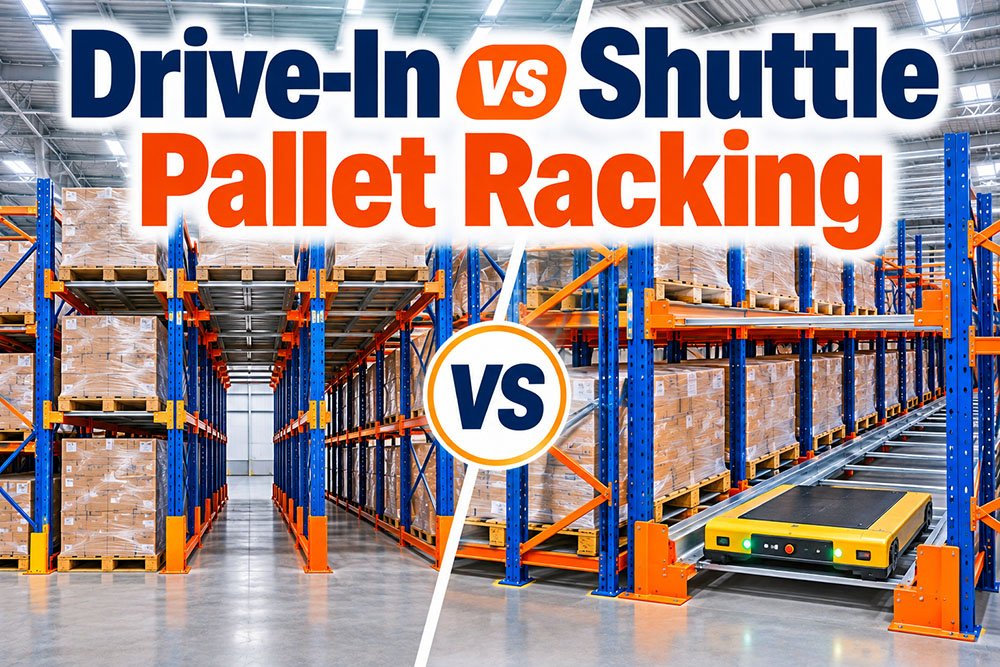
Drive-in racking and shuttle pallet racking are the two most common high-density pallet storage formats, and they’re frequently positioned as alternatives in warehouse procurement decisions. Both deliver significantly more storage density than selective racking. Both suit bulk or low-selectivity inventory. Both appear in the same supplier catalogs. But they differ dramatically in upfront investment, operating cost, retrieval speed, and long-term return on investment — and selecting between them based on density alone, or on purchase price alone, often leads to the wrong answer for the specific operation.
This guide covers how to compare drive-in and shuttle pallet racking on return on investment, what cost and benefit factors each format drives, and how to match the format choice to specific warehouse scenarios so the selected system actually delivers the ROI the business invested in.
Why ROI Comparison Matters More Than Format Comparison
Most drive-in vs shuttle discussions focus on technical differences — how each format works mechanically, what density gains each delivers, what their respective selectivity limitations are. These are useful technical points, but they don’t answer the question most buyers actually need to answer: given a specific inventory profile, throughput requirement, and operational context, which format delivers better financial return?
The answer depends on factors beyond pure density. Drive-in racking has a much lower upfront cost but requires forklifts to enter the storage structure, which slows retrieval, concentrates damage risk on the racking itself, and limits throughput. Shuttle pallet racking has a significantly higher upfront cost but keeps forklifts out of the storage lanes, delivering faster retrieval, less rack damage, and higher throughput that can offset the capital premium through labor and operational savings.
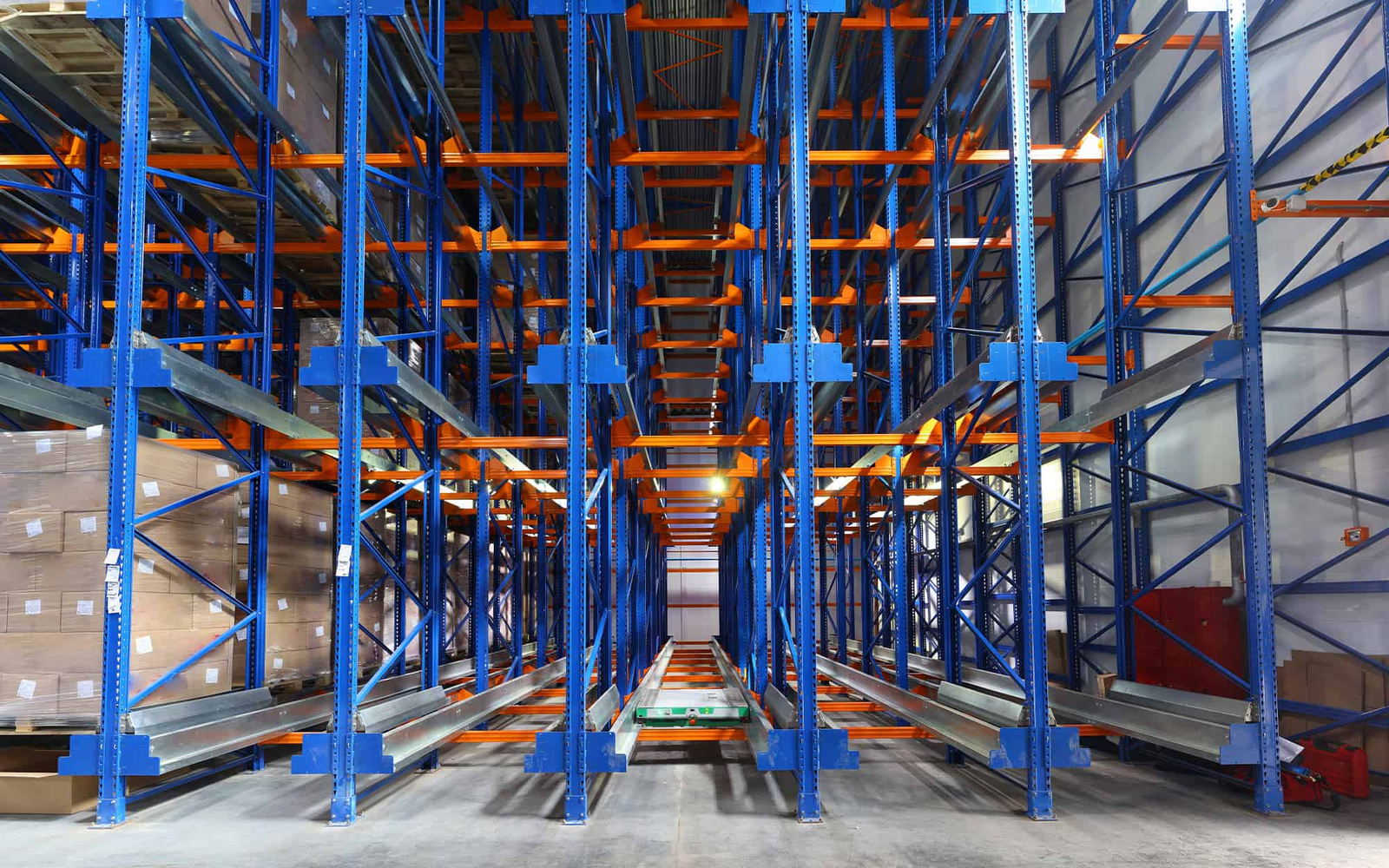
For some operations, drive-in racking’s lower investment produces faster payback and better overall return. For others, shuttle racking’s higher throughput and reduced operational cost justify the higher capital expenditure within a few years. The determining factors — throughput volume, labor cost, operational temperature, project scale — are specific to each operation and need to be modeled rather than assumed.
Current Challenges in Drive-In vs Shuttle Decisions
Comparing on purchase price alone. The capital investment difference between drive-in and shuttle racking is often substantial, and the price gap can appear to settle the decision. In practice, total cost of ownership over the system’s service life often tells a very different story than purchase price comparison.
Overestimating drive-in’s density advantage. Drive-in racking achieves density by eliminating aisles between lanes, but it loses pallet positions to deep-lane access limitations, uneven lane utilization, and the operational need to leave buffer positions. Real-world density gains are often lower than theoretical maximums.
Underestimating shuttle operational benefits. Shuttle systems reduce forklift travel into storage lanes, reduce rack damage, enable better inventory rotation, and often support higher throughput — benefits that don’t appear on a density comparison but significantly affect long-term ROI.
Ignoring operating cost differences. Drive-in racking has essentially no ongoing operating cost beyond standard inspection. Shuttle systems carry ongoing costs for shuttle maintenance, battery replacement, software updates, and occasional component replacement that need to be factored into TCO.
Not accounting for inventory damage. Drive-in racking’s forklift-into-rack operation produces predictable rack and product damage rates that accumulate over service life. Shuttle operation significantly reduces this damage, which is a real financial benefit that purchase price comparisons overlook.
Treating the choice as binary. Many warehouses benefit from hybrid configurations — drive-in racking for very slow-moving or seasonal bulk inventory, shuttle racking for higher-throughput zones. Forcing a facility-wide choice between the two often produces worse results than zoning by inventory characteristics.
Direct Technical Comparison
Before examining ROI in detail, understanding the key technical differences establishes the baseline for the financial comparison.
Density. Drive-in racking typically delivers 60 to 80 percent more pallet positions than selective racking in the same footprint. Shuttle pallet racking typically delivers 80 to 100 percent or more, with deeper lane configurations supporting even greater density. The density gap between the two is real but modest.
Retrieval speed. Drive-in retrieval requires the forklift to enter the storage lane, position the pallet, and reverse out — a slow process compared to selective racking, often taking 2 to 3 times longer per pallet. Shuttle retrieval has the shuttle move the pallet to the lane end, where the forklift picks it up without entering the lane — significantly faster than drive-in and approaching selective racking retrieval times.
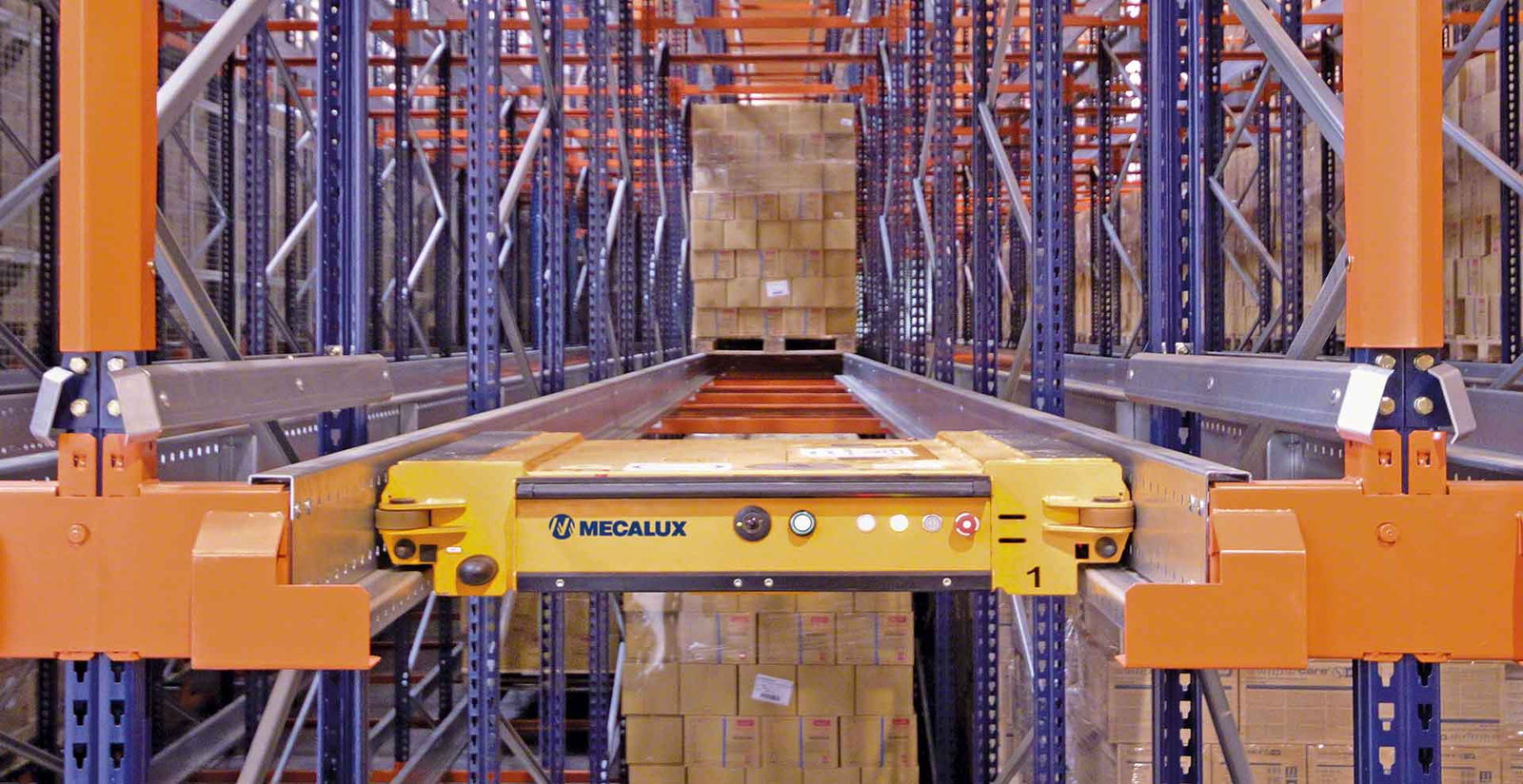
Selectivity and rotation. Drive-in racking typically supports LIFO (last-in-first-out) rotation only, since the first pallet loaded sits at the back of the lane. Drive-through configurations support FIFO but require loading and unloading access on both sides. Shuttle systems support both LIFO and FIFO depending on configuration, offering better rotation control for inventory with shelf life or lot-tracking requirements.
Rack damage. Drive-in racking experiences higher damage rates than selective or shuttle equivalents, since forklifts repeatedly enter the structure. Industry data suggests drive-in uprights experience significantly higher impact-related damage than selective racking in equivalent traffic environments.
Fire protection. Both formats trigger in-rack sprinkler requirements at scale, with specific designs depending on commodity classification and local code. Shuttle systems may require more complex fire protection design due to higher-density configurations.
Scalability. Drive-in racking scales easily — adding bays adds pallet positions at predictable per-unit cost. Shuttle systems require shuttles proportional to lane count or throughput requirements, which can increase per-unit cost as the system scales.
Technical Comparison Summary
| Factor | Drive-In Racking | Shuttle Pallet Racking |
|---|---|---|
| Density vs selective | +60–80% | +80–100%+ |
| Retrieval speed | Slow | Moderate to Fast |
| Rotation | LIFO (drive-in) or FIFO (drive-through) | LIFO or FIFO |
| Rack damage risk | High | Low (forklifts stay out of lanes) |
| Fire protection complexity | Moderate | Moderate to High |
| Scalability economics | Linear | Shuttle-count-dependent |
| Operator training | Standard forklift + lane-entry discipline | Shuttle control system training |
A more detailed look at drive-in configurations is covered in this guide to drive-in and drive-through pallet racking, and a parallel overview of shuttle configurations is in this guide to radio shuttle racking.
The ROI Comparison Framework
Comparing drive-in and shuttle racking on ROI requires modeling both cost and benefit sides across the system’s service life, not just comparing purchase prices. The following framework captures the main financial drivers.
Cost Components to Model
Initial equipment cost. The racking structure, shuttles (for shuttle systems), control systems, and any specialized components. Drive-in systems typically cost 40 to 60 percent less per pallet position than equivalent shuttle configurations at purchase.
Installation cost. Site preparation, assembly labor, commissioning, and operator training. Shuttle systems typically require more complex installation due to the integrated control and movement systems, though drive-in installations may require more floor flatness correction depending on handling equipment.
Handling equipment. Both formats work with standard counterbalance forklifts, though lane dimensions may constrain equipment choice. The handling equipment itself is typically similar in cost between the two formats.
Operating energy cost. Drive-in racking has essentially no energy consumption. Shuttle systems consume electricity for shuttle operation, charging infrastructure, and control systems — ongoing costs that accumulate over service life.
Maintenance cost. Drive-in racking requires only standard inspection and occasional component replacement from forklift damage. Shuttle systems require periodic shuttle maintenance, battery replacement (typically every 3 to 5 years), control system updates, and higher spare parts inventory.
Rack damage replacement. Drive-in racking experiences higher rack damage rates from forklift contact, resulting in higher component replacement cost over service life. Shuttle systems minimize this cost by keeping forklifts out of the storage lanes.
Fire protection and compliance. Both formats may trigger in-rack sprinkler requirements, with shuttle systems sometimes requiring more complex fire protection design due to higher density.
Benefit Components to Model
Capacity gain. Both formats add pallet positions compared to selective racking baselines, with shuttle typically delivering more. The financial value depends on the alternative cost — if the alternative is expanding to a new facility, the avoided real estate cost can be substantial.
Labor cost reduction. Drive-in operation typically requires more forklift time per pallet handled than shuttle operation, which keeps forklifts at the lane end. Over a service life, this throughput difference can produce significant labor cost differences.
Inventory damage reduction. Drive-in operation produces predictable rates of pallet damage from forklift contact with stored product. Shuttle operation reduces this, saving ongoing inventory loss.
Throughput improvement. Higher throughput capability from shuttle operation can support growing inventory without additional storage investment, enabling the business to grow revenue without proportional facility expansion.
Rotation control value. For inventory with shelf life, lot tracking, or quality control requirements, shuttle systems’ FIFO capability provides compliance and waste-reduction benefits that drive-in LIFO cannot easily match.
Insurance and safety benefits. Reduced rack damage and lower rate of safety incidents in shuttle operation can translate into insurance premium reductions and lower workplace injury costs over time.
ROI Modeling Approach
A workable ROI comparison between drive-in and shuttle systems typically follows this calculation sequence:
Step 1: Calculate initial investment. Total upfront cost for each option, including equipment, installation, commissioning, training, and any facility modifications required.
Step 2: Calculate annual operating cost difference. Difference in energy, maintenance, parts, and operator cost between the two options.
Step 3: Calculate annual benefit difference. Difference in labor cost, damage cost, throughput value, and other operational benefits.
Step 4: Calculate net annual cash flow difference. Benefits minus incremental operating costs.
Step 5: Calculate payback period for the incremental shuttle investment. The additional shuttle investment divided by net annual benefit — i.e., how many years before shuttle operation recovers its premium over drive-in.
Step 6: Calculate TCO over service life. Total cost of ownership over the expected service life (typically 15 to 20 years) for each option, including all upfront, operating, and replacement costs.
For most operations, drive-in racking delivers faster initial payback (often 2 to 4 years from capacity gain alone), while shuttle racking delivers better long-term TCO when throughput volumes are high enough to generate meaningful labor savings and avoided damage.
Typical ROI Ranges
| Factor | Drive-In Racking | Shuttle Pallet Racking |
|---|---|---|
| Initial investment per position | Baseline | 1.5–2.5x drive-in |
| Payback period (capacity gain only) | 2–4 years | 4–8 years |
| Annual operating cost | Minimal | 2–5% of initial investment |
| Expected service life | 15–20 years | 15–20 years |
| Best TCO scenario | Low-throughput, low-labor-cost | High-throughput, high-labor-cost |
These ranges are general guidance. Project-specific numbers vary significantly based on operation characteristics, local labor costs, and configuration details.
When Drive-In Racking Delivers Better ROI
Low to moderate throughput operations. When pallet movement volumes are modest, the labor efficiency advantages of shuttle operation generate limited savings, and drive-in racking’s lower investment typically produces better overall ROI.
Low labor cost markets. Where forklift operator costs are relatively low, the labor time premium of drive-in operation generates smaller cost differentials than in high-labor-cost markets. This often tilts the ROI calculation toward drive-in.
Small to medium project scale. Smaller installations may not reach the scale where shuttle systems’ fixed costs (control systems, charging infrastructure, software) can be amortized across enough pallet positions to be cost-effective per position.
Highly homogeneous inventory with LIFO tolerance. Bulk inventories of a few SKUs with no rotation requirements fit drive-in operation naturally, and the format’s limitations don’t translate into operational constraints.
Temporary or short-term facility use. For facilities with uncertain long-term occupancy or expected relocation, drive-in’s faster payback matches the shorter service horizon better than shuttle’s longer payback period.
Budget-constrained projects where capacity is the primary goal. When capital budget is the binding constraint and capacity gain is the primary objective, drive-in delivers more positions per dollar invested.
When Shuttle Pallet Racking Delivers Better ROI
High-throughput operations. When pallet movement volumes are high, shuttle operation’s labor time savings and throughput improvements generate substantial annual benefits that can justify the higher initial investment within a few years.
High labor cost markets. Where forklift operator costs are high, the labor efficiency difference between drive-in and shuttle operation produces larger annual cost differentials, favoring shuttle ROI.
Cold storage and freezer applications. Cold storage environments pay for every cubic meter of climate-controlled space, and the density premium of shuttle systems directly reduces energy cost. Additionally, forklift operator time in cold environments is particularly costly due to reduced productivity, which further favors shuttle’s reduced forklift-in-rack time.
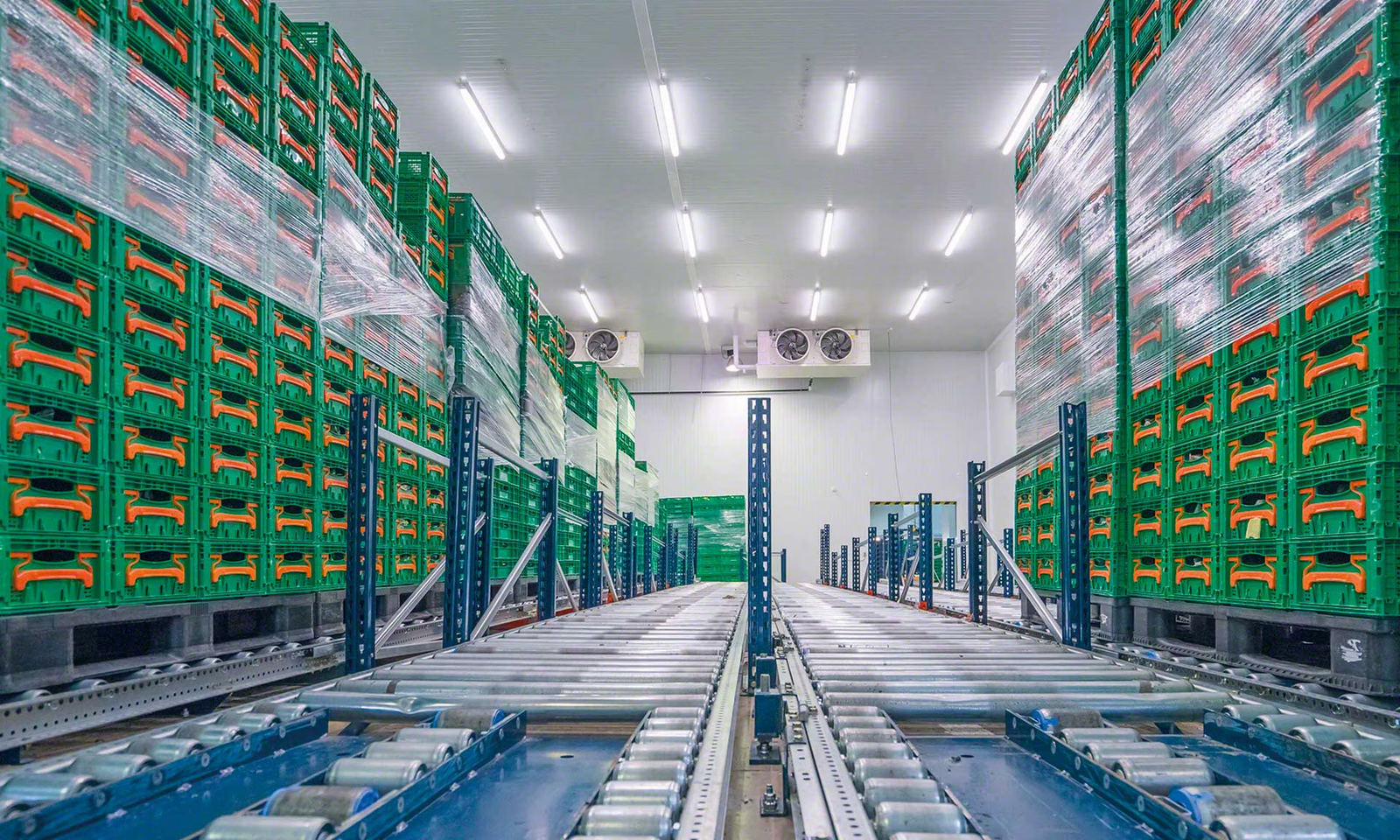
FIFO-required inventory. For food, pharmaceutical, or other inventory requiring strict first-in-first-out rotation, shuttle systems’ rotation capability eliminates the compliance workarounds drive-in’s LIFO limitation would require.
Large-scale installations. At larger project scales, shuttle systems’ fixed costs amortize across more pallet positions, reducing per-position cost and making shuttle more competitive with drive-in on initial investment.
Operations with high rack damage history. Facilities with established patterns of forklift-related rack damage benefit disproportionately from shuttle systems’ reduced forklift-in-rack operation, both through reduced direct damage cost and avoided downtime.
Operations planning long-term facility use. When the facility is expected to operate for 15 to 20 years or more, shuttle systems’ better long-term TCO can outweigh drive-in’s faster initial payback.
Scenario-Based Selection Guide
| Scenario | Recommended Format | Primary Reason |
|---|---|---|
| Bulk beverage distribution with LIFO tolerance | Drive-in | Low cost per position, format fits LIFO |
| Cold storage pharmaceutical distribution | Shuttle | FIFO required, cold space cost premium |
| Seasonal reserve storage, low turnover | Drive-in | Low investment matches short active period |
| High-throughput e-commerce reserve stock | Shuttle | Throughput volume justifies capital premium |
| Small warehouse, budget-constrained | Drive-in | Lower investment fits available capital |
| Large distribution center, long-term lease | Shuttle | TCO advantage over long service life |
| Mixed inventory requiring both LIFO and FIFO | Shuttle or hybrid | Rotation flexibility |
| Frozen food distribution | Shuttle | Cold storage economics + damage reduction |
Hybrid Configurations
Many warehouses find the strongest financial outcomes by combining both formats within a single facility rather than committing exclusively to one. Typical hybrid patterns:
Shuttle for high-throughput reserves, drive-in for seasonal buffer. The shuttle system handles core high-volume inventory where its throughput advantages apply, while drive-in handles seasonal or long-dormant stock where its lower cost suits the use case.
Shuttle for cold storage, drive-in for ambient reserves. Cold storage zones benefit disproportionately from shuttle’s density and reduced in-rack time, while ambient reserve zones can use lower-cost drive-in.
Shuttle for FIFO-required inventory, drive-in for LIFO-tolerant. When some inventory categories require strict rotation and others don’t, zoning by rotation requirement matches format strengths to specific needs.
Hybrid configurations are generally more complex to plan but often deliver better overall financial outcomes than pure drive-in or pure shuttle installations. Related material and construction considerations for both formats are covered in this guide to structural racking.
Expected Operational Improvements from Format-Matched Selection
Operations that select drive-in or shuttle racking based on ROI modeling matched to specific operational characteristics typically see:
- Better capital investment efficiency, since the chosen format matches the operation’s actual throughput, labor cost, and rotation requirements
- Faster effective payback, since format selection accounts for all cost and benefit factors rather than purchase price alone
- Lower total cost of ownership over service life, since operating and maintenance costs are included in the selection analysis
- Reduced rack and inventory damage, when shuttle is selected for operations with established damage history
- Better rotation compliance, when shuttle is selected for FIFO-required inventory rather than retrofitting drive-in with manual workarounds
- Scalable capacity for growth, since selection accounts for throughput capability as well as pallet position count
- More predictable long-term budgeting, since TCO modeling identifies maintenance and replacement cost patterns over service life
Project Considerations Beyond ROI Modeling
Site preparation requirements. Both formats require floor flatness and loading capacity verification. Shuttle systems typically require tighter floor flatness tolerances for rail or wheel operation.
Handling equipment compatibility. Both formats work with standard forklifts, but specific lane dimensions and clearance requirements may constrain equipment choice. Confirm compatibility during specification.
Fire protection impact. Both formats may trigger in-rack sprinkler requirements. Fire protection design should be reviewed early in the project, as it can significantly affect total project cost.
Material grade and construction. Heavy-load applications in either format benefit from structural racking construction over roll-formed alternatives. Material selection should match load profile and operational conditions. Related considerations are discussed in this guide to Q235B vs Q355B racking steel.
Operator training requirements. Drive-in requires forklift operators trained in lane-entry discipline and in-rack operation. Shuttle requires training on shuttle control systems, maintenance protocols, and troubleshooting.
Long-term maintenance capability. Shuttle systems require ongoing technical maintenance that drive-in doesn’t. Operations should confirm maintenance capability — either in-house or through supplier agreements — before committing to shuttle.
Fire code and insurance review. Insurance providers may treat the two formats differently, particularly where in-rack sprinklers are required. Early insurance consultation helps avoid surprises during installation.
Scalability for future growth. Drive-in scales linearly with additional bays. Shuttle scales with additional shuttles plus bays, which can create step changes in cost at specific capacity thresholds.
Frequently Asked Questions
How much more does shuttle racking cost than drive-in racking? Initial investment per pallet position for shuttle systems is typically 1.5 to 2.5 times drive-in equivalents, though the exact ratio depends on configuration, scale, and specific supplier. Total cost of ownership comparisons often tell a different story than purchase price comparisons alone.
What is the typical payback period for shuttle racking’s incremental investment over drive-in? For high-throughput operations with meaningful labor costs, payback for the incremental shuttle investment typically falls in the 3 to 6 year range. For low-throughput operations, payback can extend beyond the system’s useful life, making drive-in the better financial choice.
Does shuttle racking really reduce rack damage significantly? Yes. Since forklifts don’t enter the storage lanes in shuttle operation, the primary cause of rack damage in drive-in racking (forklift contact with uprights) is largely eliminated. Operations transitioning from drive-in to shuttle often report substantial reductions in annual rack repair costs.
Can drive-in racking support FIFO rotation? Drive-in racking by itself supports LIFO rotation only. Drive-through configurations (which require loading access from one side and unloading from the other) can support FIFO, but this requires more floor space than pure drive-in. For FIFO-required inventory with limited floor space, shuttle systems typically offer better economics.
Which format works better for cold storage? Shuttle systems generally deliver better ROI in cold storage because they maximize density (reducing climate-controlled volume per pallet), reduce forklift time in cold aisles (improving operator productivity), and reduce rack damage (reducing cold-condition repair complexity).
How long does each format typically last? Both drive-in and shuttle racking are typically specified for 15 to 20 year service lives, though actual service life depends on load conditions, environment, and maintenance quality. Shuttles themselves typically require periodic maintenance and may be replaced during the structural racking’s service life.
Can I combine both formats in the same warehouse? Yes, and many large warehouses do. Zoning by throughput, rotation requirement, or temperature typically produces better overall economics than committing exclusively to one format. Hybrid configurations require more complex planning but often deliver better TCO.
What throughput level makes shuttle racking worthwhile? There’s no single threshold, but shuttle systems typically become more cost-effective than drive-in when the operation processes enough pallets per shift that the labor time savings from shuttle operation generate meaningful annual cost reductions — often starting around 100 to 200 pallet movements per lane per day, varying by labor cost and configuration.
Key Takeaways
- Drive-in and shuttle pallet racking are both high-density formats, but they differ significantly in investment, operating cost, retrieval speed, and ROI profile
- Drive-in racking typically delivers faster initial payback through lower upfront investment, suiting low-throughput operations, budget-constrained projects, and short-term facility use
- Shuttle pallet racking typically delivers better long-term total cost of ownership for high-throughput operations, cold storage, FIFO-required inventory, and high-labor-cost markets
- ROI modeling should include labor cost, rack damage, operating cost, and throughput value — not just purchase price and density gain
- Hybrid configurations combining both formats often produce better overall economics than exclusive commitment to one format, particularly for larger facilities with mixed inventory profiles
- Scenario-based selection matching format to specific operational characteristics delivers better outcomes than defaulting to either option based on general preference
Conclusion
The drive-in versus shuttle pallet racking decision is fundamentally a financial modeling exercise rather than a technical preference, and operations that approach it as such — modeling capital investment, operating cost, labor savings, damage reduction, and throughput value over the system’s full service life — generally reach decisions that deliver meaningfully better returns than those made on purchase price or density gain alone. Companies such as Lracking are commonly involved in projects where operators are navigating this format comparison, often across hybrid configurations that match drive-in and shuttle racking to different inventory zones within a single facility to maximize overall return on investment. For warehouses evaluating drive-in versus shuttle pallet racking, a structured ROI comparison that accounts for the full cost and benefit picture — not just capital investment — remains the most reliable foundation for selecting the format that will actually deliver the financial return the business invested in.