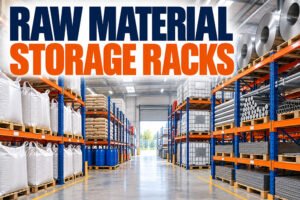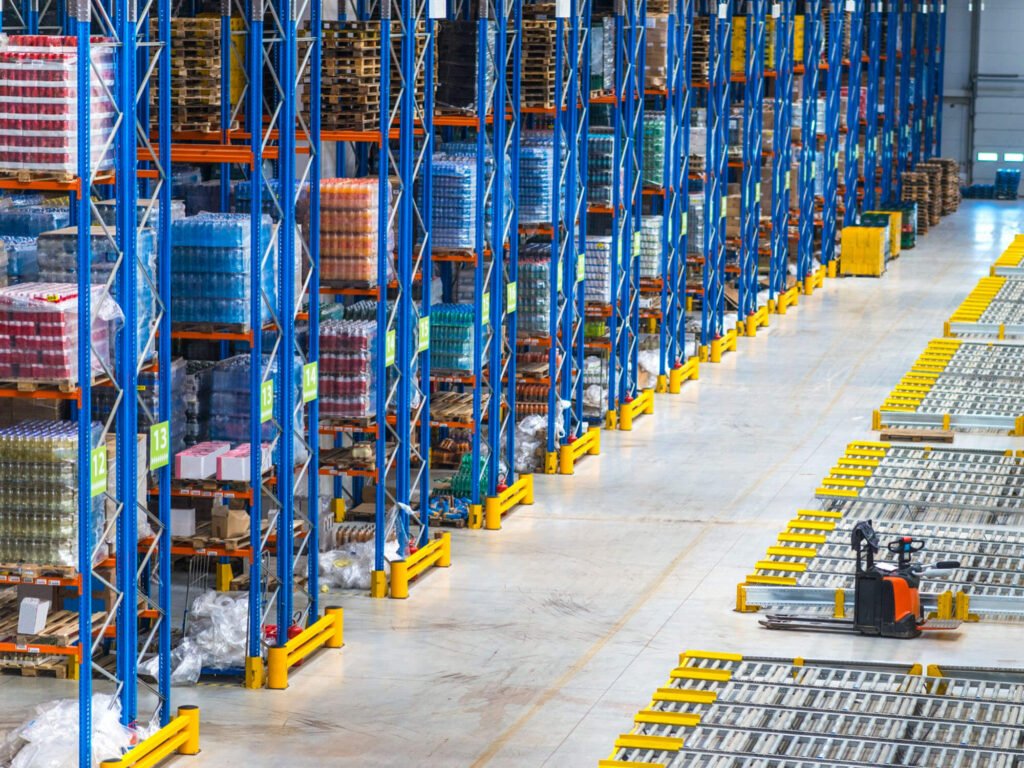
What is a FIFO Racking System?
A FIFO racking system is based on the principles of the First-In, First-Out movement of inventory. You make sure that old stock is out of the way before the new. FIFO is an inventory control method in warehouses. You use it in various rack designs, not a single fixed design. It enhances organization, tracking, and storage flow.
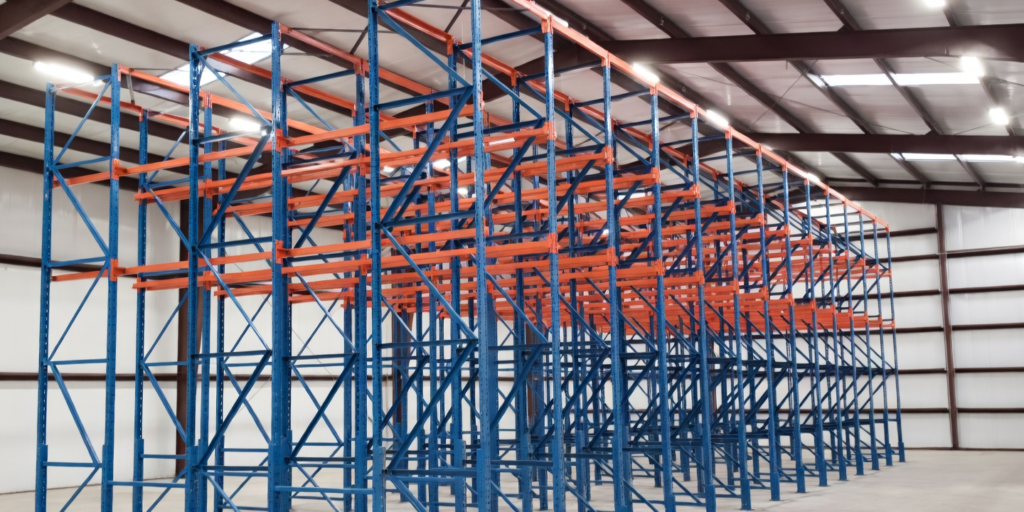
FIFO vs LIFO Storage Method
FIFO (First-In, First-Out) is an efficient way of clearing older stock. You apply it to perishable or fast moving inventory. LIFO (Last-In, First-Out) gives a higher priority to the latest items. You use LIFO when storing non-perishable or bulk commodities. FIFO enhances precision and minimizes waste in the long-run. But it requires orderly tracking systems and discipline. LIFO is easy to manage but can lead to problems of holding obsolete stock. You select method according to the type of products and the turnover requirements.
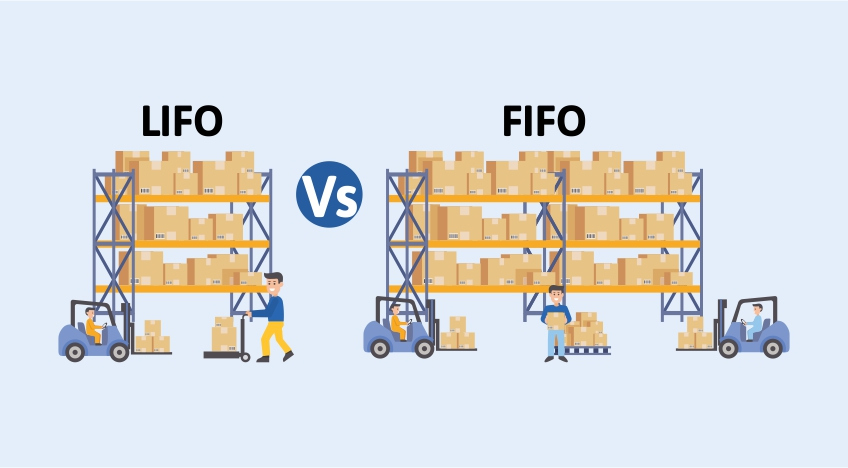
FIFO vs LIFO Storage Comparison
| Feature | FIFO | LIFO |
| Inventory Rotation | First in, first out | Last in, first out |
| Best For | Perishable goods | Non-perishable goods |
| Inventory Visibility | High | Lower |
| Risk of Expiration | Very Low | Higher |
| Storage Density | Moderate to High | Very High |
| Operational Complexity | Medium | Low |
| Typical Industries | Food, Pharma, FMCG | Construction, Manufacturing |
Key Components of FIFO Racking Systems
- Upright Frames
- Rollers
- Rails
- Pallet Supports
- Safety Stops
- Brake Rollers
- Guide Rails
- End Stops
How FIFO Racking Systems Work
Basic Working Principle
FIFO racking is used to make sure that goods come in on one side and out on the other. You have a rigid rotation, such that the oldest stock goes first. Smooth flow is facilitated by gravity, automation, or manual systems. This will minimize spoilage, enhance preciseness, and maintain inventory in a regular order throughout your warehouse activities.
Loading Process
You unload goods at the assigned access points through organized processes. Inventory is easily tracked with the help of batch labeling and date coding. You enhance performance by matching loading methods with rack types. This procedure guarantees ease of movement and lessens errors when handling high volumes in the warehouse.
Storage Flow Mechanism
Storage flow is achieved by gravity, conveyors, shuttles or manual arrangement systems. You steer pallets along controlled routes in a continuous flow. Gravity systems are based on inclined rollers. Automated solutions are faster, and even manual configurations provide the correct FIFO rotation and overall balanced warehouse efficiency.
Picking and Retrieval Process
You take the first pallet and others move automatically. This system enhances the efficiency of picking and also the forklift travel time is minimized. You simplify the processes according to FIFO order. You provide the correct dispatch, accelerated fulfillment and enhanced management of the daily productivity performance of the warehouse.
Monitoring and Management
With Warehouse Management Software and barcodes, you operate FIFO systems. The RFID technology facilitates tracking the inventory in real-time. Integration of automation increases visibility and control. You keep proper stock records, minimize mistakes and ensure that there is a smooth flow of all the operations in the warehouse.
Types of FIFO Racking Systems
Gravity Flow Racking System
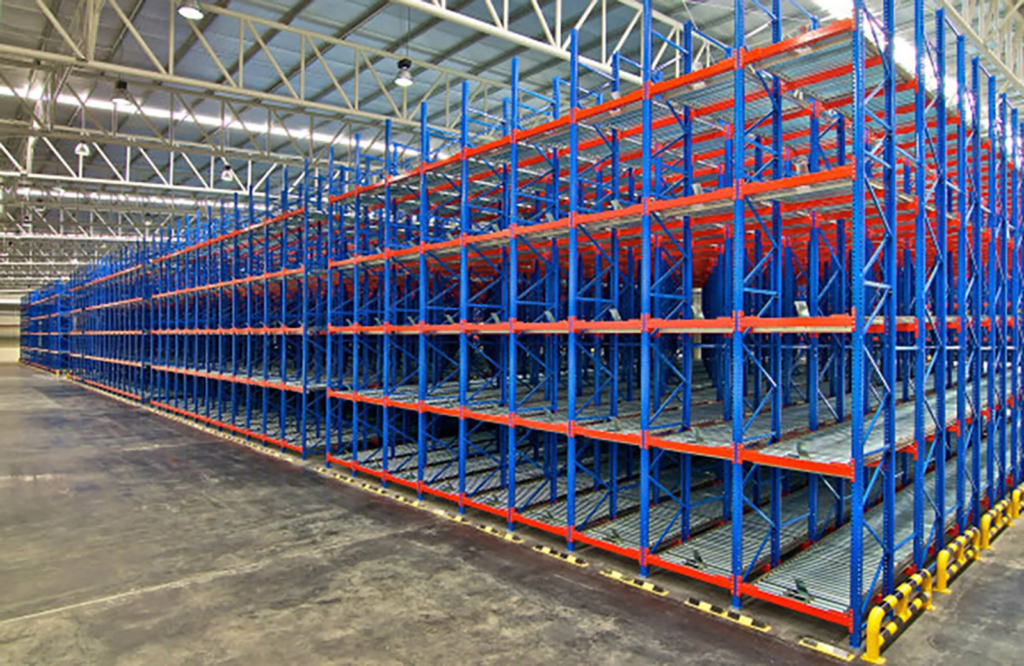
Gravity flow racking system refers to a storage system that is a FIFO system which utilizes inclined rollers. It allows automatic transfer of goods between loading zones and picking zones. This system enables large volume inventory turnover and little manual handling. It enhances efficiency as it keeps the products moving and orders fulfilled faster.
Pros
- Enables automatic stock rotation reducing manual handling and errors
- Enhances picking speed by constantly moving products using gravity.
- Reduces labor needs since there is less manual stock repositioning.
- Helps to maintain high throughput processes with steady and dependable flow.
- Increases the efficiency of the warehouse by dividing the loading and picking areas.
Cons
- It is more expensive to start up since it involves rollers and system components.
- Requires uniform quality of pallets to facilitate movement of products.
- Once systems are installed, it is hard to make changes to layout.
Pallet Flow Racking System
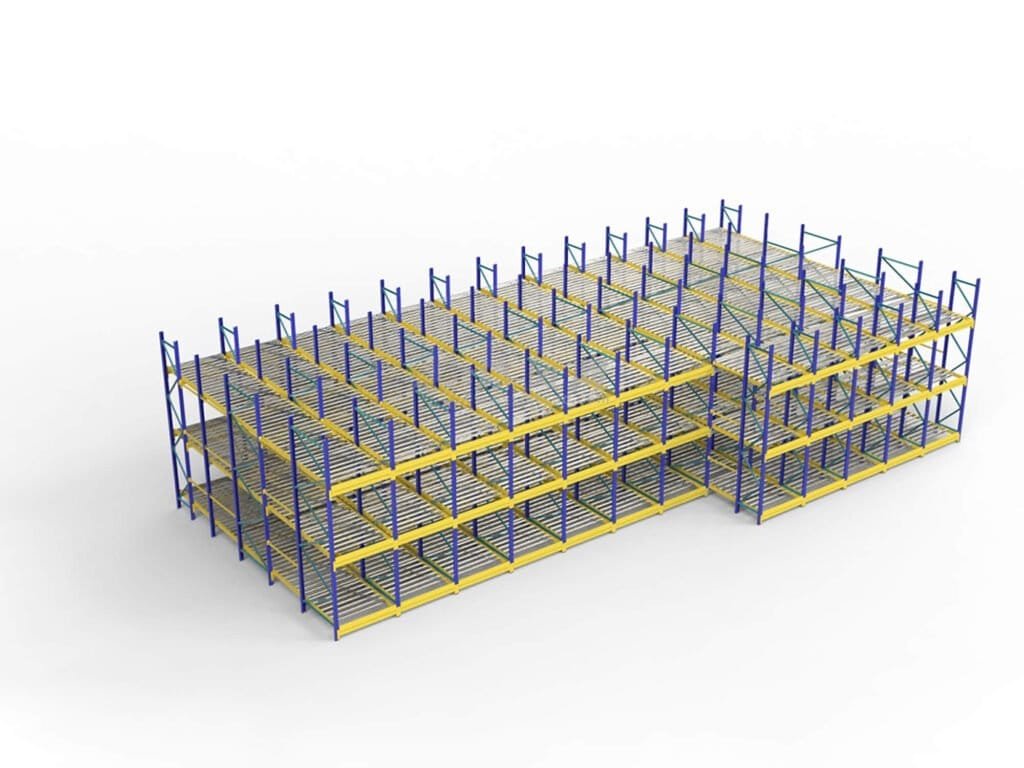
Pallet flow racking system is a heavy duty FIFO storage system. It works with inclined rollers that automatically push pallets through storage lanes. This system facilitates deep storage of lanes and the maximum use of the space in the warehouse. It provides effective inventory turnover of high volume uniform palletized products.
Pros
- Optimizes storage space through deep lane pallet storage.
- Minimizes forklift movements that enhance the overall efficiency of operations.
- Strict FIFO rotation of time sensitive palletized goods.
- High throughput in warehouse environments that require a lot of volume is supported.
- Enhances safety by reducing the movement of forklifts within the storage lanes.
Cons
- High cost of installation, rollers and complexity of structural system.
- Needs consistent pallets to move around and be efficient.
- Lack of flexibility in storing mixed SKUs in the same lane.
Carton Flow Racking System
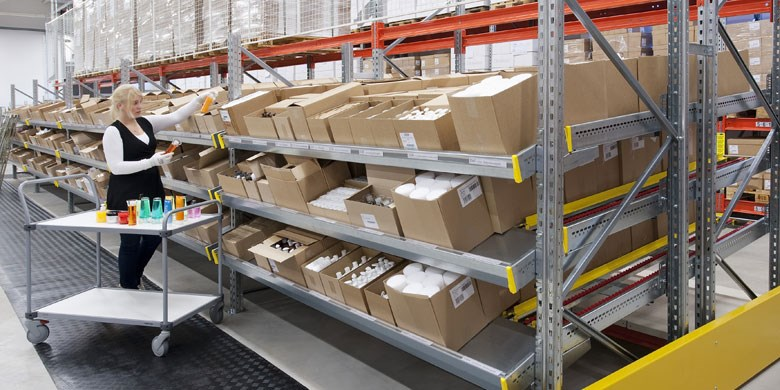
Carton flow racking system is used in storing goods that are small to medium. It uses inclined rollers to enable smooth movement of cartons for picking. It is a system that helps in the efficient picking and picking of pieces in warehouses. It is extensively employed in distribution centers that deal with lightweight products that move rapidly.
Pros
- Increases the speed of order picking of carton and piece picking.
- Improves inventory visibility with organized and structured storage lanes
- Minimizes labor input by use of gravity assisted product movement systems.
- Favors high turnover conditions where there is constant flow of stock.
- Maximizes space use in picking and distribution centers.
Cons
- Not suitable for heavy or oversized products due limitations
- Needs frequent roller repairs to prevent rough functioning.
- The upfront costs may be more than the stationary shelving systems.
Drive-Through Racking System (FIFO Setup)
Drive-through racking system is a high density FIFO storage system. It enables the forklifts to access racks to load and offload pallets. This system uses rails instead of rollers to support pallet storage operations. It can be used to store high contents of a similar product.

Pros
- Provides high storage density by reducing need for multiple aisles
- Cost effective compared to automated or gravity based FIFO systems
- Applicable to bulk storage of high volume products that are similar.
- Optimizes the use of warehouse space through small storage lanes.
- Supports effective loading and unloading on the opposite sides of the system.
Cons
- Needs qualified forklift operators to prevent the risks of breaking racks.
- Limited SKU flexibility as lanes store similar products only
- More risk of damage of products during manual handling procedures.
Selective Pallet Racking (FIFO Strategy).
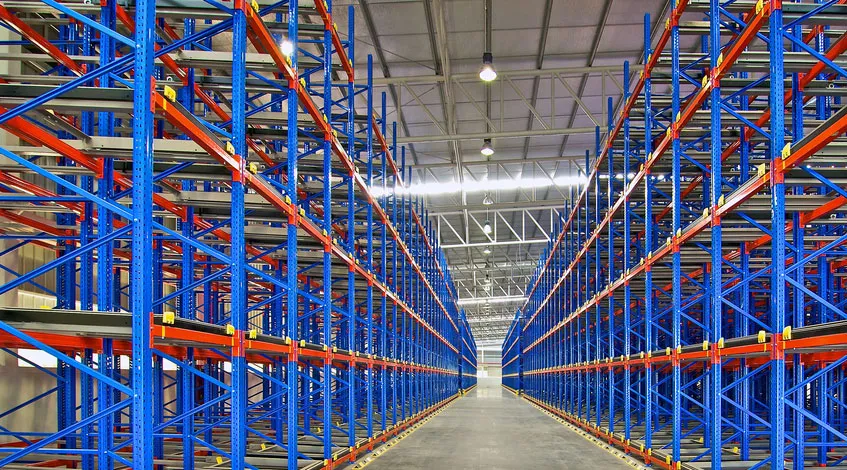
Selective pallet racking is a versatile system that promotes FIFO by maintaining the order of inventory. It offers direct access to all pallets that are stored in the racking system. Such a system is best suited in a warehouse where there are a variety of SKUs with different turnover. It is flexible and efficient in various storage and retrieval operational requirements.
Pros
- Gives direct access to all pallets enhancing flexibility in picking.
- Helps in FIFO management by labeling and rotation of stocks.
- Very flexible to warehouses with a variety of SKUs at once.
- Fits easily to be adjusted and expanded as required.
- Reduced initial expenditure than automated FIFO racking systems.
Cons
- Consumes additional aisle space lowering the overall storage density efficiency.
- FIFO relies on operational discipline as opposed to automation of the system.
- Not well suited to large density storage or large quantity inventory.
Pallet Runner System / Pallet Shuttle.
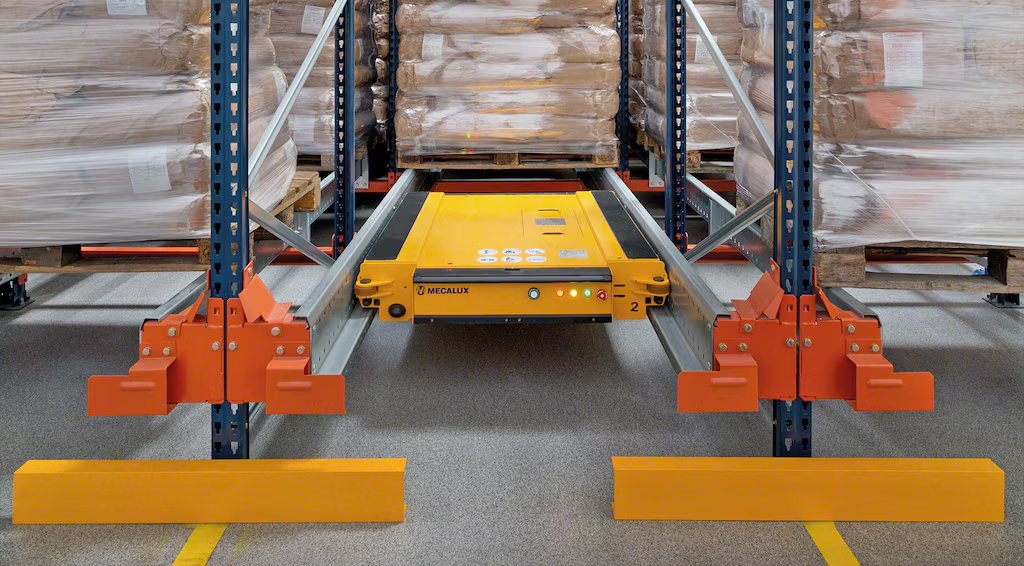
A semi automated FIFO warehouse racking solution is called the pallet shuttle racking system. It operates a remote controlled shuttle to push pallets in storage lanes. This system is efficient as it minimizes the amount of time wasted in handling and traveling of forklifts. It facilitates high-density storage and effective and precise inventory management.
Pros
- Minimizes labor dependency by semi automated pallet movement system.
- Enhances storage density through reducing the use of forklifts.
- Improves precision in the pallet handling and inventory positioning processes.
- Enhances operational efficiency through quicker loading and offloading.
- Flexible system design and control FIFO configuration.
Cons
- Better start-up cost because of shuttle equipment and technology.
- Shuttle devices need to be maintained to ensure continuous reliable operation.
- Operators should be trained on how to manage system controls and functions.
| Feature / Criteria | Gravity Flow Racking | Pallet Flow Racking | Carton Flow Racking | Drive-Through Racking | Selective Pallet Racking | Pallet Shuttle System |
| System Type | Gravity-based FIFO | Heavy-duty gravity FIFO | Light-duty gravity FIFO | Static FIFO (manual) | Static with FIFO strategy | Semi-automated FIFO |
| Load Type | Pallets / cartons | Pallets (heavy loads) | Cartons / small items | Pallets | Pallets | Pallets |
| Automation Level | Low–Medium | Medium | Low–Medium | Low | Low | High (semi-automated) |
| Storage Density | Medium | High | Medium | High | Low | Very High |
| Selectivity | Medium | Low | Medium | Low | Very High | Medium |
| FIFO Accuracy | High | Very High | High | Moderate | Depends on process | Very High |
| Space Utilization | Efficient | Highly optimized | Efficient picking space | Maximum density | Less efficient | Maximum optimization |
| Forklift Usage | Limited | Minimal inside lanes | Not required | Required inside system | Required | Limited |
| Installation Cost | Medium–High | High | Medium | Low–Medium | Low | High |
| Maintenance Requirement | Moderate (rollers) | Moderate–High | Moderate | Low | Low | High (equipment) |
Advantages of FIFO Racking Systems
Improved Inventory Rotation
You enhance inventory turnover to avoid expiration and fresh flow daily operations. FIFO will assist you in ensuring a steady flow of stock in the warehouse operations in an efficient manner.
Increased Warehouse Efficiency
When you cut down the time spent on travelling and minimise picking routes, warehouse efficiency is enhanced. FIFO racking enables quicker accessibility and easier operations in the busy warehouse settings on a daily basis.
Better Inventory Management
Inventory management can also help you to monitor your stock better, and minimize your errors. FIFO systems enhance visibility and facilitate easy tracking of inventory by your team every day.
Reduced Product Waste
Less wastage of products when you handle perishable items with FIFO system. It reduces wastage and helps in using goods before they expire and their expiration dates are effectively managed.
Improved Space Utilization
Better use of space will enable you to fit more goods within small spaces. The storage systems are high density and are very efficient in maximizing the capacity of the warehouse as well as minimizing the amount of wasted space.
Cost Savings
Cost savings are realized when you save on operating costs and enhance efficiency in general. FIFO systems reduce the labor requirements and reduce unnecessary handling expenses to your warehouse.
Improved Safety
Organized storage and designed warehouse layout design systems enable improved safety. Less congestion of forklifts will assist you to prevent accidents and enhance workflow tremendously each day.
Better Compliance
Higher compliance levels mean that you will be in line with the regulation levels in industries that are sensitive and are always needed. FIFO systems uphold food and pharma regulations of safe storage practices in an efficient manner.
Disadvantages of FIFO Racking Systems
- Increased Preliminary Investment: FIFO racking systems have high start-up costs in terms of equipment and installation. Before adoption, you need to plan budgets. This will put smaller warehouse operations under pressure in terms of finances in the first place.
- Space Requirements: FIFO systems require loading and picking aisles that are separate to allow smooth flow. You need to increase the size of the warehouse. This minimizes the storage density of small facilities.
- Poor Product Compatibility: These systems can only be used with standardized goods and homogeneous pallets. You might have problems with irregular forms. Non-standard items decrease the efficiency and overall system effectiveness.
- System Dependency: FIFO racking is very dependent on mechanical structures and automation support systems. You rely on technology to ensure smooth operations. Failures have the ability to interrupt work and inventory flow within a short period of time.
- Less Flexibility: FIFO layouts cannot be changed easily after they have been put in place in warehouses. You have constraints when switching storage requirements. This limits flexibility in changing inventory with time.
- Maintenance Requirements: Roller tracks and mechanical components need periodic inspection and maintenance procedures. You should make sure of regular maintenance. Lack of attention may lead to failures and inefficiency in the performance of the system.
When Should You Use FIFO Racking Systems?
- High Turnover Inventory: You use FIFO racking systems for high turnover inventory environments. Highly moving commodities must have constant control of stock movement. You enhance productivity and minimize product wastage.
- Perishable Goods: FIFO racking systems enable you to store perishable food and pharmaceutical products in a safe way.
- Perishable Products: FIFO racking systems help you manage perishable food and pharmaceutical items safely. You maintain freshness by dispatching and use handling first-old stock first.
- Expiration Date Management: You use FIFO racking to manage the use of expiration dates in the storage.
- Expiration Date Management: You apply FIFO racking to control expiration dates effectively in storage. Elderly batches are the ones, which are pushed out earlier before new stock comes in. This minimizes wastage and compliance risks.
- Environments in manufacturing: FIFO racking assists the manufacturing production staging and the organization of workflow.
- Manufacturing Environments: FIFO racking supports manufacturing production staging and workflow organization process. You optimize the flow of parts among assembly and storage points. This enhances accuracy and speed of production.
- Cold Storage Facilities: FIFO racking is effective in cold storage and freezer facilities settings.
- Cold Storage Facilities: FIFO racking works efficiently in cold storage and freezer environments settings. You preserve product integrity at temperature controlled conditions. This provides safety and standards of compliance.
- Retail and Distribution Centers: FIFO racking can be of significant benefit to the operations of the retail and distribution centers management.
- Retail & Distribution Centers: FIFO racking benefits retail and distribution center operations significantly management. You have stable product supply to customers on daily basis. This decreases stockouts and enhances the level of satisfaction.
Industries That Use FIFO Racking Systems
- Food and beverage industry
- Pharmaceutical industry
- FMCG warehouses
- Cold storage facilities
- Manufacturing plants
- Retail distribution centers
- Automotive industry
- Chemical industry
- E-commerce warehouses
FIFO Racking System Design Considerations
- Warehouse Space: You evaluate available warehouse space before designing FIFO racking layout effectively planned. Space planning assists you to optimize storage efficiency in general in a safe manner. The space is limited, and racking design has to be flexible to flow smoothly.
- Ceiling Height: Ceiling height determines vertical expansion potential of your FIFO racking system design. The increased ceilings enable you to install multiple-level storage racks safely and effectively. Low ceilings will limit the height of racks and efficiency.
- Product Weight: Product weight influences rack strength and structural design requirements significantly you apply. The heavy loads demand more powerful materials and planning of the loads distribution. More flexible and dense stacking is facilitated by light products.
- Pallet Type: Pallet type affects compatibility with FIFO racking system design choices significantly overall. The use of standardized pallets enhances the flow and cut operation handling problems significantly. Non standard pallets may cause alignment safety problems.
- Throughput Requirements: Throughput requirements define how fast you move goods through FIFO system operations. The layout and the flow of the material should be efficient in order to support the high throughput. The low throughput enables the uncomplicated and small racking designs.
- SKU Quantity: SKU quantity impacts complexity and organization of FIFO racking systems significantly planning. An increased number of SKUs demand improved labeling and organized inventory placement systems. Reduced SKUs make racking easier and quicker.
- Budget Constraints: Budget constraints influence material selection and system complexity in design you make. Lower budgets may limit automation and high capacity racking options. Cost effective and scalable solutions will be achieved through proper planning.
- Safety Requirements: Safety requirements ensure stable operations and prevent accidents in warehouses design phase. Correct guardrails and weight restrictions increase the general safety levels of workers. Periodic checks ensure safe and reliable performance of racking.
Planning for Pallet Rack Installation – Step-by-Step
Step 1: Assessing Your Space
Calculate total floor space and usable warehouse space. Assess the ceiling height on vertical storage plan. Locate objects such as pillars, walls, overhead beams, utilities. Examine workflow with an aim of enhancing the efficiency of the movement of material. Floor load capacity should be full of structural safety requirements.
Step 2: Determining Your Storage Needs
Determine the type of goods e.g. palletized or cartons. Consider product dimensions, size, weight requirements. Calculate load capacity of your racking system. Decide inventory flow method like FIFO or LIFO. Planning aisles required to plan smooth warehouse operations.
Step 3: Selecting the Appropriate Pallet Rack
Select appropriate type of pallet rack. Match rack design and warehouse dimensions and height. Make sure that it is compatible with forklifts and handling equipment. Test accessibility and selectivity in the day-to-day operations. Scalability of plans in future growth and cost effectiveness.
Pre-Installation Preparation Steps
Step 4: Site Preparation
Clean up area of debris and obstructions. Maintain a level and sound floor surface. Check floor load-bearing capacity of racking weight. Reinforce flooring if required for added safety. Mark installation areas to facilitate well-organized setup process.
Step 5: Safety Procedures
Adhere to OSHA and local safety requirements. Make sure that all employees are trained in safety procedures of installation. Wear proper personal protective gears during installation. Wear hard hats, safety glasses and steel-toed boots. Before installation process, obtain permits and engineer approval.
Pallet Rack Installation Process
Step 6: Laying Out the Racking System
Lay out position of the marks on the floor with the layout plan. Always make sure that there is adequate spacing between aisles to allow free movement of forklifts. Maintain clear emergency exits and safety pathways across site. Check layout correctness to ensure efficient workflow and safety. Follow installation plan.
Step 7: Assembling Upright Frames
Make sturdy upright frames, braced together and fasten footplates firmly. Make sure that everything is fitted. Check vertical to ensure high structural stability. Position frames correctly before proceeding to next stage carefully. Make safety checks prior to beam installation.
Step 8: Installing the Beams
Fix horizontal beams on upright frames. Make sure that beams are straight and in place. modify the beam spacing according to pallet size requirements. Choose proper beam gauge and stage components. Mark starter bays precisely to install with precision. Maintain safe workflow.
Step 9: Completing the Installation
Inspect all connections and fasteners thoroughly. Make sure that complete rack structure is stable. Check racks are not tilted. Close any loose fittings prior to approval. Perform last safety inspections prior to use. Always ensure that safety standards in the warehouse are met.
Lracking – State of the Art Solutions for FIFO Racking Systems
Lracking provides state-of-the-art FIFO racking solutions with 16 years of worldwide experience. The company produces pallet racks, mezzanine floors, 4-way shuttle racks and ASRS systems. Quality, safety and international compliance standards are guaranteed by ISO and CE certifications. Customized layouts maximize warehouse space, improving throughput efficiency up to 40% typically. Clients get correct quotes, quick manufacturing as well as dependable worldwide delivery within deadlines. Lracking serves 70+ countries, with Fortune 500 automotive manufacturers’ operations in the world today.
Conclusion
FIFO racking systems enhance efficiency, accuracy and control of inventory in the warehouse. They also make sure that old stock is utilized first, minimizing waste and risk of expiration. You enjoy increased space usage, quick picking, and a well-structured storage movement. Nevertheless, the right choice of systems and a disciplined operation is a key to success in any facility setting.
To achieve high-quality and reliable FIFO pallet racking solutions, IRacking provides advanced systems that would fit in a modern warehouse. Lracking has 16 years of experience worldwide and offers durable and customized racking solutions which are automation-ready. Lracking can be relied upon to provide efficient layouts, enhanced throughput and long-term performance of the warehouse across various industries across the world.