The selection of the wrong racking system is the biggest cost drain in your warehouse system. From wasted floor space to slow pick rates, stockouts and high labour costs can be traced back to one bad infrastructure decision. Both carton flow racking and pallet flow racking are gravity-fed, automatically move inventory forward and are FIFO without manual intervention. They do, however, have very different operational profiles, load types and throughput requirements. This article will dissect their mechanics, capabilities, pricing, and integration with automation systems, providing buyers with a comprehensive, data-driven guide to making an informed decision.
What is Carton Flow Racking?
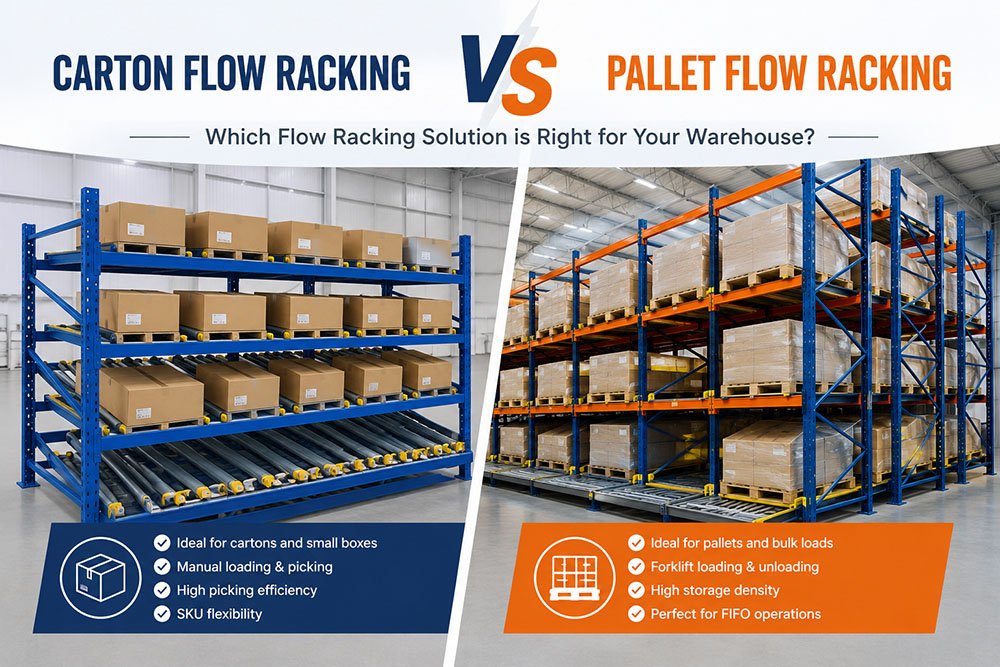
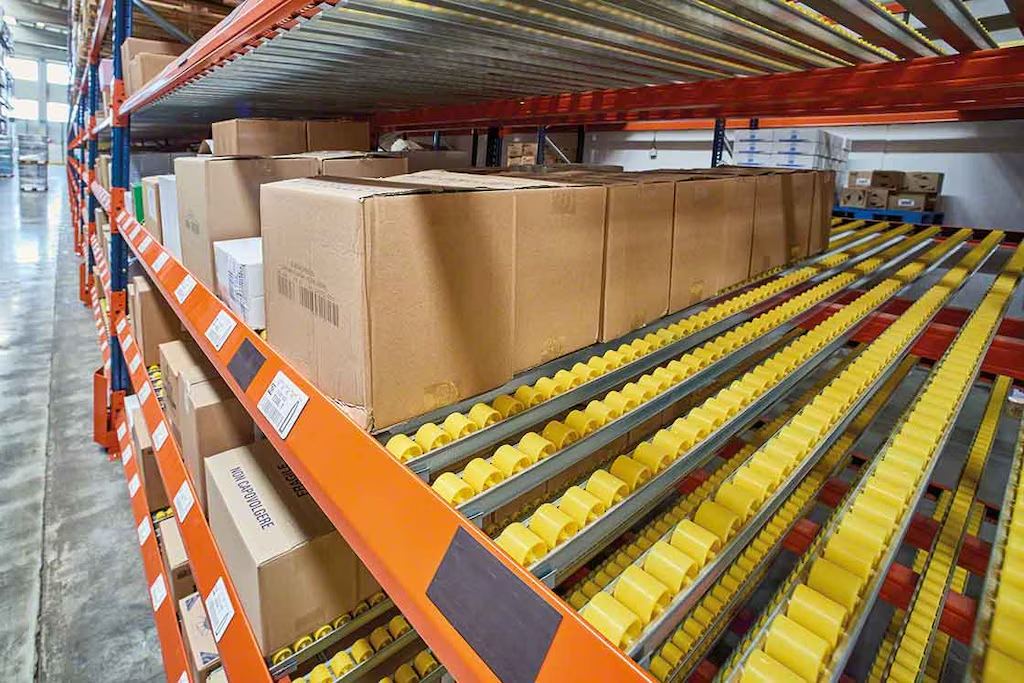
Carton flow racking makes use of inclined roller tracks or wheel lanes to automatically transport inventory to the pickers. Cartons and totes are automatically pushed by gravity from load side to the front pick face. Adjustable lane dividers are suitable for different carton sizes within a single racking bay. The system places each pick at the workers waist level, minimizing worker strain and maximizing throughput uniformity.
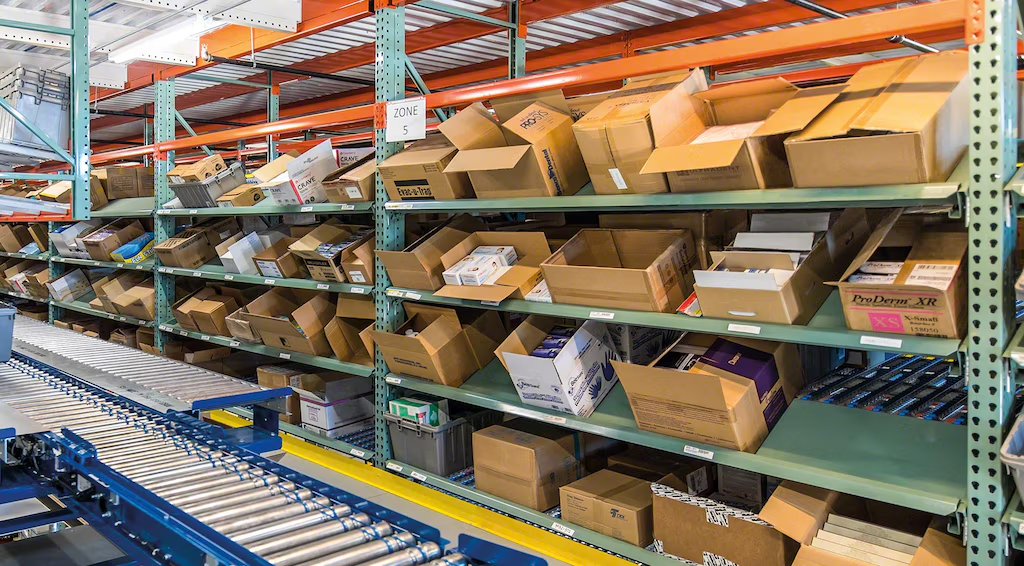
Rack Carton Flow – Primary Industry Applications
There are five key industries where carton flow racking makes a difference to revenue through speed, accuracy and rotation.
- Fast picking is a requirement of ecommerce fulfillment centers, which deal with high-SKU inventory such as apparel, consumer goods and accessories.
- Retail distribution warehouses efficiently replenish fast-moving FMCG goods, like packaged foods and beverages.
- Pharmaceutical plants adhere to the FIFO principle when it comes to medicine and medical supplies.
- Electronics distributors minimize mispick of fragile items and boxed devices.
- High-density SKUs such as automotive filters and mechanical parts are organized in the spare parts warehouses.
Key Business Benefits – Storeroom Carton Flow Racking
- Per-Pick Rates: Faster per-pick rates with goods directly delivered to the operators, allowing 200 – 1,000 lines per hour.
- Reduced Labor & Travel Time: Goods-to-person systems mean reduced labour and travel time – no walking and no manual searching.
- Automatic FIFO Control: Forced Inventory Rotation without manual handling.
- Real-Time Inventory Visibility: WMS integration enables real-time inventory visibility and organization of SKU.
- Ergonomic Operation: Waist height picking decreases strain, injuries and labour costs.
What is Pallet Flow Racking System?
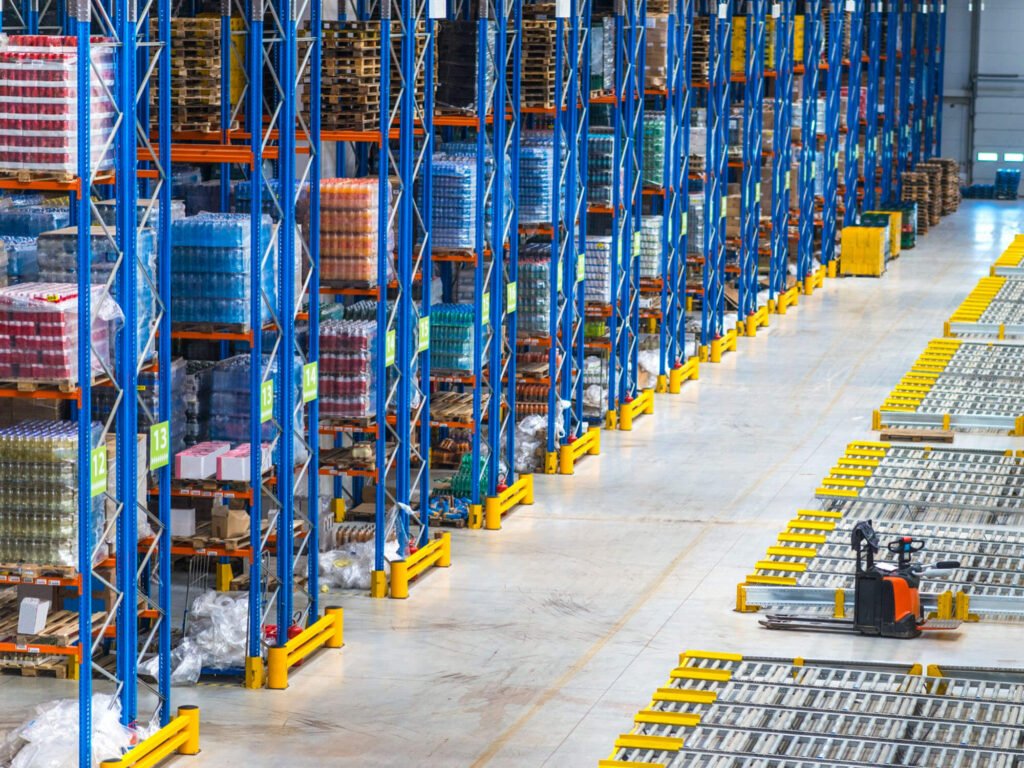
Pallet flow racking employs heavy duty, steel rollers or wheel tracks on inclined lanes. The full pallets are automatically pushed forward from loading end to pick face by gravity. Forklifts load the pallets from the back and pick them up from the other front end. The inclined design keeps product continuously advancing without any mechanical assistance. These systems can be programmed for FIFO/LIFO inventory rotation per your needs.
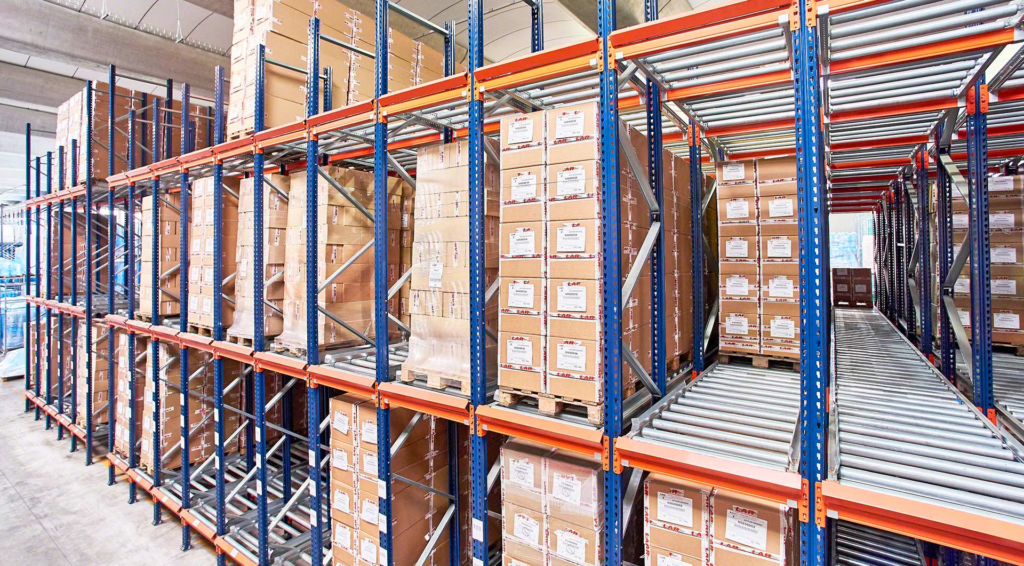
Pallet Flow System – Primary Industry Applications
- Pallet flow racking is employed in food & beverage warehouses for the strict FIFO rotation of perishables such as dairy, beverages and packaged meats.
- It is the backbone of cold storage facilities for the effective management of frozen foods and refrigerated goods.
- Automotive and manufacturing plants take care of heavy parts with constant replenishment of pallets.
- It is used for large quantities of packaged, canned and bottled products in bulk retail and distribution centres.
Key Business Benefits
- High-Density Storage: Removes the need for additional aisles, providing more storage in the same square footage with increased rack positions.
- Reduced Forklift Congestion: Boosts safety and workflow efficiency by reducing congestion and waiting times at pick zones.
- Durable Steel Construction: Heavy duty frames provide long-lasting strength and stability with low maintenance, even with continuous load cycles.
- FIFO Compliance: Product rotation is automated, minimizing product aging, spoilage and inventory obsolescence.
- Cost Per Pallet is Low: More efficient use of warehouse space means less waste, and lower costs per pallet.
Carton Racks vs Pallet Flow Racking: The Core Differences
1. Unit of Handling
Carton Flow Racking
As the fundamental unit of operation, Carton Flow Racking moves individual cartons, totes or bins. Hand picking from the rack face is done by operators. There is no decanting or secondary handling activity that slows the flow. This architecture is applicable to mixed-SKU orders received in individual cases every day.
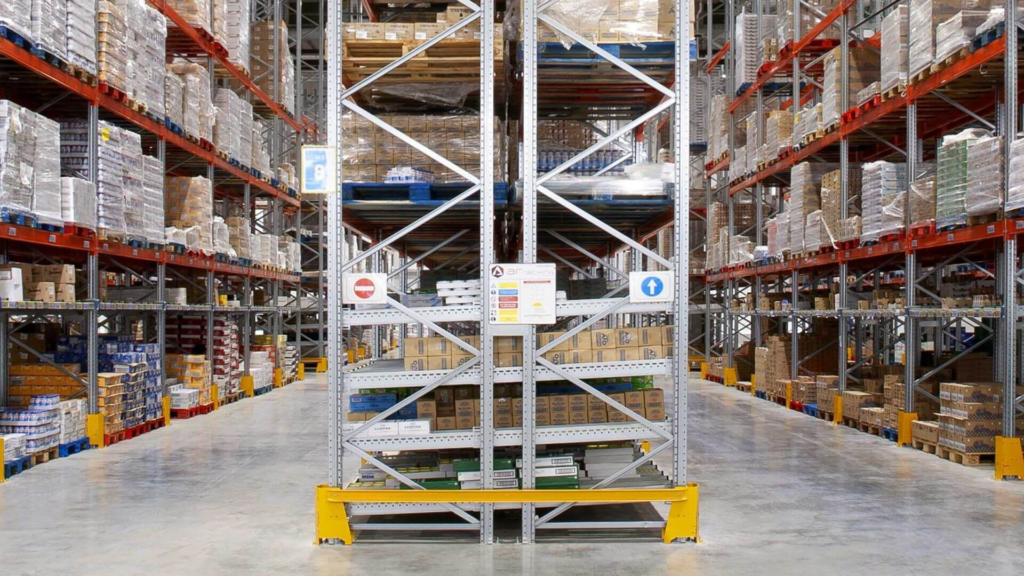
Pallet Flow Racking
Pallet Flow Racking considers the entire pallet as a single load unit for all operations. Forklifts are necessary at each and every load and unload phase. Here it is impractical to pick individual cases directly from the rack face. Relocate whole pallets to staging areas prior to any case-level activity downstream.
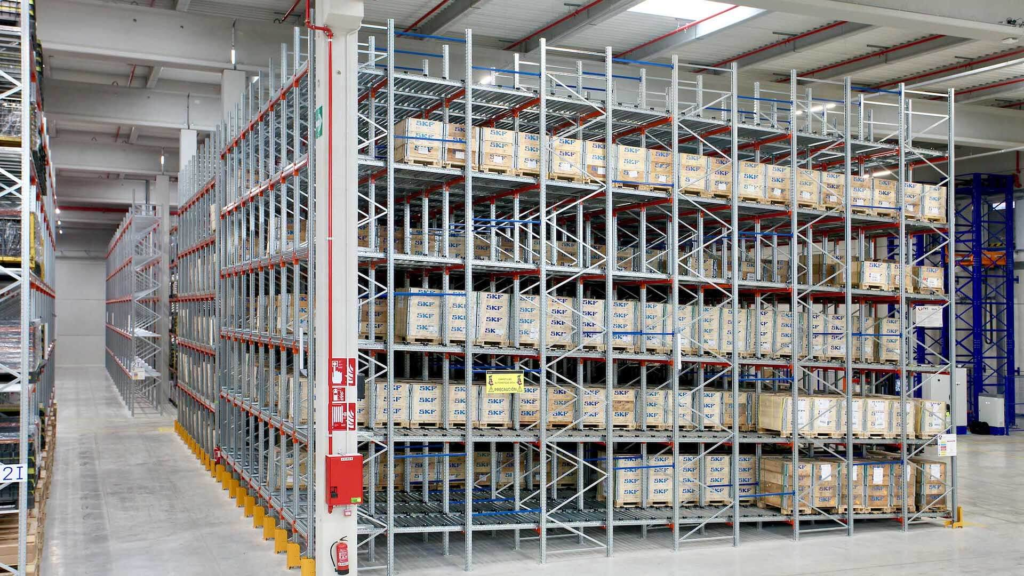
2. Weight Capacity
Carton Flow Racks
Carton Flow Racking lanes are only rated for 50 to 200 lbs per lane. Boxed goods, pharmaceuticals and common FMCG cartons are easily handled with nylon or polymer rollers. Lanes that are overloaded lead to roller failure, jamming and over time frame deformation. The most prevalent post-installation performance issue operators experience is weight variations due to fluctuating SKU profiles.
Pallet Flow Racking
Pallet Flow Racking lanes are designed to handle 2,000 – 5,000 pounds per lane on a consistent basis. Safe control of loaded pallet momentum with heavy duty steel frames and purpose built braking systems. The maximum capacity for each lane is 4-5 full pallets in series at rated capacity. The most common structural safety issue in these systems is still uneven weight distribution of the pallets.
3. Inventory Control
Carton Flow Racking
Nearly all Carton Flow Racking systems are physically designed FIFO. All the oldest cartons are automatically moved forward with each replenishment cycle due to gravity. Maintains correct product rotation without the need for operator action or WMS prompt. This makes it the standard architecture for pharmaceutical and food inventory and expiry sensitive environments.
Pallet Flow Racking
Pallet Flow Racking is gravity driven, a rear load, front pick system and is a natural FIFO system. With a standard lane configuration, older pallets always arrive at the pick face first. Lanes can be configured for LIFO in operations where rotation is not time critical. This versatility applies to the overall bulk storage conditions where pallet flow is used.
4. Space Utilization
Carton Flow Racking
Carton Flow Racking optimizes the number of different SKUs that can be accessed in a particular space. Space efficiency gains are achieved by vertical SKU stacking and by increasing bay density via the lanes. Complete length pedestrian access aisles are still needed along the whole pick face for human pickers. The problem it addresses is the lack of space for a variety of SKUs in organized, accessible pick locations.
Pallet Flow Racking
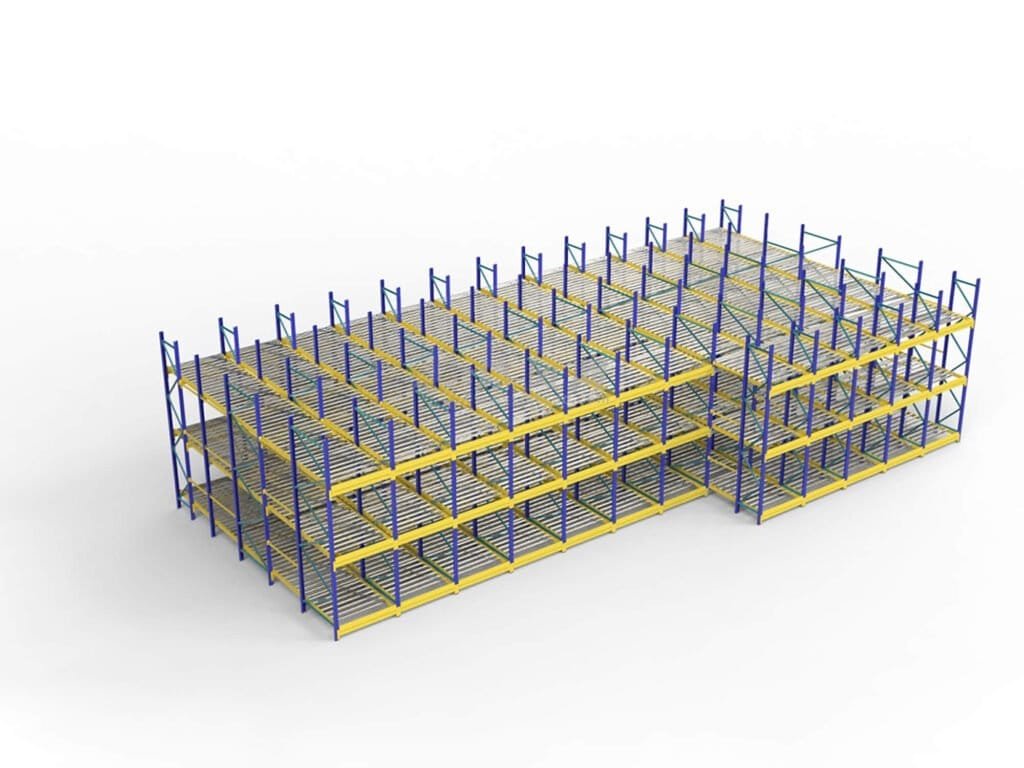
Pallet Flow Racking provides deep sequential lanes to increase the amount of pallets stored per square foot. A correct system has two to four times the capacity of selective racking for pallet positions. Space efficiency is not achieved by organizing individual product variety, it is achieved by eliminating the aisle. By stacking more pallets per lane, taller facilities compound this density benefit to a great degree.
5. Equipment and Labor
Carton Flow Racking
Carton Flow Racking is a system designed for human use and does not need powered equipment for normal daily use. Pickers hand-pick cartons and replenishment workers load lanes from the back. It can easily be combined with technologies such as pick-to-light, voice direction and robotic arm picking. Forklift downtime windows have no impact on carton flow operations at any time.
Pallet Flow Racking
Pallet Flow Racking is 100% forklift dependent in all aspects of operation. Forklifts are required to load rear lanes as well as clear spent pallets from the pick face. For facilities that do not already have a forklift fleet there is a substantial added equipment capital cost. The requirements for aisle width for forklift operation should be considered during the initial design.
6. Complexity and Scalability of installation
Carton Flow Racking
Carton Flow Racking is modular in nature, which means that lanes and bays can be added easily. Most common augmentations are performed with ease by regular warehouse staff with simple assembly instruction. No structural redesign is necessary with seasonal reconfiguration, SKU profile changes, layout changes. This flexibility is suitable for operations that require a lot of product changeovers and footprints.
Pallet Flow Racking
When installing Pallet Flow Racking, the incline angles, braking and anchoring of frames must be carefully engineered. Pallets move too quickly or do not move consistently, due to incorrect setup. Formal site assessment (ceiling height and floor load capacity) is required for each expansion. This type of permanence provides consistent performance in stable, high-volume palletized operations.
7. Green Taxonomy
Carton Flow Racking
The upfront investment is moderate, and the payback period is typically 1-3 years with Carton Flow Racking. Per-bay costs are relatively low due to lighter materials used, simpler construction, and installation. Roller maintenance is low cost and lane reconfiguration is low cost when compared to the life of the system. ROI is largely dependent on the labor savings, picking speed gains and inventory accuracy gains.
Pallet Flow Racking
Pallet Flow Racking requires more of an investment because of the precision braking systems and the structural steel. Payback usually ranges from 2-4 years based on the density of utilization and volume of operation. The cost per pallet position over a period of 15-20 years is extremely competitive in comparison to selective racking. The total investment in the system can be justified in 3 years or less for avoided real estate expansion costs alone.
| Feature | Carton Flow Racking | Pallet Flow Racking |
| Load Type | Individual cartons, totes, bins | Full pallets |
| Weight Capacity per Lane | 50–200 lbs | 2,000–5,000 lbs |
| Lane Depth | 3–8 ft | 8–20 ft |
| Incline Angle | 1–3° | 1–3° |
| Roller/Track Material | Nylon or light steel | Heavy-duty steel |
| Inventory Control | Primarily FIFO | FIFO or LIFO configurable |
| Picking Method | Manual, ergonomic case picking | Forklift/pallet jack required |
| Ideal Unit of Handling | Cases, cartons, eaches | Full or half pallets |
| Space Optimization | Moderate to high (SKU density) | High (aisle reduction) |
| Best Industry Fit | E-commerce, pharma, retail dist. | Food & beverage, cold storage, bulk |
| Installation Complexity | Low to moderate | Moderate to high |
| System Lifespan | 10–15 years | 15–20 years |
| Integration with Automation | Conveyor, robotic picking, WMS | Forklift automation, WMS, ASRS |
| Safety Equipment Needed | Speed controllers, lane dividers, flow brakes | Safety netting, column protectors, forklift guides |
Cost and ROI Comparison — Carton Flow vs Pallet Flow Racking
| Factor | Carton Flow Racking | Pallet Flow Racking |
| Initial System Cost | Moderate | High |
| Installation Complexity | Low to moderate | Moderate to high |
| Ongoing Maintenance | Minimal (nylon rollers, simple tracks) | Moderate (heavy steel rollers, lane inspection) |
| Labor Cost Savings | Moderate (faster picking, less travel) | High (reduced forklift trips, pick-face efficiency) |
| Space Efficiency Gain | Moderate to high | High (significant aisle reduction) |
| Typical Payback Period | 1–3 years | 2–4 years |
| System Lifespan | 10–15 years | 15–20 years |
| Risk of Overloading Damage | Low (lighter loads) | High if improperly loaded |
| ROI Driver | Picking speed, SKU accuracy, labor | Storage density, forklift efficiency, FIFO compliance |
| Scalability Cost | Low (modular lane additions) | Moderate (structural expansion required) |
Decision Framework — How to Choose the Right System for Your Operation
Choose Carton Flow Racking If
Your Primary Units are Cartons, Cases, or Totes
Gravity-fed roller lanes within carton flow racking automatically shift the cases or totes forward after each retrieval, eliminating the need to manually move the loads.
You work in High SKU environments
It offers high-density and organized storage that is perfect for warehouses that have a high number of SKUs for quick-moving e-commerce, retail and pharmaceutical operations.
Picking speed and accuracy are two important KPIs
Products are always displayed at the pick face, minimizing travel time and helping to speed up and accurately fulfill orders.
Ergonomics and Worker Safety Counts
Waist height picking decreases bending and lifting, which makes picking safer and decreases the risk of injury.
You need a cost effective, scalable system
Lower initial investment and modular expansion can be achieved with carton flow.
You’re in control of variable carton sizes
Adjustable lane dividers enable flexible set-up for varying carton sizes and do not require complicated tooling.
Choose Pallet Flow Racking If
The Full Pallet Handling is the main unit
Pallet flow racking is suited for operations that handle full pallets rather than individual cases, allowing for easy gravity flow pallet movement.
Storage for High Volume and Uniform SKUs
Ideal for bulk items such as beverages, food items and raw materials that have many pallets per SKU and frequent replenishment.
Efficiency and space optimization are crucial for forklift operations
Minimizes forklift travel and aisle space, thus maximizing the storage density in the same warehouse footprint.
Cold Storage and FIFO Compliance is required
Automatically implements FIFO rotation, ideal for perishable and temperature-sensitive goods.
Facility has adequate structural capacity
Needs adequate ceiling clearance and floor support for deep lane and multi-level designs.
Building long-term ROI is a priority
While the initial investment may be higher, the benefits of higher storage densities, reduced labour time and more efficient operations in the long run outweigh this initial cost.
Safety Requirements for Both Systems
Pallet and carton flow systems need to be OSHA and ANSI MH16.1 compliant with racking standards. Manufacturers specify the weight limits for each lane, which operators should not exceed. Pallet flow clearance zones at load and pick ends remain non-negotiable for forklift. There must be speed controllers and flow brakes to prevent high speed collisions in carton flow lanes. Visual inspections are performed periodically to detect early signs of roller wear, misalignment and damage to the frame.
Maintenance Best Practices
Carton flow nylon rollers should be inspected every quarter and damaged tracks should be replaced immediately to prevent jams. Pallet flow steel rollers and lane brakes require monthly inspection when in heavy use. A combination of load damage reporting procedures and lane tagging protocols helps maintain operation of both systems. The top cause of system failure for both configurations is overloading. Operators need to be thoroughly trained on maximum lane load capacities.
Common Mistakes Buyers Make — and How to Avoid Them
Overloading Lane Capacity
Over rates lane weight causes structural stress, product damage, and serious safety incidents. This is a problem common to both rack types, and load calculation is an absolute must before commissioning any system.
Unmatchable SKU Type
Pallet flow supports bulk loads and forcing small cartons through it has a tremendous effect on picking efficiency. These carton flow rails are not designed to support the entire weight of the pallet, which can lead to actual structural collapse in warehouses.
Ignoring WMS Compatibility
Systems not integrated with the warehouse management system (WMS) will only provide a fraction of the inventory accuracy. Seamless WMS connectivity is essential for real-time stock visibility, replenishment triggers, and FIFO compliance.
Avoiding Professional Site Audit
Ceiling height, floor load ratings and column spacing are direct factors in determining the type of storage system that can be used. Often, when no site data is verified, installations are subject to expensive redesigns during the project or unsafe structural compromise.
Underestimating Scalability Requirements
Carton flow systems can grow in a modular fashion with little investment, when throughput requirements are increasing in a slow manner. If the structure is not planned for pallet flow from the beginning, retrofitting will be extremely costly and disruptive.
What Makes Lracking a Top Leader in Carton and Pallet Flow Racking Systems
With almost twenty years’ experience in warehouse storage solutions, Lracking is a standout carton flow and pallet flow racking manufacturer, offering custom engineering, competitive factory direct pricing and the ability to ship to customers worldwide. Whether you’re looking for free layout drawings, accurate quotations, ISO-managed production or professional installation support, Lracking offers end-to-end solutions that are designed for efficiency, FIFO inventory management and long-lasting performance. Certified products, manufacturing capacity and exports to 70+ countries mean businesses can enjoy reliable, scalable and cost effective flow racking systems.
Conclusion
Both carton flow racking and pallet flow system racking offer unique benefits based on load profile, inventory velocity, throughput goals, warehouse limitations, and long-term warehouse strategy. Pallet flow is ideal for maximizing density and efficient movement of pallets, while carton flow is ideal for high-SKU and fast-picking applications. To make an informed investment, businesses must undergo a thorough operational evaluation and collaborate with knowledgeable providers such as Lracking to develop future-proofed, efficient, and cost-effective flow racking solutions that deliver strong returns on investment.
FAQs
Is it possible to have carton flow and pallet flow racks in one system?
Yes — hybrid setups are common in large distribution centres.
Which system is better for FIFO compliance a) First in, first out or b) Last in, first out?
Both are FIFO; it depends on the unit of handling (carton or pallet).
Do pallet flow racks require forklifts?
Yes – a forklift or motorized pallet jack is required to load/unload.
Are there any possibilities to automate such systems?
Yes — both can be connected to conveyor systems, WMS, robotic picking and AS/RS platforms.