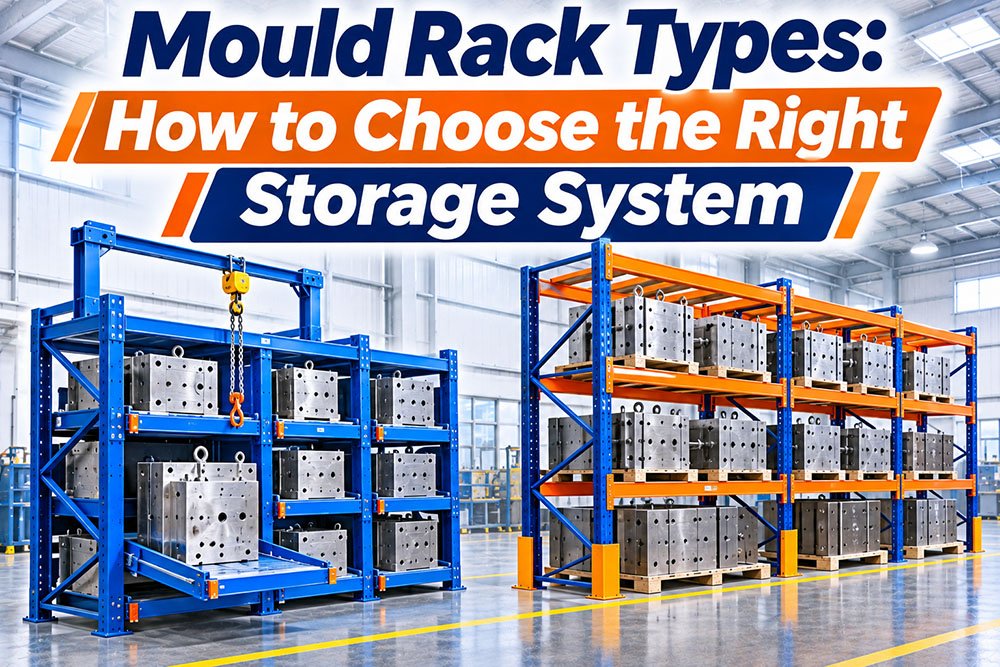
Choosing between mould rack types starts with understanding how moulds move through a factory. A storage rack must accommodate the tooling, but it must also allow operators to retrieve, transfer and return each mould using the available handling equipment.
Three practical options are full-open mould racks, standard half-open mould racks and heavy-duty pallet racking configured for mould storage. Full-open racks provide extensive drawer access for lifting. Half-open racks provide partial drawer extension where the mould position and lifting arrangement allow it. Heavy-duty pallet racking stores moulds on suitable pallets or engineered supports for forklift handling.
The appropriate choice depends on mould dimensions, weight distribution, lifting points, retrieval frequency and available floor space. A factory with frequent crane-assisted mould changes may need a different arrangement from a facility storing reserve tooling on steel pallets.
This guide compares the three systems and explains how to select a storage arrangement that supports both warehouse capacity and practical mould handling.
How the Three Mould Rack Types Differ
The main distinction is the method used to bring a mould out of its storage position.
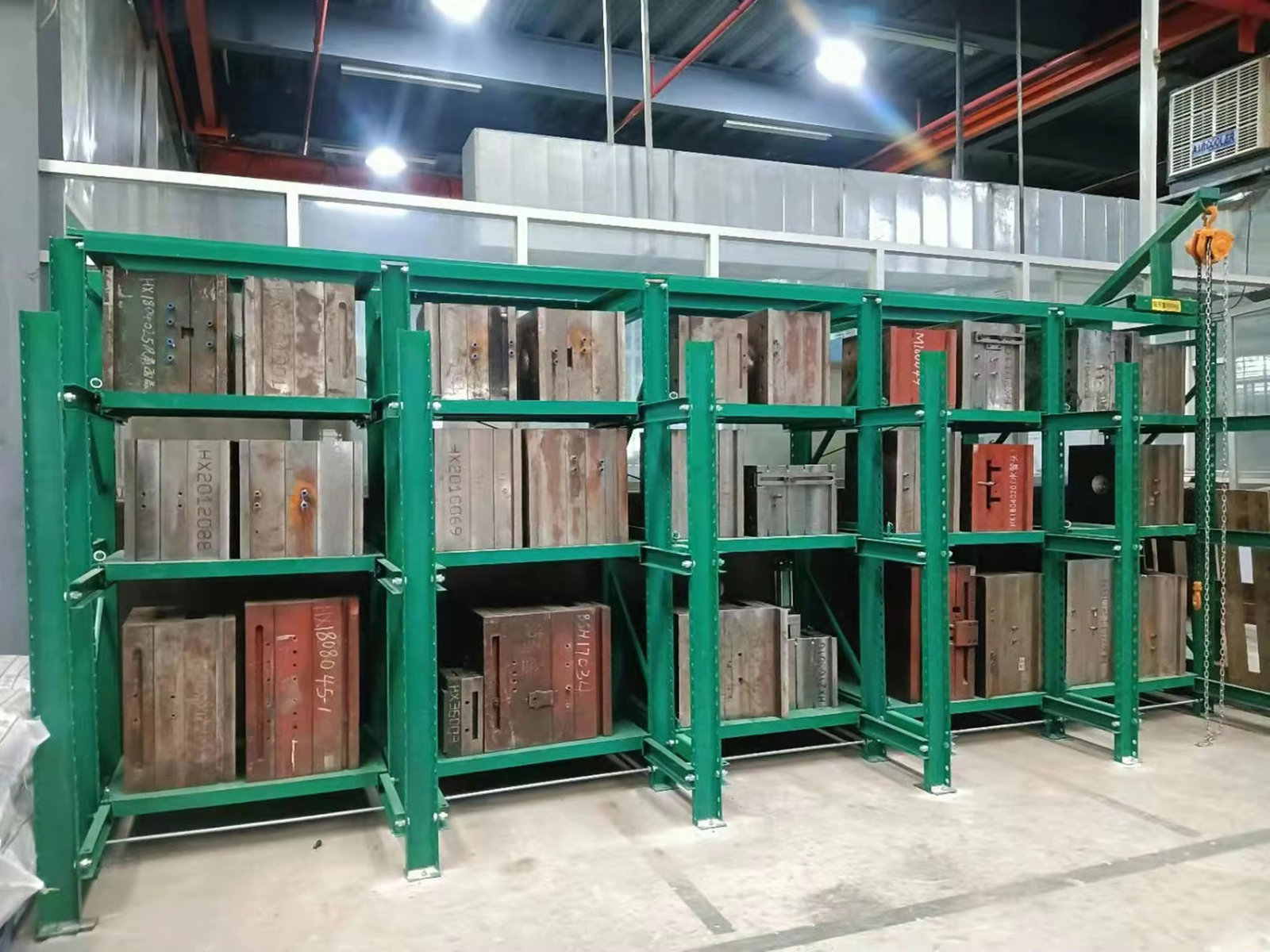
Full-open and half-open mould racks use movable drawers. The drawer brings the mould towards the aisle before lifting begins. Heavy-duty pallet racking generally uses fixed storage levels, with a forklift retrieving the mould together with its supporting pallet or cradle.
| Selection factor | Full-open mould rack | Standard half-open mould rack | Heavy-duty pallet racking for moulds |
|---|---|---|---|
| Storage arrangement | Full-extension drawer | Partial-extension drawer | Fixed beam levels with suitable load supports |
| Typical retrieval method | Crane or hoist, subject to clearance | Crane or hoist where lifting points remain accessible | Forklift handling of a supported unit load |
| Main selection advantage | Greater exposure of the drawer surface | Partial access where full extension is unnecessary | Compatibility with pallet-based storage and transport |
| Critical design check | Loaded drawer performance at full extension | Accessible lifting position within permitted travel | Pallet, support and rack suitability for concentrated loads |
| Operating space to assess | Extended drawer and lifting envelope | Extended drawer and rigging envelope | Forklift aisle and load-handling envelope |
| Suitable project direction | Tooling requiring unobstructed overhead access | Tooling accessible within partial drawer travel | Moulds handled as complete palletised units |
These are selection characteristics rather than universal product specifications. Drawer travel, capacity, dimensions and permitted operating procedures must be confirmed for the proposed system.
1. Full-Open Mould Racks
What a full-open mould rack does
A full-open mould rack uses drawers designed to extend fully, exposing the storage surface for access. Suppliers may describe this arrangement as a full-extension, full-open or 100% extension mould rack. An example is the full-extension drawer system described by Detay Endüstri.
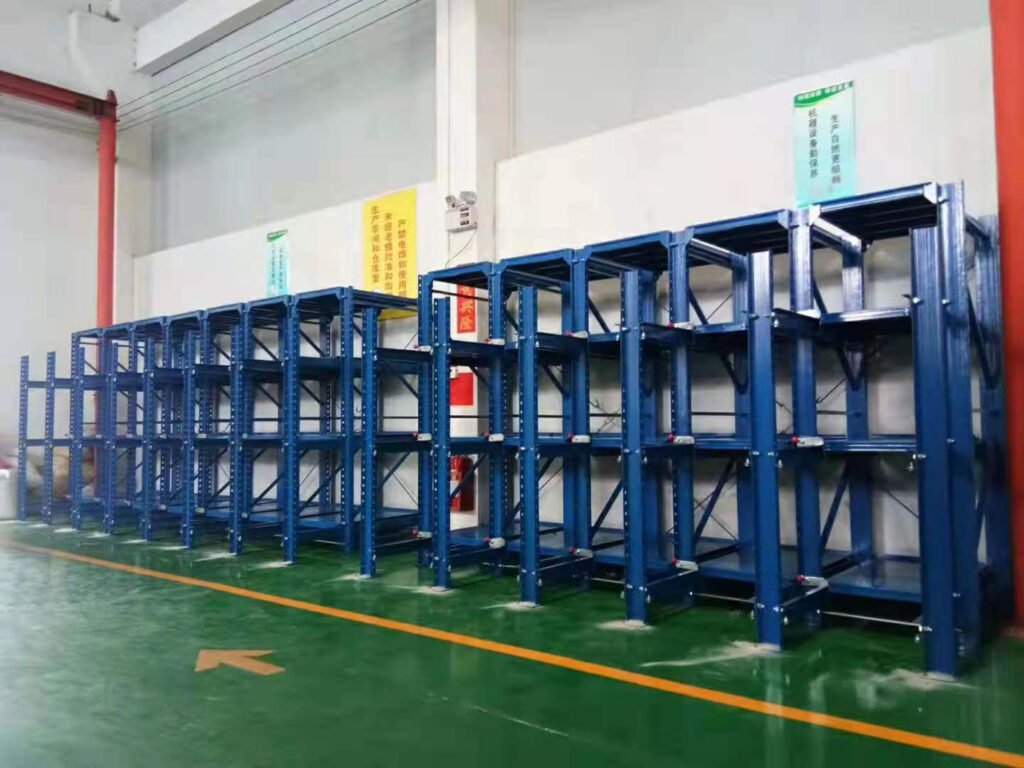
For a crane-served mould store, the purpose is to position the tooling where the lifting equipment can approach it without interference from the storage levels above.
However, drawer extension alone does not prove that a mould can be lifted. The mould’s lifting points, sling arrangement, hook position and dimensions must all fit within the available handling envelope.
When full-open access is useful
Full-open racks deserve consideration when moulds occupy much of the drawer depth or their lifting points would otherwise remain beneath an upper shelf.
They can also suit operations where operators need clear visibility when attaching lifting equipment. Bringing the mould into an accessible position may simplify the planned retrieval sequence, provided the lifting route has been checked.
For example, a deep mould with centrally located lifting points may be difficult to retrieve from a partially extended drawer. Full extension may expose those points sufficiently for a vertical lift. The actual arrangement should be verified on a drawing that includes the mould, drawer and rigging.
The same review should consider the mould’s destination. A clear lift from the drawer is only one part of the movement. The operator must also be able to transfer the mould to a trolley, maintenance area or production route without encountering another obstruction.
What must be checked before selection
The supplier should confirm the permitted load at full extension, including the specified load position. A capacity statement without its loading conditions is insufficient for comparing proposals.
A mould can place substantial weight on a small contact area. Its centre of gravity may also sit away from the drawer centre. The drawer surface, supporting members and extension mechanism must suit that arrangement.
The operating aisle needs to accommodate the drawer, personnel and lifting equipment. A rack that fits when closed may interfere with circulation when open.
The design should also identify drawer stops, locking arrangements, anchoring requirements and any restrictions on opening multiple drawers. Operators need clear instructions for the configuration actually supplied.
2. Standard Half-Open Mould Racks
What “half-open” means
A standard half-open mould rack uses drawers that extend only part of their depth. The term describes partial access rather than a universally fixed travel percentage.

For example, one supplier offers 60% and 100% drawer extension options. Buyers should therefore request both the extension percentage and the usable travel distance in millimetres.
A drawer described as half-open should not automatically be assumed to extend exactly halfway. The important question is whether its permitted travel exposes the mould’s lifting points and allows the intended handling procedure.
When partial extension is sufficient
A half-open arrangement can work where mould dimensions and placement allow lifting within the available drawer travel.
This may apply to smaller tooling positioned in designated locations on the drawer. It may also apply where the approved handling arrangement does not require the entire storage surface to clear the rack.
Selection should begin with the mould footprint and lifting geometry. If the operator can attach the lifting equipment and raise the mould without contacting the rack or adjacent tooling, additional drawer travel may provide little operational value.
A mould rack system should therefore be specified using confirmed mould dimensions, loading details and retrieval requirements. The product name alone does not establish whether a particular drawer configuration suits the application.
Where partial extension becomes restrictive
A partially extended drawer leaves part of its surface inside the rack. Problems arise when a mould’s lifting points remain beneath the level above or when the lifting equipment requires more clearance than is available.
A mould that physically fits on a drawer may therefore be unsuitable for that drawer’s retrieval method.
Avoid planning around operators dragging tooling forward, exceeding drawer stops or lifting at an improvised angle. If normal retrieval requires such actions, the storage position or rack configuration needs revision.
Partial extension also requires an operating-space assessment. Although drawer travel is shorter, the complete handling envelope still includes the mould, rigging, operator position and transfer equipment.
Where multiple moulds share one drawer, check access to every approved position. The front mould should not obstruct retrieval of tooling stored behind it.
3. Heavy-Duty Pallet Racking for Mould Storage
How pallet-based mould storage works
Heavy-duty pallet racking systems can store moulds on fixed levels using suitable pallets, cradles or other engineered load supports. A forklift retrieves the supported mould as a complete unit.
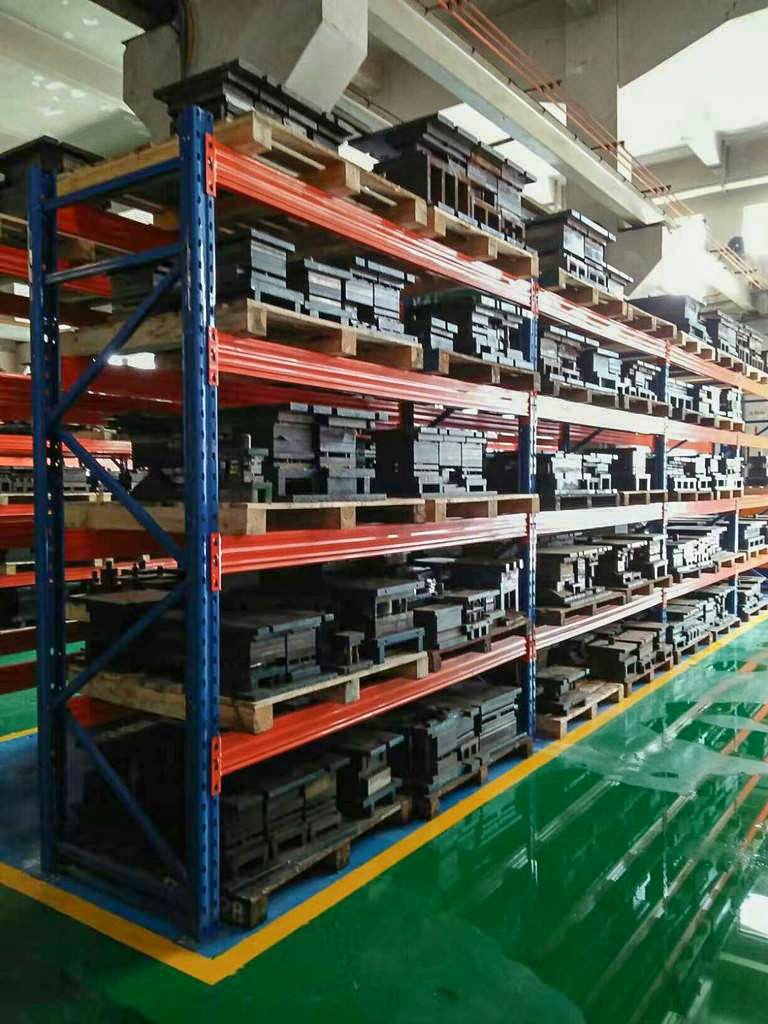
Unlike drawer-based storage, this arrangement does not bring a shelf forward for overhead access. The handling method depends on the forklift engaging and moving the load carrier.
The rack should therefore be evaluated together with the carrier. A mould, steel pallet and supporting rack form one storage arrangement, and each component must suit the actual load.
When pallet racking is a suitable option
Pallet racking can suit factories where moulds already travel on compatible carriers between storage, maintenance and production areas.
It can also be considered for reserve tooling or larger mould inventories where forklift access is available. However, retrieval frequency alone does not determine suitability. Some frequently used moulds may also be efficiently handled on pallets if that matches the production transfer process.
The key question is whether the complete load can move through the intended route without unnecessary transfers. If a mould must be lifted off a pallet immediately after every retrieval, the project should assess the additional handling step.
Pallet-based storage also requires a consistent carrier strategy. Differences in pallet dimensions, fork entry and load support can complicate storage assignments and forklift handling.
Why mould weight is only part of the specification
A rack’s stated capacity must be read with its loading assumptions. Mould feet, narrow runners or small support blocks can create concentrated loads.
A load carrier may be suitable for lifting by forklift but unsuitable for spanning between rack beams. Similarly, general-purpose decking should not be assumed to support a mould simply because its total weight appears acceptable.
The proposed arrangement should confirm:
- Mould weight, including any accessories stored with it.
- Pallet or cradle weight and dimensions.
- Contact locations between the mould and carrier.
- Support locations between the carrier and rack.
- Load restraint and stability during handling.
- Beam-level and bay loading limits.
Forklift selection also needs to reflect the complete unit load, its load centre and the required storage height. The permitted handling capacity should be checked for the actual operating configuration.
How to Choose Between Mould Rack Types
Start with the handling route
Map the movement from storage to production before comparing rack prices.
Identify whether the mould leaves storage by overhead crane, local hoist, forklift or another transfer device. Then check where it goes next and whether it changes carriers along the way.
For a crane-served area, compare full-open and half-open drawers using lifting clearance. For a pallet-based route, assess whether fixed pallet positions can accommodate the mould and its carrier.
A factory using both methods may need separate storage zones rather than one rack type throughout.
The review should include return movements. A retrieval method that works when a mould is clean and ready for production must also accommodate the actual condition and handling requirements when it returns to storage.
Use a mould inventory with physical data
A useful inventory records more than the mould identification number and total weight.
Include length, width, height, lifting-point locations, support footprint and any projecting components. Record the intended storage orientation and whether the tooling requires a dedicated cradle.
Also identify frequency of use, maintenance status and expected additions. These details help determine drawer sizes, level spacing and the number of storage positions.
Where several moulds share a drawer, document their approved positions and combined load. Available surface area alone does not establish a suitable loading arrangement.
Test the most demanding retrieval
A layout should accommodate more than an average mould. Check the deepest mould, the heaviest unit and the tooling with the least convenient lifting points.
For drawer racks, review the mould at its permitted retrieval position. Include hook height, rigging length, adjacent levels and the path into the transfer area.
For pallet racking, review the widest and deepest unit loads, forklift approach and clearances at the intended storage level.
This exercise may reveal that a small group of difficult moulds needs a different rack configuration from the rest of the inventory.
Compare total operating cost
Compare proposals using the same mould list, storage capacity and handling assumptions.
The project cost may include racks, load carriers, lifting equipment, floor preparation, installation, transport and training. Operating costs include retrieval time, inspections, maintenance and the labour required for additional transfers.
A lower rack purchase price does not necessarily produce a lower cost per retrieval. Equally, additional drawer travel has limited value if the operation never needs it.
The useful comparison is the cost of delivering the required storage and handling performance over the planned operating period.
Project Considerations Before Finalising the Layout
Operating space and building conditions
Draw the equipment in its working position. Show extended drawers, forklift movement, lifting routes and temporary set-down areas.
Include columns, doors, floor joints, utilities and emergency access. Confirm the floor and anchoring requirements for the selected rack design rather than assuming an existing slab is suitable.
The storage layout should also account for applicable fire protection and building requirements. These depend on the project location and arrangement.
A warehouse racking layout design can help review the relationship between storage positions, handling routes and building obstructions before equipment is ordered.
Capacity and loading instructions
Request drawings or schedules that identify the permitted load per drawer or position, as well as relevant level and bay limits.
For drawer racks, clarify permitted load placement, extension conditions and simultaneous drawer-opening restrictions. For pallet storage, clarify approved carriers and support arrangements.
Capacity labels should correspond to the installed configuration. Changes to level positions, drawers or stored loads should be reviewed before use.
The operating instructions should also explain how to identify and report damage or abnormal drawer movement. A storage location should not remain in service simply because the mould can still be placed in it.
Installation, inspection and future changes
The project needs an installation sequence that accounts for delivery access, assembly space and ongoing factory operations. Confirm the required racking installation support before delivery, including assembly instructions, installation responsibilities and any site guidance needed for the proposed configuration.
After installation, confirm that the supplied configuration matches the approved drawings and that moving components operate as intended.
Define an inspection and maintenance process covering the rack, drawer mechanisms, stops, locks, anchors and load carriers, as applicable.
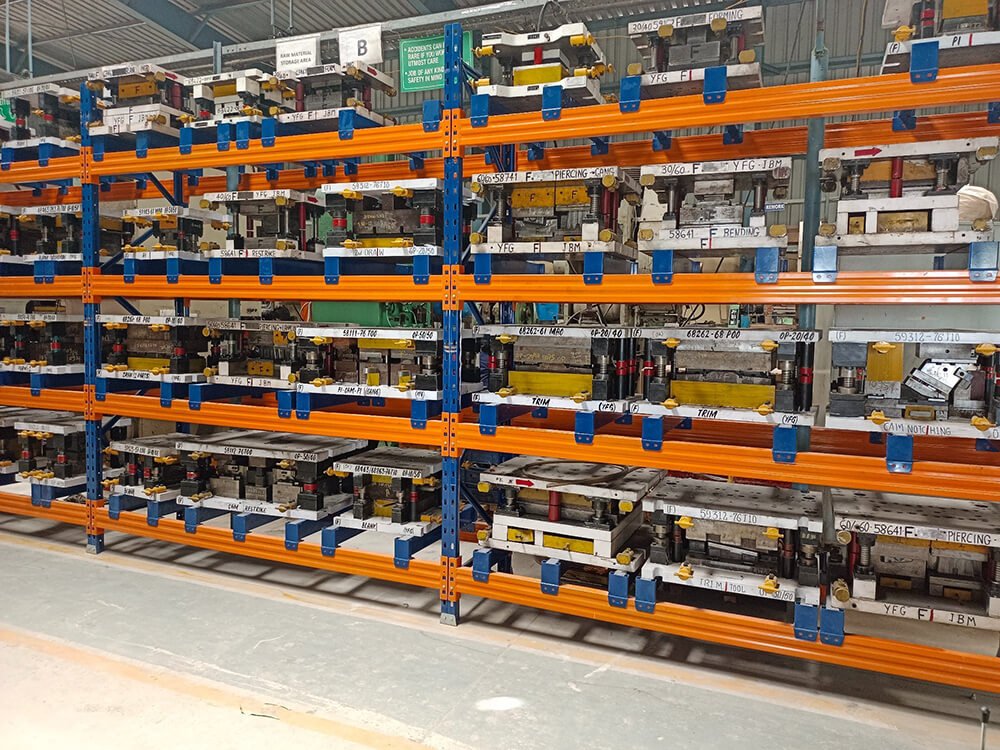
Future expansion should be planned around both storage positions and handling access. Adding more bays is useful only if crane coverage, aisle capacity and transfer areas can support them.
Expected Operational Improvements
A suitable mould storage system can support better organisation, more accessible tooling and a more predictable retrieval process. The improvement depends on the starting arrangement and the way operators use the installed system.
Measure storage capacity as usable, assigned mould positions. Counting empty drawers or pallet spaces can overstate capacity if some moulds cannot fit or be retrieved.
Measure retrieval time from a consistent starting point to a consistent handover point. Separate searching, waiting, rigging and transport so the project team can see which delays the storage system addresses.
| Performance measure | Baseline to record | Post-installation assessment |
|---|---|---|
| Usable storage capacity | Moulds stored within the defined area | Assigned positions that fit the actual inventory |
| Retrieval time | Time for representative mould movements | Repeat the same movements under comparable conditions |
| Handling steps | Transfers between storage and production | Check whether unnecessary transfers were removed |
| Location accuracy | Moulds found in their recorded positions | Audit identification and location records |
| Floor occupation | Storage plus operating and staging space | Compare the complete working footprint |
Any forecast should state its assumptions. For example, if a site estimates that retrieval time will fall from 12 minutes to 8 minutes across 15 daily retrievals, the calculated saving is 60 minutes per day. This is an illustrative planning calculation, not a measured project result.
Time savings should also be interpreted carefully. Reduced retrieval time may improve labour availability, but it only reduces machine downtime where tooling retrieval was delaying the production process.
Can a Factory Combine All Three Systems?
A mixed layout can be appropriate when the mould inventory contains different handling requirements.
Full-open drawers may serve tooling that needs extensive overhead access. Half-open drawers may serve moulds whose lifting positions are accessible with shorter travel. Pallet racking may accommodate moulds already assigned to compatible forklift-handled carriers.
The zoning should be based on documented retrieval methods. Operators should be able to identify the correct location, handling equipment and procedure for each mould.
Keep frequently retrieved tooling near its transfer route where practical, while ensuring that this does not create congestion. Reserve storage can be farther from production if the retrieval route remains workable.
Review the arrangement as the inventory changes. A location suitable for one mould may not suit a replacement with a different footprint, centre of gravity or lifting arrangement.
Frequently Asked Questions
Which mould rack types suit overhead crane handling?
Full-open and half-open drawer racks can both be considered. Selection depends on whether the drawer exposes the lifting points and provides sufficient clearance for the mould and rigging. Full extension provides more drawer exposure, but the complete lifting arrangement still needs checking.
Does a half-open mould rack always extend 50%?
No. “Half-open” is a general product description for partial-extension storage. Ask for the actual travel distance, extension percentage and permitted load conditions rather than relying on the name.
Can heavy-duty pallet racking store moulds directly?
Direct storage should only be used where the rack and supporting arrangement have been designed for it. Confirm concentrated loads, mould stability and support locations. A suitable pallet or engineered cradle may be required for both storage and forklift handling.
Which option requires the lowest investment?
There is no universal answer. Compare equivalent storage positions and include installation, carriers, lifting equipment and operating requirements. A configuration that uses existing handling equipment may reduce some project costs, but it must still suit the mould inventory.
What information is needed to estimate installation time?
Provide the rack quantities, dimensions, site location, delivery access and operating restrictions. Floor preparation, anchoring, handling equipment and inspection requirements also affect the programme. A supplier should estimate the schedule from the defined scope.
How should future mould storage expansion be planned?
Record expected mould quantities, dimensions and handling methods. Reserve space for additional storage and check whether lifting coverage, aisles and transfer areas can support it. Expansion planning should include operating capacity as well as rack capacity.
Conclusion
The choice between mould rack types depends on how each mould is supported, accessed and transferred. Full-open racks provide extensive drawer exposure; standard half-open racks suit retrieval within partial travel; heavy-duty pallet racking supports a pallet-based handling approach when the load carrier and rack are correctly specified.
For a mould storage project involving Lracking, the useful starting information is a mould inventory, lifting-point details, existing handling equipment and a dimensioned layout. These allow the proposed solution to be assessed against actual storage positions and retrieval movements, helping the factory build capacity around a workable handling process.