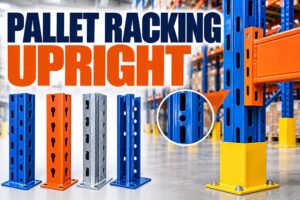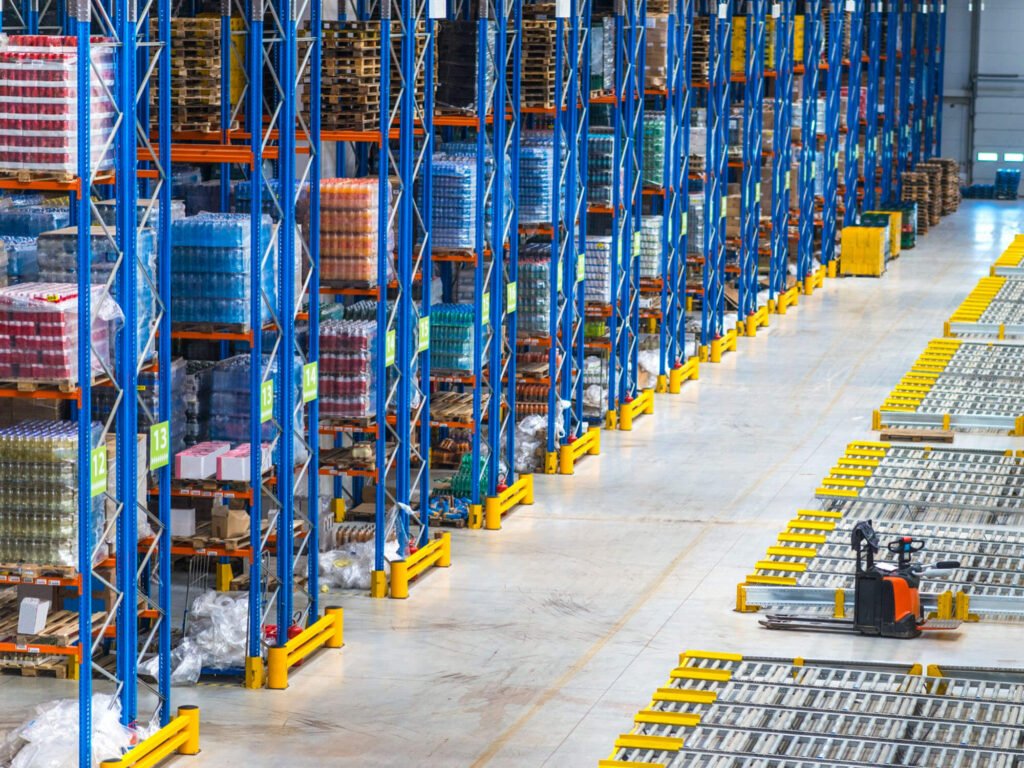
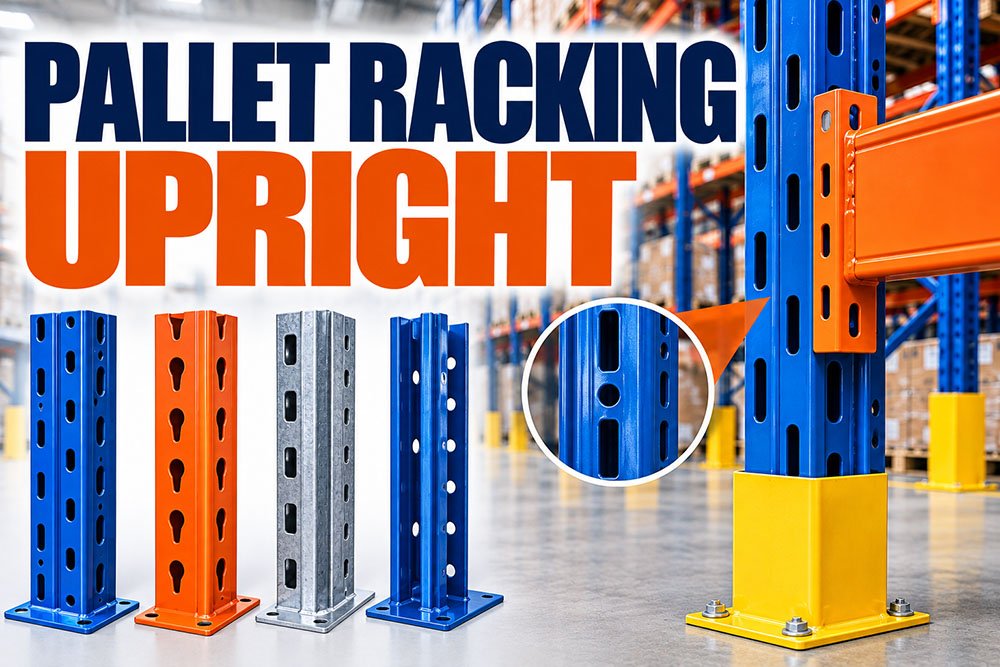
The upright — also called the column, post, or vertical frame — is the single most important structural component in any pallet racking system. Every pallet, every beam, every load eventually transfers its weight through the uprights to the floor. When uprights are correctly specified, properly installed, and well maintained, the racking system performs reliably for decades. When they’re undersized, damaged, or mismatched to the application, they become the point where the entire system fails first. Understanding uprights is therefore not just a technical curiosity — it’s foundational for anyone buying, installing, inspecting, or operating pallet racking.
This guide covers what a pallet racking upright is, how it’s constructed, the specifications that matter when selecting one, the different connection systems used across the industry, the problems uprights commonly experience, and how to approach upright selection and procurement in a project context.
What Is a Pallet Racking Upright?
A pallet racking upright is the vertical steel column that forms the load-bearing structure of a pallet racking frame. In a typical selective pallet racking configuration, two uprights are connected by horizontal and diagonal bracing to form a complete upright frame. Beams then attach between pairs of upright frames to create the horizontal storage levels where pallets are placed.
Uprights are not single pieces of steel — they’re engineered assemblies that include several integrated features: the main column profile (usually a hollow or open steel section), punched perforations along the full height for beam attachment, a base plate welded or bolted to the bottom for floor anchoring, and in some designs integrated bracing attachment points for the horizontal and diagonal members that stabilize the frame.
The role uprights play in load transfer:
- Pallet weight presses down on beams
- Beams transfer that load through their connectors into the upright
- The upright carries the cumulative weight of all levels above the beam connection point
- At the base, the upright transfers accumulated load through the base plate into the floor slab
- Diagonal and horizontal bracing between paired uprights distributes lateral forces (sway, seismic, impact) across the whole frame
Why upright specification matters more than most other components:
Because the upright is where load concentrates and compounds, small variations in material, dimension, or construction have outsized consequences for safety and durability. A beam that’s slightly undersized typically shows deflection warnings long before failure. An undersized or damaged upright can fail abruptly, taking the entire frame — and sometimes adjacent frames in a connected system — down with it. This is why nearly every racking standard worldwide specifies upright testing and documentation requirements more rigorously than for other components.
Pallet Racking Upright Construction
Modern pallet racking uprights are typically produced by one of two manufacturing methods, each with distinct characteristics.
Roll-Formed Uprights
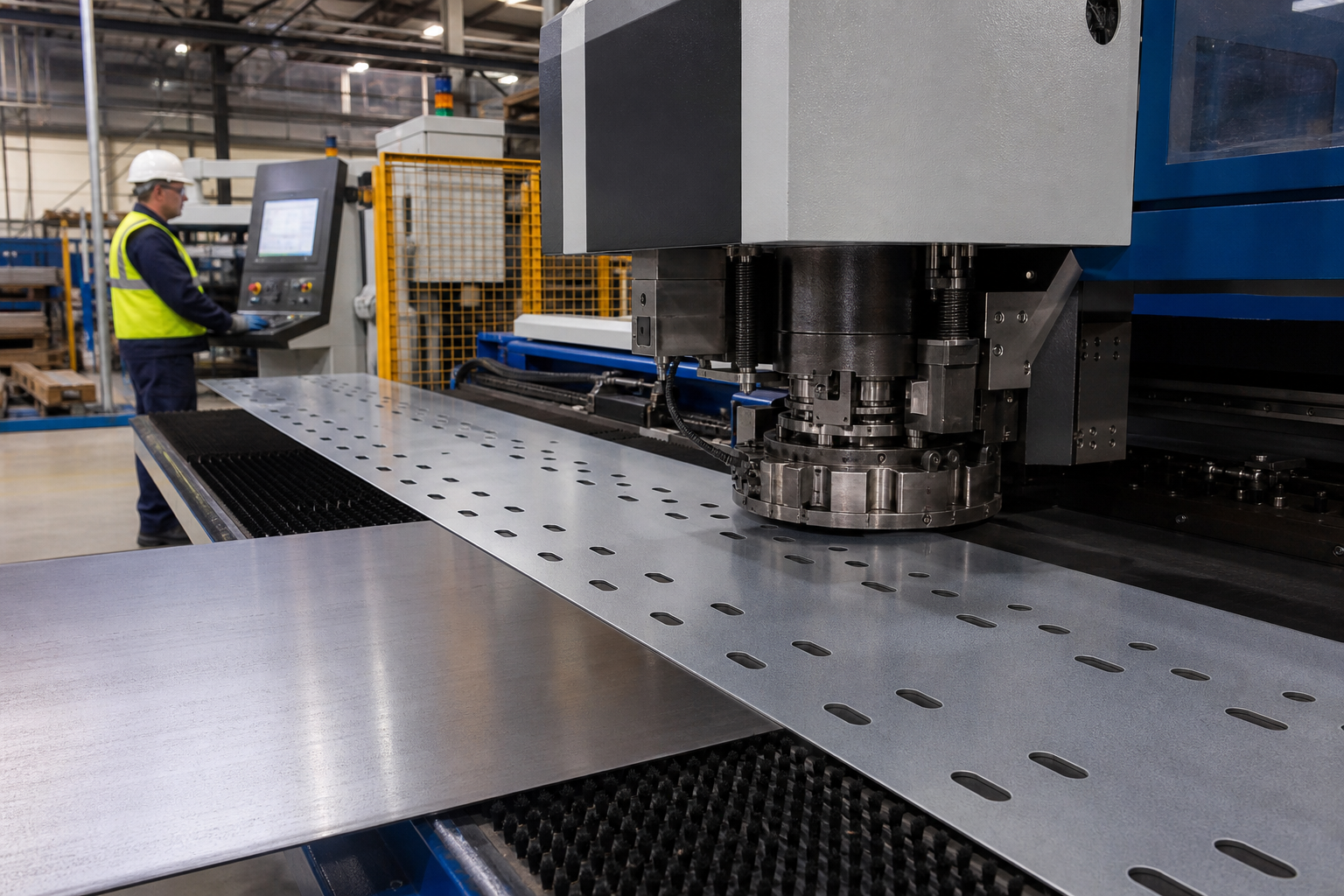
Roll-formed uprights are manufactured by passing flat steel coil through a series of shaped rollers that progressively bend it into a formed profile — most commonly an open “C” or “omega” cross-section with punched perforations along the full length for beam attachment. The process is highly efficient at scale, and the finished uprights have precise dimensional consistency.
Characteristics of roll-formed uprights:
- Cost-efficient manufacturing suited to high-volume production
- Lighter per unit length than structural equivalents
- Standard profile dimensions widely available
- Suitable for most general warehouse applications
- Perforations punched during roll-forming for beam attachment
Roll-formed construction dominates the standard pallet racking market worldwide because it produces reliable, cost-effective uprights for the vast majority of warehouse load profiles.
Structural Uprights
Structural uprights use hot-rolled structural steel sections — typically I-beams, C-channels, or hollow structural sections — joined by welded or bolted construction rather than cold-forming. Instead of punched perforations, structural uprights typically use welded or bolted brackets for beam attachment, though some designs incorporate drilled holes along the column for connector flexibility.
Characteristics of structural uprights:
- Higher per-unit load capacity than roll-formed equivalents
- Greater resistance to impact damage from forklift contact
- Longer typical service life in high-traffic environments
- Higher material and manufacturing cost
- Often specified for drive-in, high bay, and heavy-duty applications
The choice between roll-formed and structural construction is one of the most consequential upright decisions, and it depends on application rather than universal superiority. A more detailed look at structural construction is available in this guide to structural racking.
Common Cross-Section Profiles
Within roll-formed construction, several profile shapes are common:
C-shape (open channel). The most widely used upright profile, offering good balance of strength, cost, and manufacturing ease. Perforations punched along the back face for beam connectors.
Omega or “hat” profile. Named for its resemblance to the Greek letter omega, this profile provides enhanced torsional stiffness and is common in moderate-to-heavy roll-formed applications.
Lipped channel. Similar to a C-shape but with inward-folded lips at the open edges, increasing resistance to bending and buckling.
Box or hollow section. Fully enclosed profiles offering maximum torsional stiffness and highest load capacity among roll-formed options, generally at higher cost.
Different manufacturers use proprietary profile shapes within these broad categories, which is why uprights from different suppliers are often not interchangeable — the specific perforation pattern, dimensions, and profile geometry are typically engineered as a matched system.
Key Upright Specifications
When specifying or evaluating pallet racking uprights, several technical parameters determine fit for a given application. Understanding what each one controls helps buyers compare suppliers on equivalent terms.
Height
Upright height determines the maximum vertical storage capacity of the rack. Common heights range from approximately 2 meters for low-rise warehouse installations to 12 meters or more for high bay configurations. Selection depends on building clear height (not just ceiling height), pallet load height, number of storage levels needed, and clearance requirements for sprinklers and lighting.
Depth
Upright depth — measured between the front and back face of the upright frame — determines how much pallet overhang is supported and the stability of the frame against tipping. Common depths include 800 mm, 900 mm, 1,000 mm, and 1,100 mm, matched to the pallet dimension and load profile. Shallower frames save floor space but reduce overhang tolerance; deeper frames provide more stability for heavy or overhanging loads.
Column Section Dimensions
The width and thickness of the column profile itself directly affect load capacity. Wider and thicker columns support more load, with typical column widths ranging from approximately 70 mm to 150 mm, and steel thickness from 1.5 mm to 3.0 mm or more. Heavier applications generally require larger section dimensions and thicker steel.
Steel Grade
The material grade determines the yield strength of the steel used. Common grades include Q235B (235 MPa yield strength, suitable for standard applications) and Q355B (355 MPa yield strength, suitable for heavy-duty applications). Material grade selection has significant implications for load capacity and should match the actual load profile — detailed in this guide to Q235B vs Q355B steel selection for different racking applications.
Load Capacity
Upright frame load capacity — the maximum weight the complete frame can support — is specified by the manufacturer based on engineering calculation and physical testing. Capacity depends on upright height, column section, material grade, beam spacing (closer beam spacing increases capacity), and bracing configuration. Load capacity should be documented in a load chart specific to the exact configuration being used.
Perforation Pattern
The spacing and dimension of the perforations where beams attach determine how finely beam heights can be adjusted. Common patterns include 50 mm, 75 mm, and 100 mm pitch spacing. Finer pitches provide more adjustment flexibility; coarser pitches may be stronger at each specific beam position.
Base Plate
The base plate — the welded or bolted plate at the bottom of each upright — distributes load from the upright to the floor and provides the anchoring point for floor fasteners. Base plate size, thickness, and anchor hole pattern all affect how effectively load is transferred to the floor and how resistant the upright is to tipping or shifting under load.
Surface Treatment
Powder coating is the most common surface treatment, providing corrosion resistance for standard warehouse environments. Galvanizing is specified for cold storage, humid, or outdoor applications where standard powder coating would degrade. Both treatments significantly affect long-term service life in demanding environments.
Key Upright Specification Summary
| Specification | What It Controls | Typical Range |
|---|---|---|
| Height | Maximum storage height | 2 m to 12+ m |
| Depth | Pallet overhang, frame stability | 800–1,100 mm |
| Column section | Load capacity | 70–150 mm width, 1.5–3.0 mm thickness |
| Steel grade | Yield strength and ultimate load | Q235B, Q355B, S235JR, S355JR |
| Frame load capacity | Maximum frame weight | 2,000–20,000+ kg per frame |
| Perforation pitch | Beam height adjustability | 50, 75, 100 mm |
| Base plate | Load transfer to floor | Size and thickness vary by load |
| Surface treatment | Corrosion resistance | Powder coat, galvanized |
Beam-to-Upright Connection Systems
How beams connect to uprights is one of the most important system-level distinctions in pallet racking, and it affects compatibility, safety, assembly speed, and reconfiguration flexibility. Several connection systems are in common use.
Teardrop Connection
The teardrop system uses teardrop-shaped perforations along the upright, with matching hook connectors on the beam ends. Beams are inserted into the teardrop openings and lower slightly to engage the narrower bottom of the perforation, creating a secure connection. Teardrop is widely used in North America and increasingly common in export markets, offering fast tool-free assembly and good reconfiguration flexibility. A closer look at this specific format is covered in this overview of teardrop pallet racking.
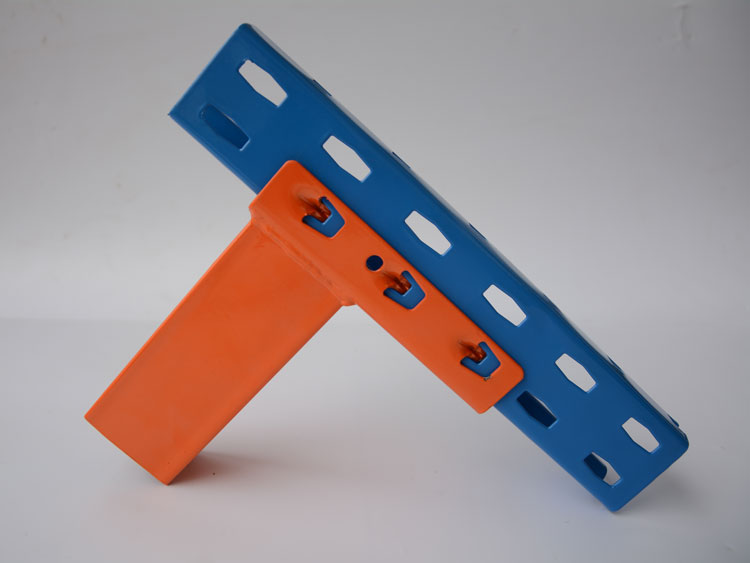
Keyed or Slot-Lock Connection
Slot-lock systems use rectangular or square perforations with beam connectors that engage specific locking features — often small tabs, pins, or integrated clips. The system provides a positive mechanical lock that resists accidental dislodgement from forklift contact. Common in European markets.
Boltless Clip Connection
Boltless systems use clip-and-slot connections that engage through gravity and lateral tension, without bolts or welded joints. These systems are extremely fast to assemble and reconfigure but typically have lower impact resistance than teardrop or keyed alternatives.
Bolted Connection
Bolted systems use bolts to secure the beam connector to the upright through drilled holes. This provides maximum connection strength and impact resistance but requires tools for assembly and reconfiguration, slowing both. Common in structural racking for heavy-duty applications.
Welded Bracket Connection
Some structural systems use beam-end plates that bolt or weld to fixed brackets on the upright. These provide the highest connection strength but offer the least flexibility — beam positions are essentially permanent.
Safety Features Across Connection Systems
Regardless of the base connection system, modern pallet racking includes safety features to prevent beams from being dislodged by forklift contact:
Beam safety locks or clips. Small pins, clips, or integrated locking tabs that physically prevent the beam from lifting out of the connector during normal operation. These are not optional components — they are structural safety requirements.
Welded connector reinforcement. Many beam connectors use welded reinforcement where the connector attaches to the beam end, strengthening the critical load path.
Column protectors. While not a connection feature per se, column protectors are typically installed on uprights in high-traffic zones to prevent forklift contact damage that could compromise the connection area.
Connection System Comparison
| Connection Type | Assembly Speed | Reconfiguration | Impact Resistance | Common Market |
|---|---|---|---|---|
| Teardrop | Fast (tool-free) | Easy | Moderate | North America, export |
| Keyed/Slot-lock | Moderate | Moderate | High | Europe |
| Boltless clip | Very fast | Very easy | Lower | Light-duty, retail back-of-house |
| Bolted | Slow | Moderate | Very high | Structural, heavy-duty |
| Welded bracket | Permanent | Difficult | Highest | Specialized structural |
Common Problems and Damage Modes
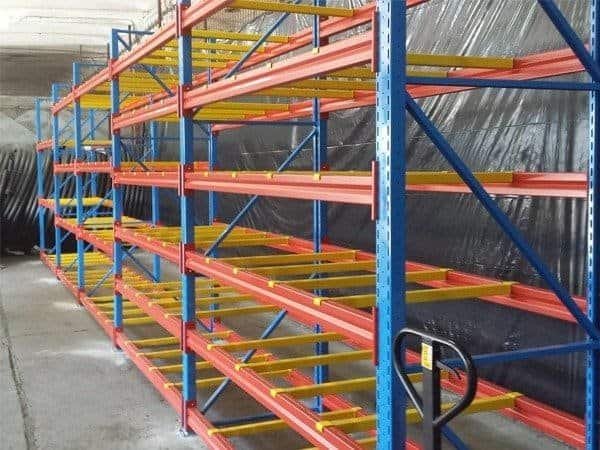
Uprights are the component most frequently damaged in a pallet racking system, both because they sit at forklift contact level and because load concentrates in them. Understanding what damage looks like, and what causes it, is essential for both inspection and prevention.
Forklift Impact Damage
Direct forklift contact with uprights — either during pallet put-away, retrieval, or aisle travel — is the single most common cause of upright damage. Impacts range from minor cosmetic contact to severe structural deformation that compromises load capacity.
What impact damage looks like:
- Visible dents or deformation in the column profile
- Bent or deflected upright that leans out of vertical
- Damage to the base plate or anchor area
- Scuff marks or paint damage indicating recent contact
- Cracked welds at connections
Even minor impact damage can reduce an upright’s effective load capacity. The industry rule of thumb is that any deflection greater than approximately 13 mm from vertical warrants immediate professional assessment and typically component replacement.
Base Plate and Anchor Damage
Base plates can crack, lift, or shear anchor bolts under impact, overload, or long-term fatigue. Base damage is particularly serious because it compromises the load path to the floor and can allow the entire frame to shift under load.
Overload Deformation
Uprights carrying loads beyond their rated capacity may show subtle deformation that develops over time — buckling of the column walls, out-of-plumb lean, or distortion at beam connection points. Overload damage often develops gradually and may not be noticed until it becomes severe.
Corrosion
Powder-coated or galvanized surfaces degrade over time, particularly in humid, cold storage, or coastal environments. Corrosion at base plates, weld joints, and beam connection areas can significantly reduce structural capacity even when the upright appears visually intact at the surface.
Fatigue from Cyclical Loading
Over decades of use, cyclical loading from repeated pallet placement and retrieval can produce fatigue cracks or weakening at critical stress points. This is particularly relevant for older racking that has never been formally inspected since installation.
Component Mismatch
In warehouses that have expanded or reconfigured over time, uprights from different manufacturers or different production runs may have been mixed. Mismatched components may not have the dimensional or load compatibility the original engineering assumed, creating hidden weakness.
Upright Repair vs Replacement
When upright damage is identified, the question of whether to repair or replace comes up frequently. The industry consensus — supported by most racking manufacturers and safety standards — is that structural uprights with visible deformation should generally be replaced rather than repaired in the field.
Why field repair is typically not advised:
- Field straightening of bent uprights does not restore original load capacity
- Welding repairs typically create heat-affected zones that weaken the surrounding steel
- Hidden stress or micro-cracks may not be visible but still affect strength
- Material certification is lost once components are repaired
- Insurance coverage may be affected by non-manufacturer-approved repairs
When replacement is the appropriate response:
- Any upright with visible deformation beyond manufacturer tolerance
- Base plates with cracks or sheared anchors
- Uprights with corrosion that extends into structural members
- Components with fatigue cracks at welds or connectors
- Any upright involved in a forklift impact until professional assessment confirms it’s still rated for use
Related inspection practices that help identify damage requiring replacement are an essential companion to any upright maintenance program.
Upright Protection
Because forklift contact is the leading cause of upright damage, physical protection is a high-return investment. Several protection options are common:
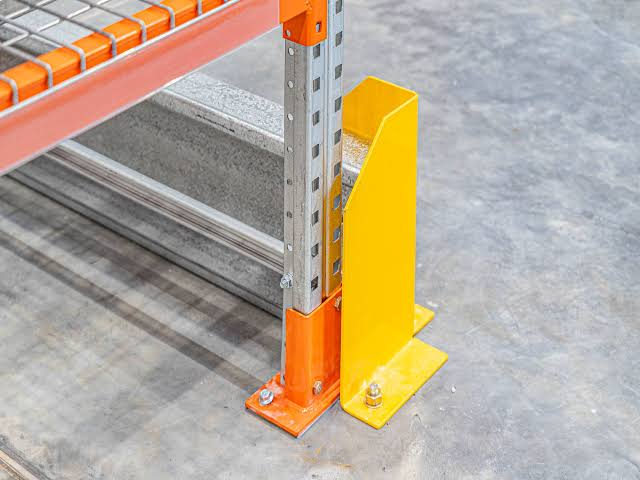
Column protectors (base-mounted). Steel guards that wrap around the lower portion of the upright, absorbing forklift contact impact and preventing damage to the upright itself. The most common and generally most cost-effective protection measure.
End-of-aisle guards. Larger guards that protect uprights at aisle endpoints, where forklifts turn and are most likely to make contact. End-of-aisle uprights carry the highest impact risk and benefit disproportionately from guarding.
Mesh panels or barriers. Behind-rack mesh panels prevent pallets from being pushed through to the opposite side during put-away, reducing both inventory damage and structural stress on the uprights.
Floor guides and bollards. Floor-mounted guides or bollards keep forklifts on intended travel paths and away from upright contact zones.
Row spacers. Horizontal spacers between back-to-back upright frames maintain alignment and distribute impact force across multiple frames rather than concentrating it on one.
How to Select Pallet Racking Uprights for a Project
For buyers approaching an upright specification decision, several factors need to be addressed systematically rather than treated as supplier defaults.
1. Document Actual Load Requirements
Rather than relying on general assumptions, document maximum pallet weight, average pallet weight, number of levels desired, and total frame load. Overload is one of the leading contributing factors in rack collapse, and specifying based on realistic rather than optimistic load profiles builds in appropriate safety margin.
2. Match Upright Height to Building and Equipment
Upright height depends on building clear height (not just ceiling height), handling equipment lift capability, and intended number of storage levels. Specifying too tall creates unused space and safety issues; too short wastes vertical capacity.
3. Choose Connection System Based on Operation
For high-traffic environments where forklift contact is likely, impact-resistant connections (keyed, bolted) often justify their added cost. For reconfigurable or lower-impact environments, teardrop or boltless systems may provide faster assembly and change-over.
4. Match Material Grade to Application
Standard operations use Q235B or equivalent carbon structural steel. Heavy-duty, high-impact, or seismic applications typically benefit from Q355B or structural steel grades. Specifying higher grade than needed adds cost without benefit; specifying lower than needed creates real safety risk.
5. Specify Appropriate Surface Treatment
Standard dry warehouses are well-served by powder coating. Cold storage, humid environments, and coastal or outdoor installations should specify galvanizing or specialized coatings to prevent premature corrosion.
6. Request Load Charts and Certification
Reputable suppliers provide upright frame load charts specific to each configuration (height × depth × column section × beam spacing). Load charts should be requested as part of the specification process, not accepted as marketing claims. For projects in regulated markets, certification against standards such as AS4084, FEM, or RMI should be documented.
7. Verify Component Consistency
If replacing or expanding existing racking, ensure new uprights are compatible with existing components. Mixing uprights from different manufacturers or product lines creates hidden compatibility risks that can affect load capacity.
8. Plan for Protection From Day One
Column protectors, end-of-aisle guards, and other impact protection should be specified as part of the initial order, not added later. Integrated planning typically costs less and provides better protection than retrofit installations.
Expected Operational Improvements from Proper Upright Specification and Maintenance
Warehouses that specify, install, and maintain uprights to appropriate standards typically see:
- Reduced racking collapse incidents, since uprights are the most common point of structural failure in pallet racking systems
- Lower long-term maintenance costs, since appropriately specified uprights degrade more slowly and require less frequent component replacement
- Improved regulatory and insurance compliance, since documented upright specifications support audits and claims
- Extended racking service life, since uprights are often the first component to show wear, and well-specified uprights typically outlast the overall system
- Better load capacity utilization, since appropriately specified uprights allow the warehouse to safely use the full rated capacity without approaching safety margins
- Safer forklift operation, since impact-resistant upright specifications and column protection reduce the risk of collapse from routine operational contact
- Simpler expansion and reconfiguration, when original upright specifications are documented and compatible components are available from the manufacturer
Project Considerations Beyond Specification
Floor flatness and slab condition. Upright base plates require level installation surfaces. Floor flatness within manufacturer tolerance should be verified before installation, with any correction completed first.
Anchor bolt specification. Floor anchors must match the slab condition and the upright base plate design. Over-specified anchors are better than under-specified; concrete anchors should match concrete strength and thickness.
Installation documentation. As-built installation records — including upright positions, anchor torques, and configuration details — should be retained for future inspection and modification reference.
Training for operators and inspectors. Forklift operators should be trained to recognize upright damage and understand reporting procedures. Facility inspectors should know what warning signs to look for during routine walkthroughs.
Inspection cadence. Weekly visual inspections and annual formal inspections by qualified rack safety personnel help catch upright damage before it progresses to failure.
Spare parts inventory. Keeping replacement uprights, base plates, column protectors, and anchors in stock allows immediate repair when damage is found, rather than extended downtime waiting for parts.
Documentation retention. Load charts, material certifications, installation records, and inspection reports should be retained for the service life of the racking.
Impact reporting culture. Facility policy should treat all forklift contact with racking as a reportable event requiring inspection, regardless of visible damage. Related collapse prevention practices are covered in detail in this guide to preventing warehouse rack collapse.
Frequently Asked Questions
What is the difference between an upright and an upright frame? An upright refers to a single vertical column, while an upright frame refers to a pair of uprights joined by horizontal and diagonal bracing to form the complete structural unit of a pallet racking system. Beams attach between pairs of upright frames to create storage levels.
How tall can pallet racking uprights be? Standard uprights range from approximately 2 meters to 12 meters or more. For heights above approximately 12 meters, specialized high bay configurations typically use structural uprights with site-specific engineering rather than standard product offerings.
Can I mix uprights from different manufacturers? Generally not advisable. Different manufacturers use different perforation patterns, profile dimensions, and connection systems, which may not be compatible even when they look similar. Component mismatch can compromise load capacity and create safety risk.
How often should uprights be inspected? Industry standards generally recommend visual inspections at least weekly by warehouse supervisors, with formal inspections by qualified rack safety inspectors at least annually. Any forklift impact should trigger an immediate inspection regardless of regular schedule.
Can a bent upright be straightened and reused? Industry practice and most manufacturer guidance recommend replacing uprights with visible deformation rather than attempting field repair. Straightening does not restore original load capacity and may create hidden weaknesses that fail under load later.
What is the load capacity of a standard pallet racking upright? Load capacity varies dramatically based on upright configuration — height, column section, material grade, beam spacing, and bracing all affect it. Standard uprights range from approximately 2,000 kg to 20,000 kg per frame, with heavy-duty structural uprights supporting significantly more. Actual capacity should be confirmed via the manufacturer’s load chart for the specific configuration.
Are column protectors really necessary? In high-traffic environments or at end-of-aisle positions where forklift contact is likely, column protectors are a high-return investment that typically pays back many times over through avoided damage. In low-traffic reserve storage areas, they may be less critical.
What’s the difference between roll-formed and structural uprights? Roll-formed uprights are made from cold-formed steel sheet shaped into profiles, offering cost-efficient manufacturing suitable for standard applications. Structural uprights use hot-rolled structural steel sections with bolted or welded construction, offering higher load capacity and impact resistance at higher cost. The right choice depends on the application rather than universal superiority.
How long do pallet racking uprights last? Well-specified, properly maintained uprights can last decades. Service life depends on load conditions, environment, impact exposure, and maintenance quality. Harsh environments (cold storage, humid, high-impact zones) may shorten service life significantly, while light-duty, well-maintained installations often exceed expected lifespan.
Do I need to install anchor bolts for every upright? Yes. All uprights in a selective pallet racking system require floor anchoring through their base plates. Unanchored uprights can shift under load, concentrate stress at unexpected points, and dramatically increase collapse risk.
Key Takeaways
- The upright is the single most important structural component in pallet racking — all load eventually transfers through it to the floor
- Roll-formed uprights offer cost-efficient manufacturing for standard applications; structural uprights offer higher capacity and impact resistance for heavy-duty applications
- Key specifications include height, depth, column section, steel grade, perforation pattern, base plate, and surface treatment — each affects load capacity and application fit
- Connection systems (teardrop, keyed, boltless, bolted) determine assembly speed, reconfiguration ease, and impact resistance
- Forklift impact is the leading cause of upright damage, making column protection and impact reporting high-return safety investments
- Damaged uprights should generally be replaced rather than repaired, since field straightening does not restore original load capacity
- Selection should document actual loads, match height to building and equipment, choose appropriate connection system and material grade, and specify protection from day one
Conclusion
The pallet racking upright is where structural performance, safety, and long-term operational cost all converge. Warehouses that treat upright specification as a careful engineering decision — matched to actual loads, building characteristics, and operational patterns — generally see better safety, longer service life, and lower total cost of ownership than those accepting supplier default specifications without evaluation. Companies such as Lracking are commonly involved in projects where operators are specifying new uprights, replacing damaged components, or evaluating existing racking against updated load profiles, particularly in applications where upright performance has direct implications for structural safety and long-term reliability. For warehouses planning any upright-related project — new installation, replacement, or system upgrade — documenting the actual load requirements, building conditions, and operational demands remains the most reliable starting point for ensuring the uprights specified will actually deliver the capacity and safety the operation requires.