Beam pallet racking is the most widely deployed warehouse storage system in the world. It is the default choice for the majority of distribution centers, third-party logistics facilities, manufacturing plants, and general warehousing operations because it delivers 100 percent selectivity, direct forklift access to every pallet, and the lowest capital cost per pallet position.
Behind its apparent simplicity, however, beam pallet racking involves engineering choices — beam profile, connector type, upright section, base plate, and configuration depth — that determine load capacity, service life, safety, and operational efficiency. Selecting the correct beam pallet racking specification requires understanding how each component contributes to structural performance and how the assembled system supports warehouse throughput. This guide explains the components, load characteristics, configuration options, and selection framework for beam pallet racking.
What Is Beam Pallet Racking?
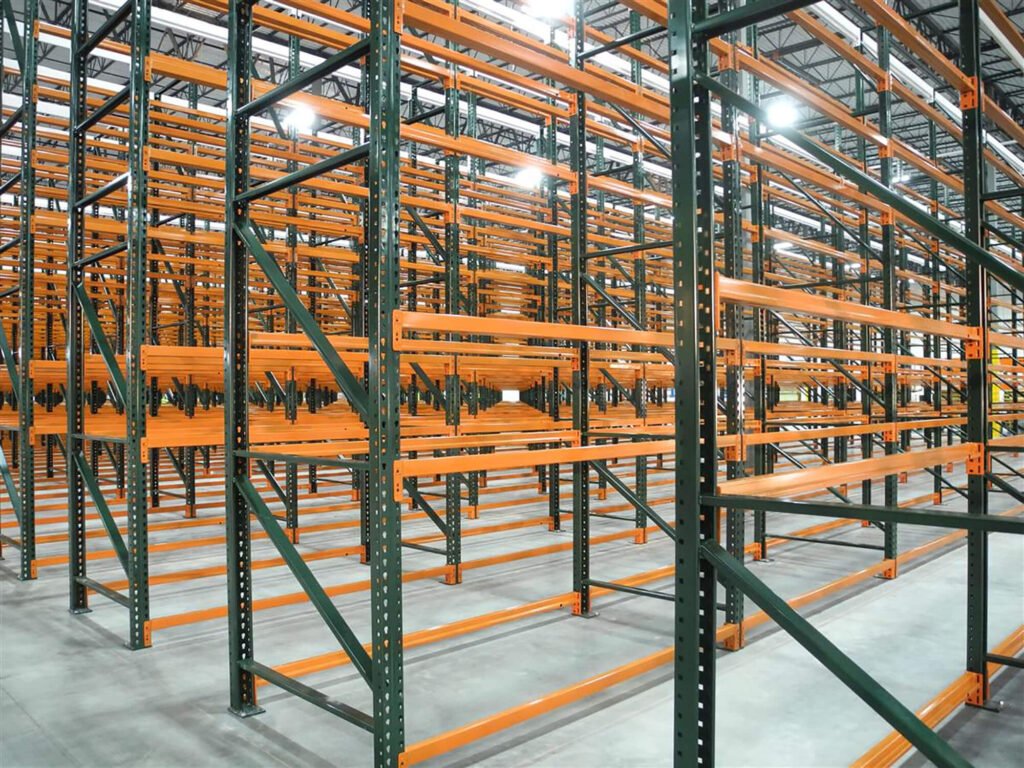
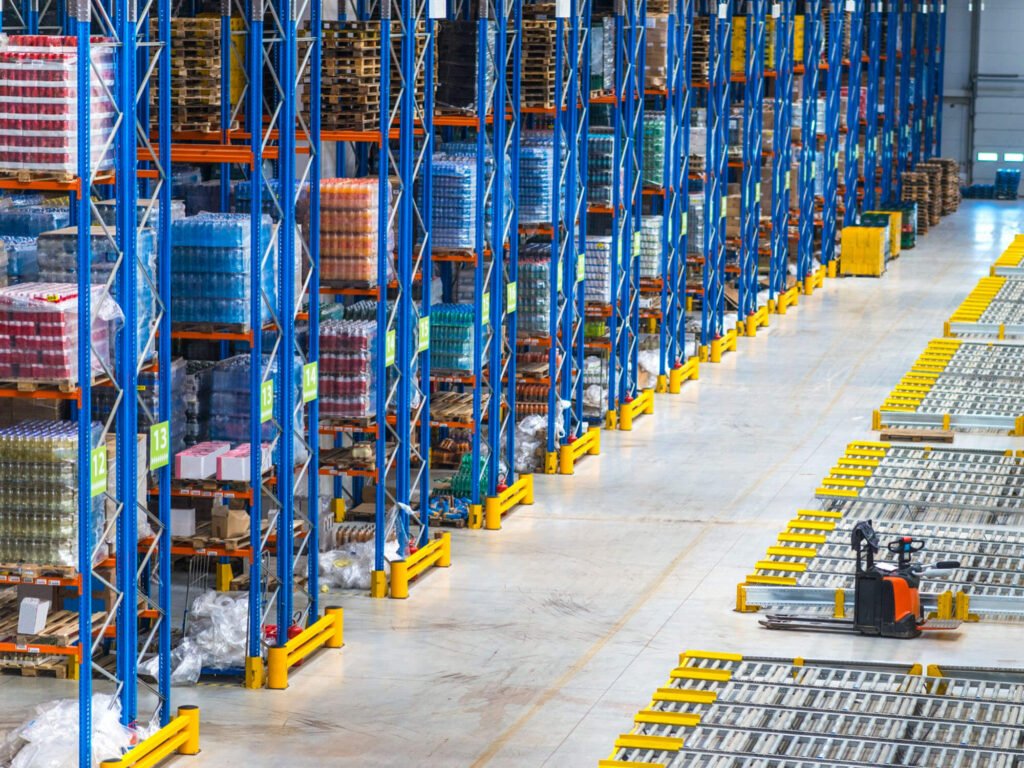
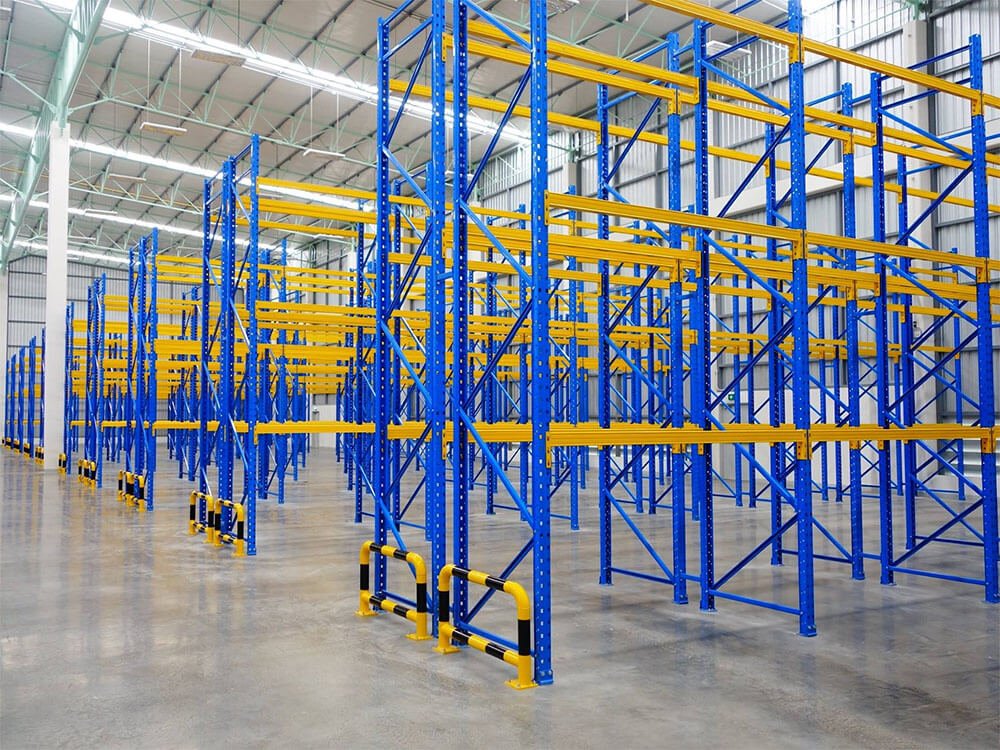
Beam pallet racking is a modular warehouse storage system in which horizontal load beams span between vertical upright frames to support palletized inventory. It is also commonly referred to as selective pallet racking or adjustable pallet racking (APR), reflecting its two defining characteristics: every pallet is directly selectable from the aisle, and beam levels can be adjusted without dismantling the structure.
The system consists of standardized components that assemble into a wide range of configurations to match SKU profile, pallet size, load weight, and building height. A properly specified beam pallet racking installation supports operational performance across four dimensions:
- Selectivity — every pallet position is directly accessible without moving other inventory
- Density — vertical utilization multiplies floor capacity into 3, 4, 5, or more storage levels
- Flexibility — beam levels adjust as pallet heights or SKU mix change
- Scalability — bays can be added, extended, or reconfigured as operational requirements evolve
Structural Components of Beam Pallet Racking
Understanding the components of beam pallet racking is essential to specifying a system that will perform safely and cost-effectively over its 15 to 25-year service life.
Upright Frames
Upright frames are the vertical structural elements that carry all loads to the floor. Each frame consists of two upright columns connected by horizontal and diagonal bracing, forming a rigid ladder-like structure.

Key upright specifications:
- Section profile — cold-rolled sections in varying depths and gauges
- Column thickness — typically 1.5 mm to 3.0 mm depending on load
- Bracing pattern — Z-bracing, K-bracing, or D-bracing
- Frame depth — matched to pallet depth (typically 800 mm to 1,200 mm)
- Frame height — 3 m to 12 m or higher depending on building clear height
Load Beams
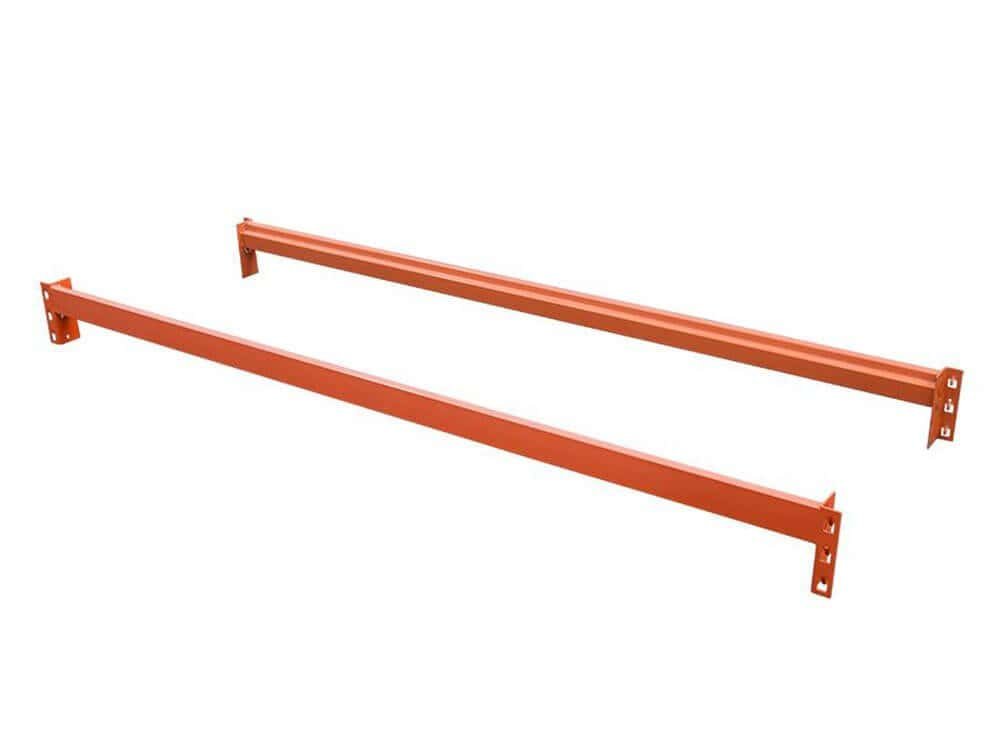
Load beams are the horizontal elements that carry pallets. They span between two upright frames and transmit load through end connectors to the uprights.
Common beam profiles:
- Box beam — closed rectangular section, highest load capacity, standard for heavy pallets
- Step beam — includes a step to support wire mesh decks or timber panels
- C-beam — open section, lighter loads, cost-optimized for lower-weight applications
Beam capacity depends on profile, length, gauge, and end connector design. A beam supporting three pallets over a 3.6-meter span is rated differently from the same beam over a 2.7-meter span.
End Connectors
End connectors join the beam to the upright. The connector transfers vertical load and provides moment resistance at the joint. Common connector designs include:
- Bolted connectors — high strength, less common in modern systems
- Hook-in connectors — quick assembly, adjustable, industry standard
- Multi-tab hook-in — 2 to 5 tabs engaging the upright for higher moment capacity
Safety pins or locking clips prevent beam disengagement during forklift impact.
Base Plates and Anchors
Base plates transfer upright loads into the concrete floor and are secured with mechanical or chemical anchors. Base plate size depends on load and floor slab capacity. In seismic zones, oversized base plates and additional anchoring may be required.
Accessories
- Pallet support bars — cross-members supporting pallets between beams, essential for damaged pallets or unstable loads
- Wire mesh decks — provide continuous surface for cartons or non-standard loads
- Row spacers — connect back-to-back frames at the required gap, ensuring stability and sprinkler flue space
- Column protectors — absorb forklift impact at floor level, reducing damage to uprights
- Rack guards / end frame protectors — additional impact protection at aisle ends
Beam Profile Comparison
| Profile | Cross-Section | Load Capacity | Common Use |
|---|---|---|---|
| Box Beam | Closed rectangular | High | Standard palletized goods, industrial loads |
| Step Beam | Rectangular with step | High | Systems with wire mesh or timber decks |
| C-Beam | Open channel | Low-Medium | Light loads, cost-sensitive projects |
| Structural I-Beam | Rolled I-section | Very High | Heavy industrial, extreme loads |
Beam selection should be verified against actual load per level, not nominal maximum ratings. Point load, uniformly distributed load, and safety factor requirements all affect the effective usable capacity. You can check out the different types of pallet racking beams in this article.
Beam Pallet Racking Configuration Options
Single-Deep Selective
The standard configuration: one pallet deep per side of the aisle. Every pallet is directly accessible.
- 100 percent selectivity
- Lowest storage density
- Fastest putaway and retrieval
- Compatible with all forklift types
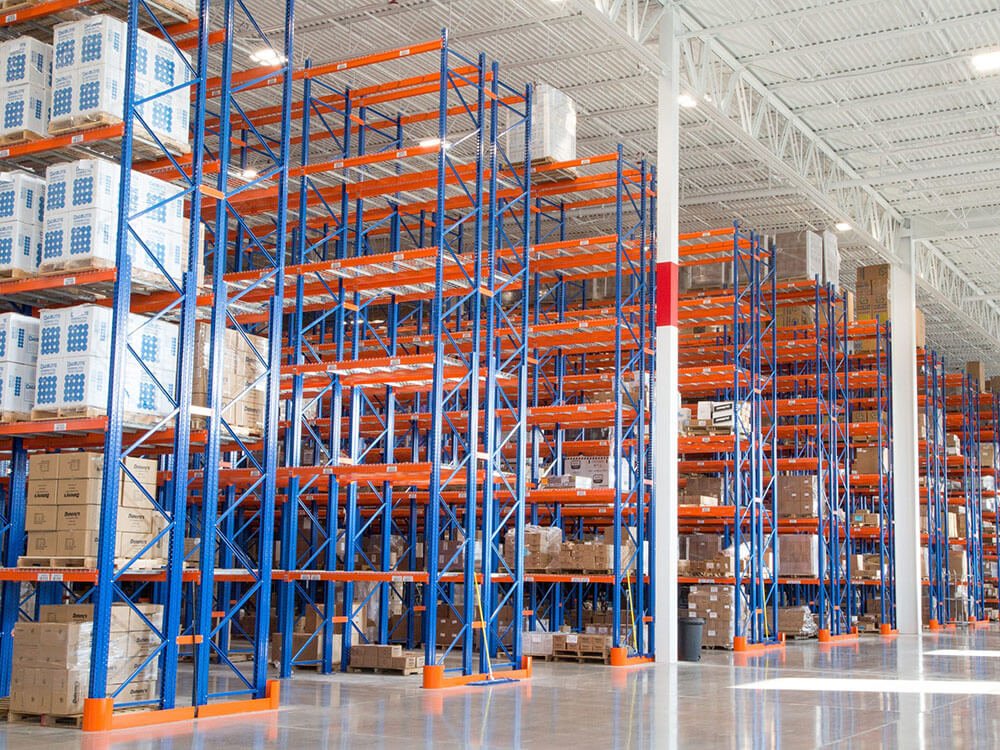
Double-Deep
Two pallets deep per side, retrieved with an extended-reach forklift.
- 50 percent reduction in aisle area
- ~90 percent selectivity (front pallets must move to access back pallets)
- Requires reach truck with pantograph extension
- Suitable when pallets per SKU ≥ 2
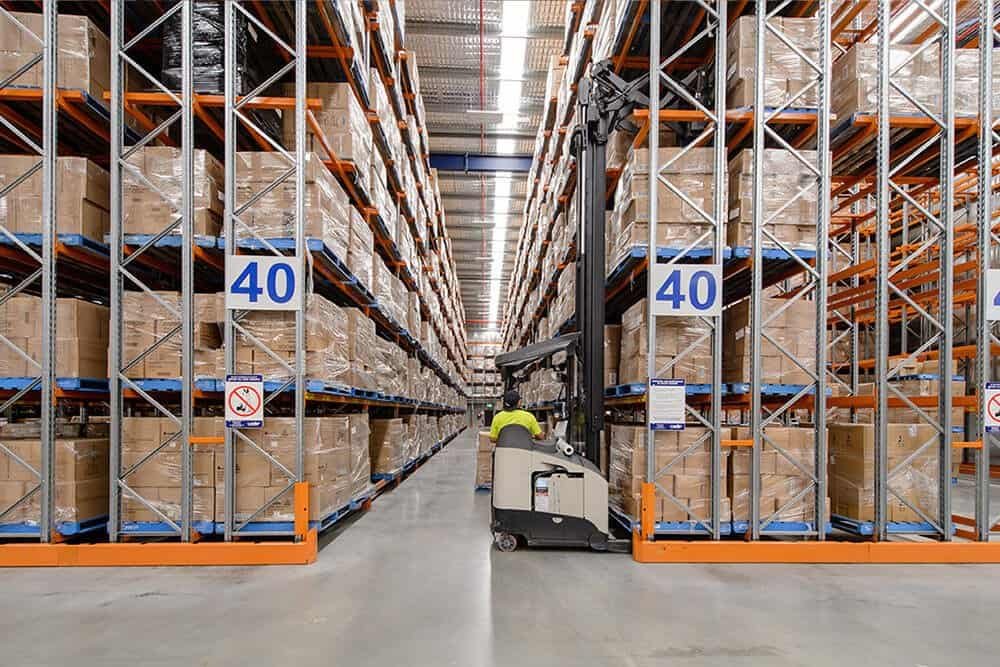
Narrow-Aisle Selective
Standard beam pallet racking with reduced aisle width (2.5 to 3.0 m).
- ~25 percent higher density than wide-aisle
- Requires reach trucks or articulated forklifts
- Maintains 100 percent selectivity
Very Narrow Aisle (VNA)
Selective racking with aisles of 1.6 to 1.8 m, served by turret trucks or man-up order pickers.
- ~40 to 50 percent higher density than wide-aisle
- Maintains 100 percent selectivity
- Requires floor flatness (F-min rating) and guidance systems
- Best in buildings with 10 meters or more of clear height
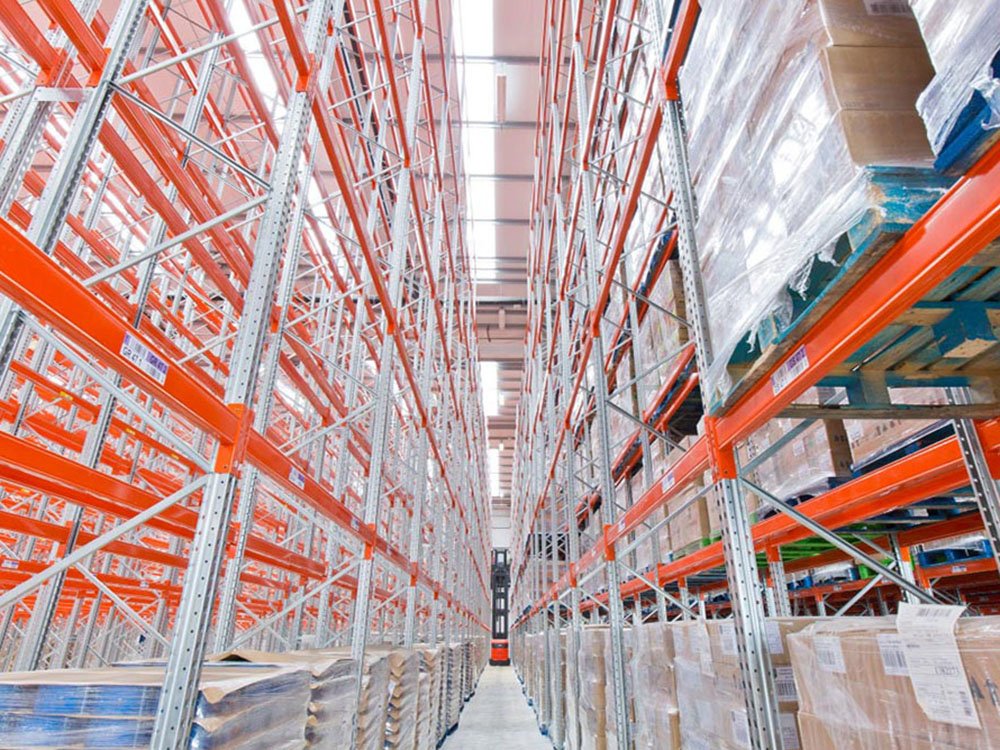
High-Bay Selective
Beam pallet racking configured to heights of 12 m or more.
- Maximizes building volume utilization
- Requires specialized high-lift forklifts or automated cranes
- Often combined with VNA aisles for maximum density
Load Capacity For Beam Pallet Racking
Load capacity in beam pallet racking is determined by the weakest structural element in the load path. Specifications should be verified for:
Beam capacity per level. Rated for uniformly distributed load (UDL) across two, three, or four pallets. Individual point loads may reduce effective capacity.
Upright frame capacity. Total load per frame across all levels, calculated with consideration for compression, buckling, and eccentric loading.
Base plate and anchor capacity. Transfers load to concrete slab; must not exceed slab bearing capacity.
Deflection limits. Typical limit is L/200 of beam span. Excessive deflection indicates under-specification and reduces service life.
Impact rating. Real-world capacity should assume periodic forklift impact and include an appropriate safety factor. Racks specified only for static load fail earlier.
Load charts issued by the manufacturer are the definitive reference. Load notices should be displayed at each racking bay showing maximum permissible load per beam level and per bay.
Industry Applications for Beam Pallet Racking
| Industry | Typical Configuration | Reason |
|---|---|---|
| FMCG Distribution | Single-deep selective, wide-aisle | High SKU count, direct accessibility |
| E-commerce Fulfillment | Selective + carton flow on mezzanine | Piece-pick support with pallet backup |
| Cold Storage | Double-deep or VNA | Space cost justifies density investment |
| Pharmaceutical | Single-deep selective + lot control | Regulatory selectivity and FEFO |
| Automotive Parts | Single-deep selective + cantilever | Standard pallets + long items |
| 3PL / Multi-client | Wide-aisle selective | Flexibility across variable customer profiles |
| Heavy Industrial | Heavy-duty selective with structural beams | High individual load weights |
| Retail Distribution | Single-deep selective | High SKU, moderate volume per SKU |
Operational Impact of Beam Pallet Racking
The operational performance of beam pallet racking is shaped by three interacting factors: configuration, forklift matching, and slotting strategy.
Labor efficiency — Direct pallet access minimizes double-handling and search time. Poorly slotted racking, however, can cancel out this advantage by placing high-velocity SKUs in remote locations.
Storage capacity — Vertical utilization typically delivers 3 to 5 times the floor-area storage capacity. Moving from wide-aisle to VNA or high-bay configurations can add another 40 to 60 percent.
Rotation discipline — Beam pallet racking naturally supports FIFO and FEFO because every pallet is individually selectable, unlike double deep racking systems where rotation depends on physical loading order.
Inventory accuracy — Selective racking supports piece-level counting, lot verification, and cycle counts without moving pallets. This reduces cycle count labor and improves inventory data integrity.
Damage exposure — Beam pallet racking is more vulnerable to forklift impact than deeper systems because uprights sit adjacent to aisles. Column protectors, rack guards, and driver training substantially reduce damage costs.
Warehouse Planning Recommendations
1. Specify racking based on actual pallet dimensions and weights Standard load ratings assume standard pallets. Non-standard pallets — heavier, oversized, or damaged — require verified specifications and often additional support bars.
2. Match beam span to pallet count per level Two-pallet, three-pallet, and four-pallet-per-level configurations trade off beam capacity against upright frequency. Optimize based on total pallet count per bay and required load rating.
3. Verify floor slab capacity before finalizing rack height Higher racking creates concentrated point loads at each upright base. Existing slabs may require reinforcement or thicker base plates.
4. Design for forklift compatibility from the start Aisle width, upright depth, and beam height should match the intended forklift type. Retrofitting racking to accommodate a different forklift is disruptive and rarely cost-effective.
5. Include impact protection in the base specification Column protectors and rack guards should be part of the initial installation, not an afterthought. Damage costs from unprotected racks accumulate faster than the cost of protection.
6. Reserve adjustment capacity in beam levels Beam levels should be positioned to accommodate the tallest expected pallet plus a working clearance of 100 to 150 mm. Reserving one adjustable level per bay preserves flexibility for future SKU changes.
7. Comply with racking design and inspection standards Verify design against FEM 10.2.02, ANSI MH16.1, or the applicable national standard. Establish an inspection schedule with documented damage assessment and repair procedures.
How to Select Beam Pallet Racking: Step-by-Step Framework
Step 1 — Document the pallet and load profile. Record pallet dimensions, weight per pallet, load stability, and whether pallets are standard or non-standard.
Step 2 — Determine total pallet positions required. Calculate current requirement and projected 3-year peak requirement, including seasonal variation.
Step 3 — Measure the building envelope. Record clear height, column grid, floor loading, floor flatness, and sprinkler configuration.
Step 4 — Select configuration type. Choose single-deep, double-deep, narrow-aisle, VNA, or high-bay based on selectivity requirements and building constraints.
Step 5 — Specify beam profile and capacity. Select beam type based on load per level, span, and deflection requirements. Include safety factor for dynamic loads.
Step 6 — Specify upright frames. Match frame depth to pallet, frame height to building, and frame section to total vertical load with buckling analysis.
Step 7 — Verify total structural performance. Confirm the system meets requirements for load, seismic zone, and forklift impact. Independent structural review is recommended for high-bay or complex installations.
Step 8 — Integrate accessories and protection. Specify wire mesh decks, pallet support bars, column protectors, and row spacers as required by application.
Step 9 — Document load notices and inspection schedule. Prepare load notices for each bay and establish periodic inspection procedures per applicable standard.
Step 10 — Coordinate installation with material handling. Schedule installation, floor marking, and forklift commissioning together to avoid rework.
FAQ
1. What is the difference between beam pallet racking and selective pallet racking? There is no operational difference — the two terms refer to the same system. “Beam pallet racking” emphasizes the load beam construction, while “selective pallet racking” emphasizes the access characteristic. Some markets also use “adjustable pallet racking” (APR) to highlight the adjustable beam levels.
2. How much weight can beam pallet racking hold? Load capacity depends on beam profile, span, upright section, and configuration. Standard beam levels typically support 1,500 to 3,500 kg UDL per pair; heavy-duty configurations support 5,000 kg or more. Manufacturer load charts are the definitive reference; nominal ratings should never be exceeded.
3. Can beam levels be adjusted after installation? Yes. Beam levels can be adjusted on a 50 mm or 75 mm pitch by lifting the beam and repositioning the end connector on the upright. Adjustment should always be performed when the beam is empty, and safety pins must be reinstalled after adjustment.
4. What aisle width is required for beam pallet racking? Wide-aisle configurations require 3.5 to 4.0 m for counterbalance forklifts. Narrow-aisle configurations require 2.5 to 3.0 m for reach trucks. VNA configurations require 1.6 to 1.8 m for turret trucks. The forklift specification must be confirmed before finalizing aisle dimensions.
5. Does beam pallet racking require floor anchoring? Yes. Every upright must be anchored to the concrete slab through the base plate. Anchor type, quantity, and embedment depth are specified by the racking designer based on load, slab thickness, and seismic zone.
6. How often should beam pallet racking be inspected? Standards such as FEM 10.2.02 recommend visual inspections weekly by warehouse staff, monthly by a nominated Person Responsible for Racking Safety (PRRS), and formal expert inspection annually. Damaged components should be offloaded and repaired or replaced immediately.
7. What is the difference between hot-rolled and cold-rolled beam racking? Cold-rolled beam racking uses thin-gauge steel sections formed at ambient temperature and is the modern industry standard, offering good strength-to-weight ratio and modular assembly. Hot-rolled systems use heavier structural steel and are typically reserved for very heavy loads or specialized applications.
8. Can beam pallet racking be reconfigured or expanded? Yes. Beam pallet racking is modular by design. Bays can be added, beam levels adjusted, and configurations reworked as operational requirements evolve. Component compatibility with the existing system must be verified before adding to installations from different manufacturers.
Key Takeaways
- Beam pallet racking is the most widely used warehouse storage system, offering 100 percent selectivity and the lowest capital cost per pallet position.
- Structural performance depends on upright, beam, connector, and base plate specification working together; the weakest element determines actual capacity.
- Configuration options — single-deep, double-deep, narrow-aisle, VNA, and high-bay — allow the same base system to serve widely different operational profiles.
- Load capacity must be verified against real operating conditions including dynamic impact, not just static ratings.
- Regular inspection and impact protection significantly extend service life and preserve safety.
Conclusion
Beam pallet racking remains the foundation of modern warehouse storage because it balances selectivity, flexibility, cost, and structural performance better than any other single system. Its modular design allows the same core components to be configured for high-SKU distribution, high-bay density, cold storage, or heavy industrial loads, adapting to operational requirements without fundamental redesign.
Realizing this potential requires structural specifications matched to actual load conditions, configurations aligned with SKU profile and forklift type, and inspection practices that preserve safety over the full service life. Companies such as Lracking represent the type of warehouse storage solution provider commonly evaluated by warehouse operators seeking to align beam pallet racking design, structural performance, and configuration flexibility with long-term operational objectives.