Warehouses handling fluctuating inventory volumes, seasonal storage needs, or heavy off-floor items often reach a point where fixed pallet racking becomes either underutilized during slow periods or inadequate for temporary surges. Pallet stacking frames offer a middle-ground solution — portable, stackable storage structures that can be deployed when needed, folded flat when not in use, and moved between locations as operational demands shift.
This guide covers what pallet stacking frames are, how they are built, their main types and applications, their advantages and limitations compared to conventional racking, and what to consider when selecting them for a specific storage scenario.
What Are Pallet Stacking Frames?
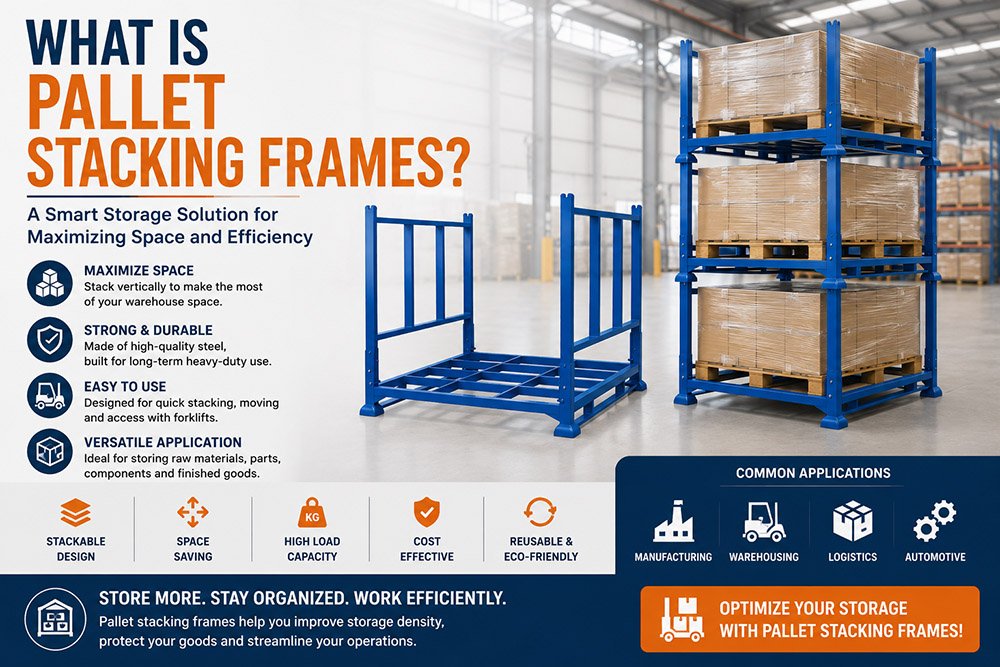
Pallet stacking frames are portable steel storage structures designed to be placed onto or around a pallet load, allowing multiple loaded pallets to be safely stacked vertically without requiring a permanent racking system. Each frame typically consists of a base and two upright posts with connecting rails or side panels, forming a rigid structure that supports the weight of additional stacked units above.
Unlike fixed pallet racking, which is bolted to the floor and configured for permanent storage aisles, pallet stacking frames are freestanding and self-supporting through the load itself. A loaded pallet is placed on the floor, the stacking frame is fitted over it, and additional loaded pallets with their own frames can then be stacked directly on top — creating a temporary vertical storage arrangement that can be dismantled or reconfigured as inventory needs change.
Core components of a pallet stacking frame:
- Base frame: The lower rectangular structure that sits on or around a pallet, providing the load-bearing foundation and connection points for the upright posts.
- Upright posts (corner posts): Vertical steel columns rising from each corner of the base, transferring the weight of stacked units above down to the base and floor.
- Cross members or side panels: Horizontal or mesh elements connecting the uprights, adding lateral stability and, in some configurations, containing the stored load.
- Corner connectors or locking mechanisms: Interlocking fittings at the top of each upright that engage with the base of the frame stacked above, ensuring vertical alignment and preventing lateral shifting under load.
- Feet or base pads: Reinforced contact points at the bottom of the base, distributing weight to the floor or to the pallet below.
How they differ from traditional pallet racking:
Traditional pallet racking is a permanent, anchored structure designed for long-term storage in fixed warehouse layouts. Pallet stacking frames, by contrast, are portable, modular, and typically stack directly with the loaded pallets they carry, making them suitable for scenarios where storage volume changes frequently or where inventory needs to be relocated between facilities. They also generally cost less per unit than a comparable section of fixed racking and require no floor anchoring, installation, or building modification to deploy.
Types of Pallet Stacking Frames
Pallet stacking frames come in several configurations, each suited to different operational profiles. The main distinction is between foldable and fixed designs, with additional variation in side panel style and connection method.
Foldable pallet stacking frames. Also called collapsible stacking frames, these units feature hinged or removable uprights that can be folded flat against the base when not in use. When empty, foldable frames occupy roughly one-quarter of their in-use height, dramatically reducing storage space during off-peak periods and lowering transport costs since more empty frames can be shipped per truckload. This is the most common configuration for warehouses with seasonal or variable storage demand.
Fixed (non-foldable) pallet stacking frames. These units have permanently welded uprights and are shipped and stored in their in-use configuration. Fixed frames are generally more rigid than foldable equivalents due to the absence of hinge points, and are often used in operations where frames remain deployed year-round rather than cycling in and out of storage.
Post-only frames. A minimalist configuration where only the base and four corner posts are provided, without side panels. These are suited to loads that do not require containment, such as boxed goods that are self-contained on their own pallets.
Wire mesh side frames. Configurations with wire mesh or perforated steel side panels between the uprights, useful for containing loose or irregularly shaped goods, or for improving visibility of stored contents while providing a partial physical barrier.
Solid panel side frames. Fully enclosed side panels providing full containment and dust protection, common in industries such as textiles or automotive parts where the stored goods benefit from more complete enclosure.
Custom-configured frames. Many manufacturers offer bespoke stacking frame dimensions and load ratings tailored to specific pallet sizes or product types, particularly for industries with non-standard pallet dimensions or unusual load characteristics.
Pallet Stacking Frame Configuration Comparison
| Configuration | Storage When Empty | Rigidity | Best For |
|---|---|---|---|
| Foldable | Very compact (fold flat) | Moderate to High | Seasonal or variable demand |
| Fixed (non-foldable) | Full height | High | Continuous year-round deployment |
| Post-only | Compact | Moderate | Self-contained boxed loads |
| Wire mesh sides | Full or folded (per design) | High | Loose or irregular goods |
| Solid panel sides | Full or folded (per design) | High | Textiles, automotive parts |
Advantages and Disadvantages of Pallet Stacking Frames
Pallet stacking frames occupy a specific niche in warehouse storage — they are not a universal substitute for fixed racking, and understanding both sides helps clarify when they are the right choice.
Advantages:
- Flexibility for variable inventory volumes. Frames can be deployed when storage demand increases and removed or folded away when demand decreases, without permanent floor space commitment.
- No installation or floor anchoring required. Because frames are self-supporting through the pallet loads they carry, they can be deployed immediately without the site preparation, engineering, and anchoring required for fixed racking.
- Portability across facilities. Empty foldable frames can be shipped between warehouses or moved within a single facility as needs change, making them useful for operations spread across multiple sites.
- Lower initial cost than fixed racking. For equivalent storage capacity, stacking frames typically require less upfront investment than a comparable installed pallet racking system, particularly for smaller-scale deployments.
- Compact storage during off-peak periods. Foldable configurations occupy significantly less space when not in use, freeing floor area for other operations during slow periods.
- Reduced warehouse modification. Facilities that lease their space or expect to relocate benefit from stacking frames’ lack of permanent installation, since no floor anchoring or building modification is required.
Disadvantages:
- Lower stacking height than fixed racking. Pallet stacking frames typically support fewer vertical levels than a comparable fixed racking bay, limiting their storage density in facilities with substantial vertical clear height available.
- Load capacity limitations per frame. Individual frames generally have lower load ratings than heavy-duty fixed racking beams, restricting their suitability for very heavy pallet loads.
- Requires uniform pallet dimensions. Because frames typically stack directly on top of the pallets they surround, they work best with standardized pallet sizes rather than mixed or irregular pallet dimensions.
- Manual handling considerations. Deploying and folding frames often involves manual labor unless mechanized handling equipment is used, which can affect labor costs in high-turnover deployments.
- Not ideal for high-selectivity picking. Because upper stacks must be removed before accessing lower pallets, stacking frames follow a last-in-first-out (LIFO) retrieval pattern that may not suit operations requiring frequent access to specific pallets buried in a stack.
- Structural condition affects long-term safety. Frequent deployment, folding, and moving can accelerate wear compared to permanently installed racking, requiring regular inspection to catch bent uprights or damaged connectors before failure.
Common Applications and Industry Scenarios
Pallet stacking frames are particularly useful in industries and scenarios where storage volume is not constant, or where inventory needs to be temporarily consolidated without permanent racking infrastructure.
Automotive parts storage. Automotive supply chains often handle bulky components — tires, body panels, exhaust systems — that benefit from being kept on their own pallets rather than shelved. Stacking frames allow multiple parts pallets to be stored vertically without dedicated racking, and can be folded away when production lines change over.
Textile and garment warehousing. Rolls of fabric, bales, and boxed garments store well in solid- or mesh-sided stacking frames, particularly for seasonal collections that occupy warehouse space only during specific parts of the year.
Food and beverage seasonal storage. Beverage distributors handling seasonal peaks — holiday deliveries, summer beverage demand — often deploy stacking frames temporarily to accommodate volume that exceeds their fixed racking capacity, then fold the frames away during slower periods.
Cold storage and refrigerated warehousing. In refrigerated warehousing where reconfiguring fixed racking is disruptive and expensive, stacking frames can be added or removed to match seasonal inventory shifts without altering the underlying storage infrastructure.
E-commerce fulfillment centers. High-volume periods around holidays or promotions can push storage requirements well beyond a facility’s baseline capacity, and stacking frames provide temporary overflow storage without long-term commitment.
Third-party logistics (3PL) and cross-dock operations. 3PL providers frequently handle short-term storage for multiple clients with varying volume, making the flexibility of stacking frames particularly well-suited to their operating model.
Trade shows, events, and temporary storage. Frames can be deployed for a specific event or temporary storage need and then broken down and stored or returned to another location.
For warehouses evaluating whether stacking frames complement or replace a fixed racking layout, reviewing this overview of stacking rack systems alongside conventional pallet racking systems can help clarify which format suits the intended storage profile.
Pallet Stacking Frames vs. Traditional Pallet Racking
| Factor | Pallet Stacking Frames | Traditional Pallet Racking |
|---|---|---|
| Installation | None required | Bolted to floor, requires setup |
| Portability | High (foldable models) | None (permanent) |
| Storage Height | Limited (typically 2–4 units high) | High (multiple levels possible) |
| Selectivity | LIFO (top-down access) | Selective (per-pallet access) |
| Initial Cost | Lower per unit | Higher for full installation |
| Flexibility | High (deploy/fold as needed) | Low (fixed layout) |
| Load Capacity | Moderate | Moderate to Very High |
| Best For | Variable, seasonal, or temporary storage | Continuous, high-density fixed storage |
Project Considerations When Selecting Pallet Stacking Frames
Load weight per pallet. Confirm the frame’s rated load capacity comfortably exceeds the maximum weight of the pallets to be stacked, including a safety margin for irregular loads or minor imbalances.
Number of stackable tiers. Rated stacking height varies by frame design and load weight. Higher loads generally reduce the safe number of tiers, so this should be confirmed with the manufacturer for the specific load profile involved.
Pallet dimensions and compatibility. Frames are typically sized for specific pallet dimensions (such as 1200 × 1000 mm or 1200 × 800 mm), and mismatched pallet sizes can compromise stacking stability. Standardizing pallet dimensions before deploying stacking frames tends to improve safety and efficiency.
Foldable versus fixed configuration. For operations with genuinely seasonal demand, foldable frames provide meaningful space savings during off-peak periods, while fixed frames may be simpler and more rigid for year-round deployment.
Storage environment. Cold storage, humid conditions, and outdoor deployment all affect coating selection — powder coating, galvanization, or specialized corrosion-resistant treatments should be matched to the operating environment.
Handling equipment compatibility. Confirm the frame design is compatible with the forklifts or pallet jacks used in the facility, particularly the fork entry points on the base.
Inspection and maintenance planning. Because stacking frames are often deployed and folded repeatedly, a routine inspection process — checking for bent uprights, damaged connectors, or coating wear — helps prevent structural issues from developing unnoticed. General inspection principles covered in this guide to pallet racking inspection also apply to stacking frames, with additional attention to the hinges and connectors specific to foldable designs.
Regulatory and safety compliance. Depending on the region and industry, stacking frames may need to comply with specific load rating and testing standards, and confirmation of compliance documentation is worth requesting from the manufacturer before purchase.
How Much Do Pallet Stacking Frames Cost?
Pallet stacking frame pricing varies based on configuration, size, load rating, and coating specifications, making a single universal figure unreliable. However, understanding the main cost drivers helps frame procurement decisions:
| Cost Driver | What It Covers | Impact on Price |
|---|---|---|
| Load rating | Steel gauge, welding, connector strength | High |
| Foldable vs fixed | Hinge and locking mechanism complexity | Moderate |
| Side panel type | Post-only, wire mesh, or solid panel construction | Moderate |
| Surface treatment | Powder coating, galvanization, specialized coatings | Low to Moderate |
| Custom dimensions | Non-standard pallet sizes or specialized configurations | Moderate |
| Order volume | Manufacturing economies of scale | Moderate (larger orders lower per-unit price) |
Because per-unit pricing scales significantly with order volume, buyers planning multiple frame purchases should generally consolidate orders where practical to benefit from volume discounts, rather than purchasing in small batches over time.
Frequently Asked Questions
How many pallets can be safely stacked using pallet stacking frames? Typical configurations support two to four stacked tiers, depending on load weight, frame design, and manufacturer specifications. The rated stacking height should always be confirmed with the manufacturer for the specific load profile.
Are pallet stacking frames suitable for cold storage environments? Yes, provided the frames are specified with appropriate corrosion-resistant coatings — such as galvanization or specialized cold-tolerant powder coatings — rather than standard coatings that may degrade in low-temperature or high-humidity conditions.
How much space do foldable frames save when stored? Foldable pallet stacking frames typically compress to roughly one-quarter of their deployed height when folded flat, allowing significantly more empty frames to be stored in the same footprint compared to fixed frames.
Do pallet stacking frames require floor anchoring? No. They are self-supporting through the pallet loads they carry, which is one of the main reasons they are used in facilities that need portable or temporary storage without permanent floor modification.
Can pallet stacking frames be used outdoors? Yes, though outdoor use significantly increases corrosion risk, so galvanization or specialized weather-resistant coatings should be specified rather than standard indoor finishes.
What is the typical service life of a pallet stacking frame? Service life varies with usage intensity, environment, and maintenance practices, but well-manufactured frames used within their rated load capacity and inspected regularly can generally provide many years of service before requiring replacement.
How do I inspect a stacking frame for damage? Regular visual checks should focus on bent or dented uprights, worn or damaged connectors and hinges, coating condition indicating corrosion, and any signs of stress at welded joints. Any frame with visible structural damage should be removed from service until repaired or replaced.
Are stacking frames a good substitute for permanent pallet racking? Not directly — they serve different purposes. Stacking frames are best suited to variable, seasonal, or temporary storage, while fixed pallet racking remains the standard choice for continuous high-density warehouse storage with frequent per-pallet access needs.
Key Takeaways
- Pallet stacking frames are portable steel structures that allow pallets to be safely stacked vertically without permanent racking installation
- Foldable frames offer significant space savings during off-peak periods, making them well suited to seasonal or variable storage demands
- Advantages include flexibility, portability, and low installation requirements, while limitations include lower stacking height and load capacity compared to fixed racking
- Common applications include automotive parts, textiles, seasonal food and beverage storage, cold storage, e-commerce peak periods, and 3PL operations
- Selection should account for load weight, pallet dimensions, storage environment, and whether foldable or fixed configuration best matches the operational profile
Conclusion
Pallet stacking frames occupy a specific and often underappreciated role in warehouse storage strategy — they are not a universal replacement for fixed racking, but for operations facing variable, seasonal, or temporary storage demands, they provide flexibility that permanent racking cannot easily match. Companies such as Lracking are commonly involved in projects where operators need to balance long-term fixed racking infrastructure with the flexibility to expand or contract storage capacity as demand shifts, particularly in industries such as automotive, textiles, and seasonal distribution. For warehouses evaluating whether stacking frames fit their operation, matching frame configuration to actual load profile, pallet standardization, and deployment patterns remains the most reliable way to determine which format delivers real operational value.