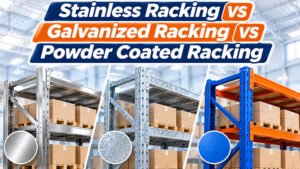
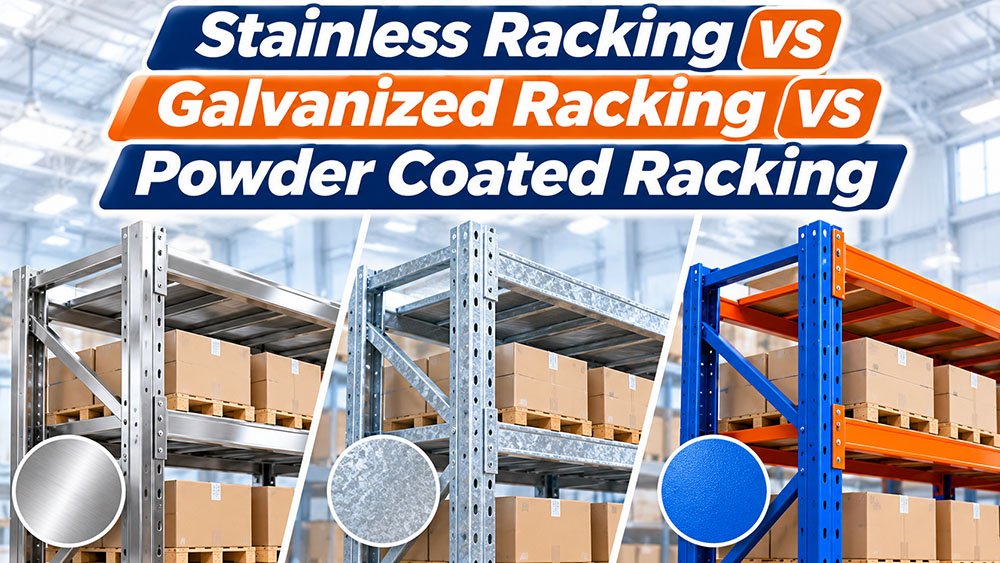
Choosing between stainless steel, galvanized and powder-coated racking starts with the warehouse environment. Moisture, cleaning chemicals, airborne salts and handling damage all influence how a storage system performs over time.
For a dry indoor warehouse storing packaged goods, a correctly specified powder-coated system may meet the operating requirements without unnecessary material expenditure. A humid building or exposed storage area may justify a galvanized specification. A frequently washed processing area may require stainless steel, with the grade and construction selected around the cleaning process.
However, these options are not three equivalent surface finishes. Stainless steel is a material family. Galvanizing adds a protective zinc coating to steel. Powder coating creates an organic protective layer over a prepared substrate.
Understanding that difference helps buyers compare proposals accurately. The goal is to select a storage system that supports the required loads, remains maintainable in its working environment and avoids preventable replacement or disruption.
Stainless Steel vs Galvanized vs Powder-Coated Racking at a Glance
The following table provides a starting point for selection. Final suitability depends on the complete material or coating specification and the actual exposure conditions.
| Selection factor | Stainless steel racking | Galvanized steel racking | Powder-coated steel racking |
|---|---|---|---|
| Protection approach | Corrosion resistance associated with the alloy and its passive surface film | Zinc coating provides barrier and sacrificial protection | Organic coating provides barrier protection |
| Specification to confirm | Alloy grade, fabrication treatment and surface finish | Galvanizing process, coating requirements and treatment of fabricated areas | Substrate, pretreatment, powder chemistry and curing requirements |
| Typical selection context | Cleaning-intensive or corrosion-sensitive areas | Humid, exposed or outdoor storage, subject to exposure review | Dry indoor storage and applications covered by the specified coating system |
| Main maintenance concern | Deposits, incompatible chemicals, contamination and localised corrosion | Coating consumption, damaged areas and unsuitable chemical exposure | Scratches, chips, adhesion loss and corrosion beneath damaged coating |
| Appearance | Metallic, with different available surface finishes | Metallic grey, with variation depending on process | Wide choice of colours and textures |
| Cost comparison | Obtain a quotation for the required grade and construction | Compare equivalent processes and coating specifications | Compare equivalent preparation and application quality |
None of these choices establishes the rack’s load capacity. Structural performance must be assessed separately using the member sections, material properties, connections, configuration and project conditions.
What Each Option Actually Means
Stainless steel racking
Stainless steel racking uses a specified stainless alloy for the relevant structural members and components. Buyers should confirm whether the proposal covers the complete rack or only selected shelves, panels or accessories.

Stainless steels are generally used without an additional protective coating. Their corrosion performance depends partly on a continuous chromium-rich passive surface film. Fabrication contamination and unsuitable surface treatment can affect that condition, which is why post-fabrication treatment matters. World Stainless explains the role of surface treatment, pickling and passivation.
A quotation stating only “stainless steel” leaves important questions unanswered. It should identify the grade, surface condition, fabrication requirements and materials used for fasteners and other exposed components.
Galvanized steel racking
Galvanized racking uses steel protected by a zinc coating. Zinc provides a barrier and can offer sacrificial protection to nearby exposed steel at small discontinuities. This differs from the protection provided by an organic coating alone. The American Galvanizers Association describes these protection mechanisms.
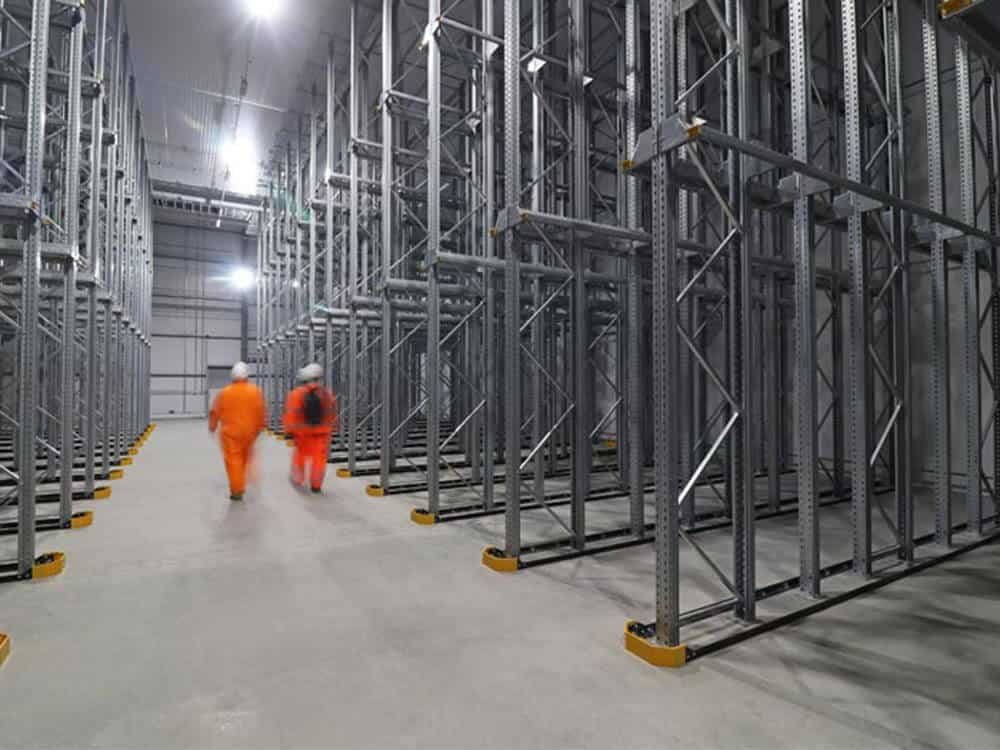
However, “galvanized” does not identify a single manufacturing route.
Rack members may be formed from continuously galvanized sheet, or fabricated components may be hot-dip galvanized after manufacture. The location of cutting, punching and welding within that sequence affects which areas receive the original coating.
Buyers should ask how cut edges, welds and repairs are addressed instead of assuming that all galvanized proposals provide identical coverage.
Powder-coated steel racking
Powder-coated racking typically uses steel that is cleaned, pretreated, coated with powder and cured. The completed film separates the substrate from its surroundings.
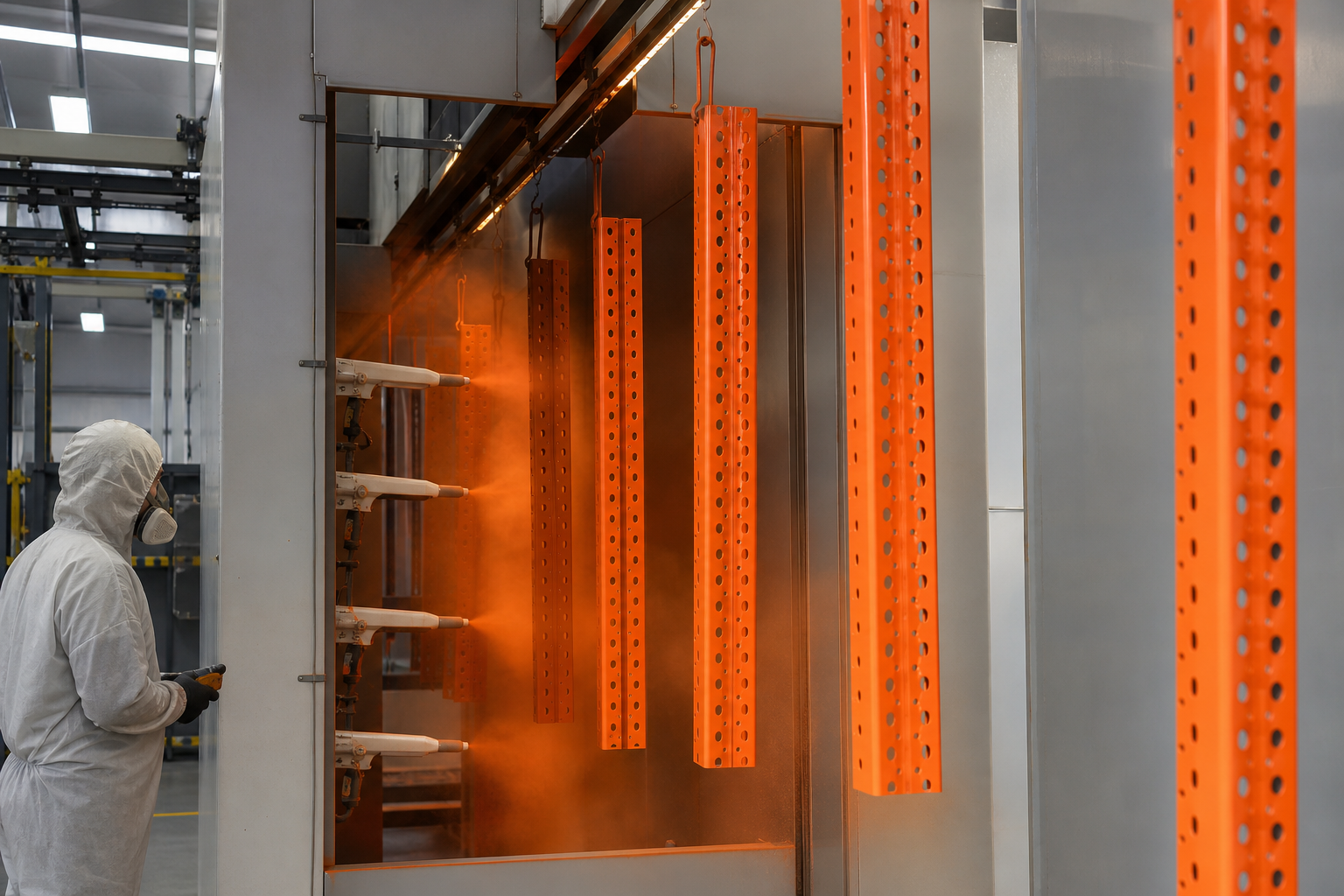
Performance depends on the complete application process, including surface preparation, coating selection and curing. Colour alone provides little information about corrosion resistance.
Powder coatings provide barrier protection, so damage and coating integrity matter. The coating specification should include handling and repair requirements. The American Galvanizers Association explains the barrier role of powder coatings and their use over galvanized steel.
For procurement purposes, ask what coating system is supplied and which exposure conditions it is intended to withstand.
When Stainless Steel Racking Deserves Consideration
Frequent washing and demanding cleaning routines
Stainless steel should be considered where cleaning is a central operating requirement, particularly when storage equipment is regularly wetted.
The assessment needs to include the cleaning product, concentration, temperature, contact time and rinsing procedure. “Washdown area” is too broad a description to support material selection.
Request the cleaning schedule before selecting the alloy. A rack exposed to occasional mild cleaning has different requirements from equipment receiving frequent hot chemical washing.
The construction also matters. Review whether personnel can reach surfaces for cleaning and inspection, whether water can drain, and whether joints create inaccessible collection points.
Choosing between 304 and 316
Grades 304 and 316 are common comparison points, but they are not interchangeable specifications.
Grade 316 contains molybdenum and generally offers greater resistance to chloride-related pitting than 304. Nevertheless, alloy selection still depends on the chemical environment, temperature and other exposure conditions. World Stainless’s design guidelines discuss these grade-selection factors.
The appropriate purchasing question is therefore more specific than “Is 316 better?” Ask whether the proposed grade suits the actual cleaning chemicals, deposits and operating temperature.
More demanding exposure may require specialist material assessment rather than an automatic move from 304 to 316.
Limits of a stainless specification
Stainless steel should not be treated as maintenance-free or universally resistant to chemicals. Poor grade selection, unsuitable finishing, fabrication details and insufficient cleaning can lead to staining or corrosion-related problems. World Stainless discusses these factors in its guidance on tea staining.
For a warehouse project, translate that into practical requirements: identify cleaning access, define compatible maintenance methods and establish how surface problems will be investigated.
Also distinguish material choice from hygiene approval. A stainless rack still needs a construction and operating arrangement appropriate to its intended use.
When Galvanized Racking Deserves Consideration
Humid and exposed storage areas
Galvanized racking is a candidate where carbon-steel equipment faces recurring moisture or atmospheric exposure.
Relevant situations may include open-sided buildings, areas near frequently opened loading doors and storage exposed to condensation. The project should record how often the equipment becomes wet and whether it dries between exposures.
Galvanizing performance varies with the environment. Chemical composition, temperature and exposure conditions influence corrosion behaviour, so an industrial chemical area requires more information than a general “corrosion-resistant” description. The American Galvanizers Association reviews performance across different environments.
Use the exposure record to support the specification rather than selecting a coating from the building label alone.
Confirm the galvanizing process
Ask whether the rack is manufactured from pre-galvanized material or galvanized after fabrication.
For pre-galvanized members, request details of the sheet coating and the treatment of subsequent fabrication features. For after-fabrication hot-dip galvanizing, ask how the component design accommodates the process and how dimensional compatibility is checked.
These routes should be evaluated against the actual rack design. They should not be reduced to a universal claim that one is suitable for every warehouse.
The existing comparison of galvanized and painted steel pallet racking provides related context. A purchasing specification should go further by identifying the process and acceptance requirements for the proposed components.
Outdoor storage needs a complete project review
Choosing a galvanized finish does not complete an outdoor rack specification.
The design must also address the site’s structural and operational conditions, including the applicable wind and seismic requirements, foundations, drainage, anchors and stored-load characteristics.
Review water collection at base plates and around obstacles. Identify which components are exposed differently and whether their materials and protection match the intended arrangement.
The distinction between finish selection and complete project design is explored further in this comparison of indoor and outdoor racking.
When Powder-Coated Racking Deserves Consideration
Dry indoor warehouses
Powder-coated racking is a practical candidate for dry indoor storage where exposure is controlled and the specified coating system matches the cleaning and handling conditions.
Start by checking whether the warehouse remains dry throughout normal operation. Leaking roofs, wet incoming pallets, nearby washing and condensation can create local conditions that differ from the rest of the building.
The same facility may therefore need more than one finish specification. A dry reserve-storage area and a wet receiving zone should be assessed separately.
This approach helps avoid specifying an expensive material throughout the building when only a limited area requires additional protection.
Colour and operational identification
Powder coating offers colour choices that can support equipment identification and consistent warehouse presentation.
For example, a project may use different colours for frames, beams or protective equipment. Such choices should remain consistent with the site’s operational system.
However, colour should sit alongside the technical coating requirements. Two visually similar racks may have different pretreatment quality, film properties or application control.
Procurement documents should therefore identify the approved colour and the performance requirements as separate items.
Damage, repair and replacement access
Pallet contact, installation handling and equipment impacts can damage a coating. The maintenance plan should explain how coating damage is recorded and repaired.
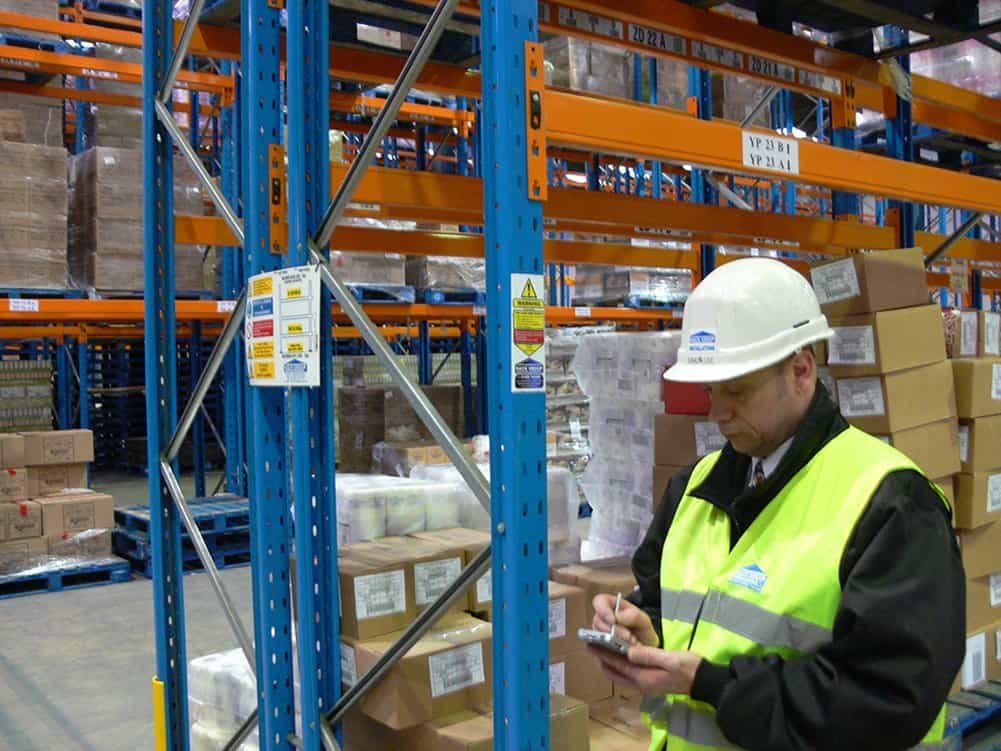
It should also distinguish coating repair from structural repair. Applying paint to an impacted upright does not establish that the member remains suitable for service.
Ask whether replacement members can be obtained in the future and how repairs will be carried out without disrupting adjacent storage.
Outdoor powder-coated proposals require additional review of the particular coating system, including weather exposure. A general indoor powder specification should not be assumed suitable merely because the colour and appearance meet the project brief.
How to Compare the Three Options for Your Warehouse
1. Divide the site into exposure zones
Prepare a simple plan identifying dry storage, loading areas, cold rooms, washing areas and outdoor positions.
For each zone, record moisture sources, cleaning methods, chemical exposure and handling activity. Include unusual conditions such as product spills or deposits that remain between cleaning cycles.
This produces a more useful specification than assigning one material to the entire warehouse without examining local conditions.
A warehouse racking layout design can incorporate these zones alongside storage capacity, access routes and building constraints.
2. Define the cleaning conditions
Provide the supplier with the actual cleaning products and procedures.
Include product names or chemical information, dilution, application temperature, contact time, rinsing and frequency. Explain whether equipment remains wet afterwards.
Where cleaning practices may change, identify the planned process rather than relying only on current routines. Material selection should support the operating method the facility intends to use.
3. Keep structural requirements consistent
Compare quotations against the same loads, pallet dimensions, beam spans, storage levels and handling clearances.
Ask the supplier to identify any differences in structural configuration between material options. A stainless proposal and a coated carbon-steel proposal may require different member designs.
The finish should not become a substitute for a documented structural specification. Equally, a higher stated capacity does not establish corrosion suitability.
4. Review manufacturing evidence
Request evidence relevant to the proposed system rather than a generic list of factory capabilities.
Depending on the specification, this may include material identification, coating inspection records, fabrication checks and documented acceptance criteria.
The broader rack manufacturing process is useful context for understanding where forming, welding, surface treatment and inspection affect the delivered equipment.
Agree on what documentation will accompany the order before production begins.
Initial Cost vs Total Ownership Cost
Avoid comparing the three options using a fixed price ratio. Material grade, fabrication complexity, project volume, coating process and transport all influence the quotation.
Instead, compare the cost of delivering equivalent storage performance over the same evaluation period.
Include purchase, shipping, installation, routine cleaning, inspection, approved coating repairs and expected component replacement. Where maintenance requires unloading or closing an aisle, include the operational consequence.
A higher initial price may be justified if it avoids a defined maintenance problem. That justification should be supported by realistic assumptions rather than an unsupported service-life promise.
For example, an illustrative comparison might show one proposal costing $10,000 more initially but reducing expected maintenance and disruption costs by $2,000 annually. The simple payback would be five years before discounting and other adjustments.
Those figures are a calculation example, not market pricing or a forecast for a particular material.
Expected Operational Improvements
Selecting a suitable material or coating can support more predictable maintenance and reduce disruption associated with surface deterioration.
However, a finish change does not directly increase pallet positions or picking speed. Capacity and handling improvements usually depend on layout, rack configuration and operating methods.
Track the outcomes that the specification is intended to influence.
| Project objective | Baseline information | Measure after installation |
|---|---|---|
| Reduce corrosion-related interventions | Previous repair and replacement records | Frequency and scope of comparable interventions |
| Improve maintenance planning | Unplanned aisle closures and labour hours | Planned versus unplanned maintenance time |
| Support cleaning operations | Cleaning access and time per area | Time and accessibility under the agreed procedure |
| Improve equipment availability | Storage positions unavailable during repairs | Position-hours lost to maintenance |
| Control ownership cost | Purchase and maintenance expenditure | Actual costs over the evaluation period |
Keep forklift damage and corrosion-related work distinguishable in the records. Otherwise, maintenance data may incorrectly suggest that a coating change can solve a handling problem.
Project Considerations Before Ordering
Confirm the materials and protection of the complete assembly, including decking, connectors, fasteners, base plates and exposed accessories.
Review drainage, trapped moisture and access for inspection. For mixed-material assemblies, ask the designer to assess compatibility where components are electrically connected and exposed to moisture.
Agree on packaging and receiving checks. Equipment can arrive with surface contamination, coating damage or moisture trapped within packaging, creating problems before installation.
Finally, document the handover requirements: approved configuration, loading instructions, cleaning restrictions, inspection procedures and repair methods. The warehouse team needs usable instructions for the system delivered.
Frequently Asked Questions
Which is more suitable: stainless steel, galvanized or powder-coated racking?
The answer depends on exposure and operating requirements. Consider powder-coated systems for suitable dry indoor conditions, galvanized systems where the specified zinc protection matches the exposure, and stainless steel where the alloy and construction suit cleaning or corrosion-sensitive service.
Is stainless steel racking always necessary for food warehouses?
No. A dry warehouse storing sealed products has different requirements from an area handling exposed food or receiving frequent washdown. Assess product exposure, cleaning procedures and applicable facility requirements before specifying the material.
Does galvanized racking mean hot-dip galvanized after fabrication?
No. The term may also describe components made from galvanized sheet. Ask the supplier to identify the manufacturing route and explain the protection of cuts, welds and other fabricated areas.
Can powder-coated racking be installed outdoors?
Some coating systems are designed for outdoor exposure, but suitability must be established from the specified preparation, coating chemistry and application requirements. An unspecified indoor coating should not be treated as an outdoor system.
Which option is appropriate for cold storage?
Review operating temperature, condensation, defrosting, cleaning and handling conditions. Both structural materials and surface protection need to suit the application. A freezer temperature alone is insufficient to select a finish.
Can galvanized racking also be powder coated?
Yes. A combined galvanized and organic coating arrangement is commonly called a duplex system. Surface preparation and compatibility must be specified for that combination. It should be evaluated as a defined coating system rather than an automatic upgrade.
How should buyers estimate return on investment?
Compare equivalent storage capacity and include installation, maintenance, cleaning, replacement and disruption costs. State the evaluation period and assumptions. Avoid assigning a financial return based solely on a material name or a generic lifespan claim.
Conclusion
The choice between stainless steel, galvanized and powder-coated racking should follow the warehouse’s exposure conditions, cleaning methods and maintenance requirements. Stainless steel needs a suitable alloy and fabrication specification. Galvanized racking needs a defined zinc-coating process. Powder-coated racking needs a coating system matched to its working environment.
For projects involving Lracking, a useful starting brief includes the storage layout, required loads, moisture conditions and cleaning procedures. These details support a practical material comparison and help direct investment towards the areas where additional corrosion protection provides measurable operational value.